August 13, 2026
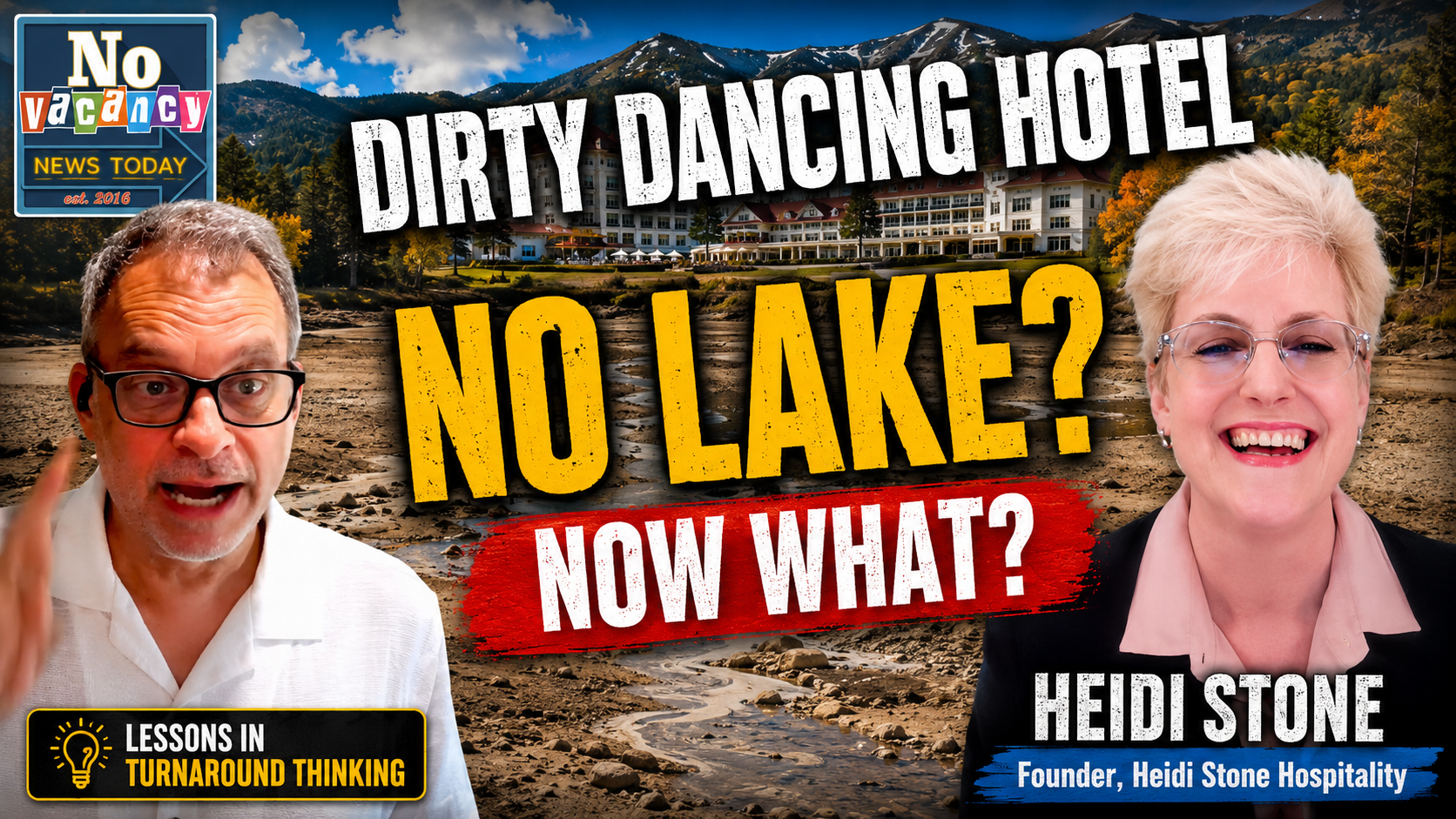
The Dirty Dancing Hotel Lost Its Lake. Here’s What Happened Next
Independent hoteliers face constant pressure to renovate, replace, add amenities and spend more money. Heidi Stone thinks they may need to look somewhere else first.
Stone ran Mountain Lake Lodge, the Virginia resort made famous by *Dirty Dancing*. When she arrived, the lake had dried up and the property faced serious challenges. Her approach started by identifying the value everyone else had stopped seeing.
Glenn Haussman talks with Stone about how hotel owners can recognize what actually deserves their money and attention — and what may simply distract them from the opportunity already sitting in front of them.
Thanks to Actabl for supporting No Vacancy. Actabl gives you the power to profit. Visit Actabl.com.
See where Stone tells hotel owners to look before reaching for the checkbook.
#Hotels #Hospitality #HotelManagement #IndependentHotels #DirtyDancing
Want the weekly roundup of news, videos, and what you might’ve missed from #NoVacancyNews? Text HOTEL to 66866.
Transcript
Glenn: [00:00:01] Hey, everybody. It’s your hospitality friend, Glenn. Thank you so much for tuning in to another episode. I really appreciate all of you tuning in. And today I’m excited because we’re gonna do a couple of little things. We’re going to talk about being an entrepreneur, but we’re also going to talk about how you out there are thinking about your hospitality business and maybe how to put a different angle, a different lens on it as well to make sure that your business can succeed. But none of this would be possible without our amazing friends over Actabl. Actabl, you know them, they give you the power to profit. Do me a favor, please check them out actabl.com. All right, so first time guest. Then from the way I’m feeling already about how we’re vibing backstage, maybe will be a second and third time guest as well. We got the awesome Heidi Stone of Heidi Stone hospitality. How are you, Heidi?
Heidi: [00:00:51] I’m great today. How are you doing, Glenn?
Glenn: [00:00:53] I’m doing great. Congratulations to you. As we’re recording this, you’re nearly seven, eight months into your own business. Heidi Stone hospitality, where you’re really helping people understand how to strengthen their performance without sacrificing their identity. Hi. How are you feeling today? Now that you took the plunge and you’re all this time, you’re all this time in.
Heidi: [00:01:19] Well, I feel really I feel really excited because.
Heidi: [00:01:21] I’ve been, you know, an independent hotelier for 20 years, a hotelier for 35 years. So I’ve been doing this my whole life. Right. And so I it was time, right? It was I had discovered so many things at my last couple of places, independent hotels save them and was like the Hail Mary that came in to save them. And so, you know, we’re at a point it’s been a hard five years. Right. And independent owner operated hotel. They’re they’re fatigued and they’re very excited about the help and they’re really grateful for it.
Glenn: [00:01:53] Excellent. I love that you’re getting to do something new. And that’s one of the things that I love in, in my business is it’s great when you have that sort of thing. But at some point in your life, you love the challenge of going in, assessing that new situation, solving the problem, and then tackling a new challenge in like a, in a very hyper focused way. So I love that you’re doing that. I’m also a little envious because it sounds really cool. Now before you were there, one of your jobs was you were the former president and CEO of Mountain Lake Lodge. For those of you who don’t know, it’s a Dirty Dancing fame. So I know we got to talk about that a little bit before we get into how you’re empowering hospitality out there.
Heidi: [00:02:34] Yeah, absolutely.
Speaker 4: [00:02:35] Doctor Houseman I, I love, I love that when first of all.
Glenn: [00:02:42] My prom song was time of our, you know, time of your life. I’ve had the time of our lives because I graduated high school in 1988. Right? So that was right after that. Plus, as a Long Island Jew coming from Brooklyn Jews, They had the Catskills in the summer sort of thing. And everybody loves Jerry Orbach. Yeah. So. So what was that? So what did you learn as an independent hotelier over there that really got you to understand the different needs of the different types of hoteliers out there that are really focused on strong identity.
Heidi: [00:03:25] Sure.
Heidi: [00:03:25] So when I arrived at Mountain Lake Lodge, it it it was the most condemnable hotel in Virginia, you know, 14 years ago. Right. It was very neglected. It was not in the Catskills. Newsflash for everybody. It was not in the Catskills. Everybody thinks it was in the Catskills. It actually was in Southwest Virginia is where the the hotel is. But when I arrived, the lake had dried up, right? It it looked like a giant spaceship had landed in the front yard. And, you know, it was ugly and neglected and all those amazing things, but it really was a fabulous, wonderful, beautiful property. The problem was they had just focused on what they didn’t have. They became obsessed with what they didn’t have versus focusing on what assets do we have?
Glenn: [00:04:14] All right, Heidi, you get me excited. I gotta put I gotta pin in that for a second because that’s an interesting mindset to be trapped in. Because if you’re living in it sometimes, as that old expression goes, you don’t see the forest for the trees, right? So you get all caught up in the problems that you’ve been having, and you kind of get disconnected from what made you love that particular asset experience, etc.. So I think that’s a really, really spot on type of a of a thing. It also reminds me of that theory of kind of like have the shoes next to your door in your house, right? And you say you’re going to move it or your spouse is going to move it, and then nobody moves it. And then it just becomes part of it and it becomes invisible. So you stop seeing things as well, right? So you come in and you see what can be instead of what hasn’t been.
Heidi: [00:05:03] Correct. Absolutely. And the other, another point that I’ll make is that when especially in independent destination resorts, you’ve got to have a commercial strategy. And that commercial strategy has to start with your story. And then everything has to be aligned. Your whole organization has to be aligned. Everybody rowing in the same boat together. But it all starts with the story. And if though, if everyone’s kind of doing their own thing and it’s not aligned on the story, it won’t work.
Glenn: [00:05:37] So what’s the story of a run down, depressed resort that has no lake?
Heidi: [00:05:46] Sure. So we were there to breathe new life into this amazing property and really save it. We were all on mission, right? We’re all on a mission together. We’re all behind the same purpose to save it for future generations. And as you started peeling away the onion per se that property has some of the most amazing overlooks you know, 45 100ft above sea level. I mean, it was the highest peaks in the region. There were many things that we could focus on natural assets that they had instead of focusing on the negative. But yeah, lots of, lots of really good nuggets coming out of that property.
Glenn: [00:06:29] So how do you then how do you go about going into a property, really understanding what their assets are and then changing the physical plant, but more importantly, the culture behind it. So let’s just break that down to a little bit, a little bit clearer segments. What do you do when you first get to a property and you start to, to think about what is and what could be sure.
Heidi: [00:06:54] So it, it, it starts with just having conversations. Good old talking, right? We don’t talk enough anymore. Everything’s emails and digital and this and that. It’s really sitting down with the owners and having real conversations about what are their pain points, what are the things that keep them up at night? Where are they? Where do they feel like they’re struggling? And as you talk about it, you start uncovering things that lead to other things. And, and one way I’ve kind of a litmus test that I’ve done is I simply, if they’re having pain problems, it probably is at their website, right? One way you can quickly tell a temperature on a property is, is, is the website, is it just an information hub or is it an invitation into a new way of living?
Glenn: [00:07:39] Interesting. Tell me the difference.
Heidi: [00:07:43] So one property I was at just last week they are learning, you know, multigenerational property. They are coming to the realization that what got them here is not going to get them there.
Glenn: [00:08:00] Right. Fascinating.
Heidi: [00:08:01] Right. And so and in looking at it, what they’ve always done isn’t going to get them where they need to go. Because generational legacy type properties, they tend to just, if it’s work, they just do it, they do it for ten, 20, 30, 40 years and that isn’t going to work anymore.
Glenn: [00:08:18] No, that’s really, and that’s really hard to break through that mindset. And this is not limited to just hotels that are in families. You have seen it all out there in other aspects of your your life as well. When you get so rooted into doing things, I think that sometimes it becomes hard to believe that there’s any other way to do those things. And you’ve got to be pretty open to be to, to, to make those changes. I guess that’s why those reality TV shows where they come in and fix restaurants and stuff like that are so popular. Right? Except I suppose you have less, less drama and less people walking out in a huff. You know.
Heidi: [00:08:57] I don’t I’m not screaming. I’m not raving and screaming ever. Right?
Glenn: [00:09:01] Yeah. I just think about, like, Jon Taffer, how he just comes in immediately just yells at everybody. That’s not really that’s not really what I’m looking for in an advisor. I like your I like your softer, more thoughtful approach. So so you have to get people out of that mindset and understand that there’s a different way of doing a different way of doing things. So that websites are really great example. I, I find number one with like a lot of branded hotels that, you know, your favorite brand.com don’t really tell the story of what’s going on at the property or within the community. It’s more like dot fitness center dot museum, six miles, that sort of thing. No real understanding. So how do these independent hoteliers really start to tell their story to get people to understand what they are in a way that customers are going to connect with them today in a way that they want to connect with those websites because that’s an answer that takes you far away from you know, grandpa had a pamphlet on the side of the highway, you know?
Heidi: [00:10:12] Sure, sure. Well, you know, for every property, it’s a little bit different. Perhaps there is a really rich history of the property for sure. But I find with independent properties and, you know, branded properties don’t tend to do it, but you really should be the gateway to your community, right? These places, it’s not just everything that’s at the resort or hotel and the history of that. You should be the gateway to every authentic experience within your community. And you are maybe that concierge for that. Because another example I was talking to, you know, one of these motor lodges that completely renovated and is modern and everything now, but they don’t have food and beverage and they’re like, they’re again, they’re, they’re focusing on what they don’t have versus what they do have. I said, well, what you do have is the connection to every local insider experience in town. And you can connect every guest with a totally unique experience that’s tailored to them. You can give them the insider information, and that’s even better than having breakfast. I mean, that’s even more you know, more experiences that they’re going to go back and say, you know what? I, I got to go back because I wasn’t able to do everything they told me I could do.
Glenn: [00:11:26] Right. Yeah. Number one, the hotel breakfast that are complimentary pretty much stink. Nothing, nothing personal hoteliers. But I mean, you really bring it in a low, low price. So they’re not that they’re not that great. So they’re not memorable. They’re not adding anything to my experience. Right. That’s really what I’m trying to say. But what you’re talking about is really what all hoteliers should be thinking about as well, because nobody well, depending on your hotel. But generally speaking, a lot of nobody is coming to your hotel. They’re coming to the area for some sort of reason, and it’s incumbent on you to connect yourself to the woven fabric of the community in order to be able to make those sales to the people. So, Heidi, I see this as the smartest way, the only way to really move forward. And if you are of your neighborhood, then that neighborhood is always going to think of you, you know? Right.
Heidi: [00:12:22] Correct. We all need love from the locals, right? As businesses, the small business owners, you always need love from the locals. And you need to build that love. It’s both. It goes both ways. Yeah.
Glenn: [00:12:33] Right. So then if you’re also coming in, you’ve got to look at the the physicality of the place. How are you thinking about matching up experiences and infrastructure to create something that breaks through? And we actually remember as customers because, and I’ll set this up by saying, Heidi, I stay in a lot of hotels. I’m traveling 150 plus nights a year, and I rarely remember any of them. Not a smack against any of them, because they’re all satisfying my needs to an extent that I’m happy and I could move on with my life, but I’m not connecting emotionally with them, and I’m only booking them because they’re close to where I need to be. And by the time I’m at the the bag carousel on the way home, I’ve forgotten where I stayed. So how do you help hotels break through that to create that emotional connection through the physicality of what’s going on at the plant?
Speaker 5: [00:13:31] Sure. So it.
Heidi: [00:13:33] Have you ever had an emotional connection with your bed or the nightstand?
Glenn: [00:13:38] I do every single morning before I get out of it, and then I, then I say this one f word and I get on with it. Yeah.
Heidi: [00:13:47] My point is, it really starts with who you’re hiring, right? We know this. It all starts with, you know, you’re probably not going to have an emotional connection with the TV or the TV stand or the shower.
Speaker 5: [00:14:03] I say that all the time. I always joke, Heidi.
Glenn: [00:14:06] I’m always like, no one ever came back from a trip. And he goes, you gotta stay here. That lamp. Oh my God. The switch went on and off. It was amazing, right? So it’s all about the people. Go on please.
Heidi: [00:14:16] I’m all about the people. And you know, I’ve gotta. I’ve gotta just say this, Glenn. You may or may not agree with me, but I just think it’s ridiculous for these hotel companies that have a director of culture, director of culture. It doesn’t start with a person named a director of culture. I’m just like, what are you guys doing? You know, it starts from the top and it and it comes down from the top, right? And then it and then it’s filtered through. But it’s got to be the philosophy at the top that we’re here to take care of people, and we’re here to meet them where they’re at. And you know, everybody’s walking around with something. Everybody’s walking around with their own baggage.
Speaker 5: [00:14:54] You know.
Glenn: [00:14:54] What? I just read this this book. I’m doing an interview on it next month. And the author was telling a story about this sort of culture thing, and it’s a high end hotel, and the GM is in a rush, rush, rush. The literally the president of the United States is coming. He’s still stopped, bent over, picked the paper off the floor and put it in his pocket and continued running. I think that is how you model culture on a day to day basis. I thought it was an awesome kind of an example.
Heidi: [00:15:27] You do? Yeah, absolutely. But it really does start with who, with who you hire. Yeah. And it’s, it’s got to be on purpose, right? It’s, you’ve got to be, you, you can’t just be filling. We’ve all said it warm bodies because that isn’t going to get you where you need to go. Right. You’re going to regret it every time.
Speaker 5: [00:15:43] Every time.
Heidi: [00:15:44] You’re just putting warm bodies in places.
Glenn: [00:15:46] Right. And it’s going to wind up costing you more money in the future. And that money you didn’t even realize you’re losing from loss of future bookings from guests that you might have made fall in love with you. But how do you think about the things in a hotel? Because people are still going to remember things. Maybe not that lamp or that TV, but they’re definitely going to remember the overall static and the connection that it makes with the environment that they’re in, that sort of thing.
Heidi: [00:16:14] Sure. So I think if owners, owners know they got to spend capital, right? They know they’ve got to be modern, they know they’ve got to keep up on things. And the brands, of course, are making them, whether they like it or not. It’s a little different with independent hoteliers. They they may be squeezed particularly right now they’re everybody is squeezed. Right. So my advice is, and it was when I was at Mountain Lake, you know, we didn’t have millions of dollars. We could have sunk $100 million into that place. When I walked to the door, we didn’t have that. But. So what can we do that’s going to make a difference? That costs us essentially nothing but time and energy and thought is culture. Yeah. So yes, all those things matter. Everybody knows all those things matter. But I think where you can make a difference today and you don’t really have to technically spend a dime is, is your culture.
Glenn: [00:17:05] Yeah, I do, I do the smile test whenever I see somebody, I just I just smile at them and see if they make eye contact when they smile back and say hello or if they scurry away. I gotta tell you, Heidi, I’ve been in 4 or 5 hotels over the last few weeks, and in more than one of them, I saw associates walking around with cell phones and stuff like that and doing personal stuff. And that made me very sad. And I feel like that’s the mark of a GM who’s losing sight of things. So my question for you is, how can how can a GM do an honest assessment of themselves to see if they’re still hyper focused or they’re cruising a little bit too much, that might be affecting their their culture without them even realizing it because, hey, we all get, we all get sloppy and we all get tired. And I want to half ass it as much as I possibly can. So I get humanity and our inclination. So I’m not smacking anybody, so.
Speaker 5: [00:18:06] But go on. Sure.
Heidi: [00:18:07] So I think a no cell phones policy is, you know, front of the house. There is no cell phones. Period.
Speaker 5: [00:18:14] Period.
Heidi: [00:18:14] I mean, it’s just a non-negotiable, right? I.
Speaker 5: [00:18:19] I used to get upset.
Glenn: [00:18:20] I, when I worked at Wendy’s, they would have us, we could get a cheaper meal, but then they wouldn’t have a place for us to eat in the back and we’re supposed to eat out in front. And I thought that was weird that I’m a Wendy’s employee, where am I? Little Wendy’s hat eating a Wendy’s burger that felt like I was. I’m not Walt Disney or anything like that, but I felt like I was betraying the show, you know? Sorry. Sorry to interrupt you in your flow.
Heidi: [00:18:44] Yeah. No, no, you’re right. You’re on stage.
Speaker 5: [00:18:46] Right.
Heidi: [00:18:46] Yeah, yeah, you’re on stage.
Speaker 5: [00:18:47] So that’s where that.
Glenn: [00:18:48] Cell phone thing kind of makes me feel like and other things like that.
Heidi: [00:18:52] And we, I think we’re old school, Glenn. I think we’re, we’re, I think we’re old school, but I, I, I still think front of the house, no cell phones whatsoever.
Speaker 5: [00:19:00] Yeah, yeah. Because it’s all about.
Glenn: [00:19:02] It’s all about making the human connection. Anything that you could do to enhance that. That’s why I’m talking about like making eye contact with people and no cell phones and stuff like that, because it’s all about building a relationship.
Speaker 5: [00:19:14] So sure. Yeah.
Heidi: [00:19:17] I want to answer your question real quick. I would challenge a GM to go through from the very first he needs to go through, or she needs to go through the whole step of every guest interaction from the beginning. So you need to you need to go through everything. You need to see every piece of communication. We call it every touchpoint you need to go through as a GM from the very first call, all the way through the entire process, all the way up to that post guest survey. You need to do it all yourself because I guarantee you you will find opportunities if you do it right.
Glenn: [00:19:51] That’s that’s good. You should always be relooking, reevaluating, rethinking. Is there a better way? And it it reminds me of that like rule of 1%. If you can just continue to get 1% better and better over a lot of time, you’re going to make excellent strides forwards. So what else? What are you working on these days that you’re particularly excited about?
Heidi: [00:20:14] Well, you know, I’m working the fun thing about this Doctor Houseman, is that we get to go in all different kinds of properties all over the US. I was just in Tucson a couple weeks ago in a dude ranch. Oh, yeah. And, you know, that’s a whole it’s kind of a micro niche in our business, right? But very family legacy oriented. So, you know, putting some fresh eyes on that. Here I’m in southwest Virginia, so all different kinds of properties here independent, you know, hotels that are very in the mountains. But then I’m in Virginia, so there’s Northern Virginia and D.C. and, you know, so it’s just all different kinds of properties all over the place. And they’ve all have different issues. No two are the same. No two have the same questions or issues or pain points. They’re all different.
Speaker 5: [00:21:06] Well, that’s why it’s.
Glenn: [00:21:07] Exciting and that’s why it’s a challenge, right? Yeah. Because it’s that sense of the the unknown, what to what you don’t expect that’s going to be fun. So I’m sure you come in with all your experience. You find that low hanging fruit immediately, and then you start talking to people and you make some interesting discoveries without saying anything. Is there one interesting discovery that you made that people were able to make a good change real quick, and all of a sudden things were going a lot better. They were saving extra cash or whatever it might be.
Heidi: [00:21:38] Oh, something super, super quick. Believe it or not, I have a legacy property and they’ve never done any any email marketing.
Glenn: [00:21:49] Oh my goodness.
Heidi: [00:21:50] I was like.
Speaker 5: [00:21:51] Okay, let me pick that fruit up the floor. Super low hanging fruit.
Heidi: [00:21:54] We can, we can make a difference in, in your revenue stream right now.
Speaker 5: [00:21:59] Yeah. Wow. That’s a, that’s a, that’s amazing.
Glenn: [00:22:04] To be fair, the owners were cryogenically frozen in 1994 and.
Speaker 5: [00:22:11] They just got.
Glenn: [00:22:11] Brought back to life. So you know, we gotta give them a little, we gotta give him a little leeway on on that one, but that’s that’s incredible. I, and I think sometimes that gets me thinking Heidi, sometimes we don’t know what we don’t know, and therefore we don’t know what we’re missing out on. Right. So right now, technology is changing really rapidly. And I kind of teased it at the beginning over the last year or so, I’m talking about we’re talking about agentic AI and natural flow, organic language and all of that kind of stuff. How are you starting to think about connecting with potential customers as we move into this more AI driven era for hotel connections and bookings?
Heidi: [00:22:55] Sure. Well, it’s more important than ever that all of your technology is aligned, that your that your commercial strategy is all aligned and everybody’s in the same boat and they’re all rowing together and that you’re as connected to an interconnected to as many places as you can be, because that’s only going to help you with your AI search as people are doing travel itineraries, that kind of thing. So here, here’s another tip. You know, you need to, as in your community, you all need to connect to each other so that you’re not just one independent business rowing your own boat. You need to connect with everybody in your community and they need to connect back to you because that’s only going to be instead of, you know, 15 small businesses, you become a bigger business and AI is going to find you a whole lot faster.
Glenn: [00:23:47] I love that. So we’re really what we’ve really talked about today is making those physical relationship connections with the other businesses in your community so you could all be more successful together. Now leading into that virtual connectivity as, as well, because a lot of people are going to be mixing hotel and activities and food and dining or whatever in there. It’s a really good observation. Heidi, I appreciate that. Anything else? Anything else we need to know about you before we before we wrap up?
Heidi: [00:24:15] No, it’s been a pleasure, Doctor Houseman today. It’s been really, really fun. Thank you for the opportunity. It’s been a real pleasure.
Glenn: [00:24:22] Hey, listen, make sure you reach out to Heidi Stone. Heidi stone hospitality. Where her where her motto is that you won’t ever put Heidi in a in a corner. How are you? I’ll see you soon. Heidi, I want to thank all of you guys for watching today. Really appreciate it. Be sure to like, share, subscribe, all of that kind of good stuff. Remember, you’ve got one life, so blaze on and see you later, everybody.

More Episodes
-
September 29, 2026
Inside HomeTowne Studios by Red Roof: Why This Extended Stay Model Works
-
September 28, 2026
Why Hospitality Leaders Must Stay Uncomfortable
-
September 28, 2026
Hotel Marketing With AI: How My Place Hotels Competes With Bigger Brands
-
September 26, 2026
My Place Hotels: Growth, Leadership and the Next Generation

Subscribe