November 11, 2025
Lantern Columbia: How Raines Company Is Redefining Adaptive Reuse and Inclusion
Hospitality meets purpose in Lantern Columbia, a stunning adaptive reuse project turning a historic firehouse into a boutique hotel that celebrates inclusion and community.
In this episode, Glenn Haussman and Anthony Melchiorri talk with David Tart, Managing Partner at Raines Company, about how the Lantern will partner with the University of South Carolina’s Carolina LIFE program to employ individuals with intellectual disabilities and create a model for inclusive hospitality.
From design and construction to culture and mission, David explains how hotels like Lantern Columbia show that doing good and doing well aren’t mutually exclusive — they’re connected.
What we cover
🏨 How Lantern Columbia blends adaptive reuse with modern design
💡 Partnering with Carolina LIFE to build an inclusive workforce
🤝 The business case for purpose-led hospitality
🔥 Why community connection drives profitability
🎯 Turning old spaces into new opportunities
🌆 The story behind Raines Company’s next Lantern project in Rock Hill
🙏 Special thanks to Actabl — Actabl gives you the power to profit. Visit Actabl.com.
If you believe hospitality can make a difference, like, subscribe, and share your thoughts below:
How can hotels create more inclusive opportunities in your community?
Transcript
Glenn: The following is brought to you by our friends over at Actabl. Actabl gives you the power to profit. Please check them out at actabl.com And enjoy today’s show. Hey everybody, thank you so much for tuning in to another episode of No Vacancy Live. That is Anthony Melchiorri joining us today. I’m Glenn Haussman joining you every day. I gotta I gotta take a day off some time over here. But that’s not today because today we’ve got an important, important show for you today. Right, Anthony.
Anthony: Yes. And I’d like to introduce everyone to something that if you’re under 30, you may not know what it is that.
Glenn: Yeah.
Anthony: That is a typo. Yeah. Apparently the 30s and was given to us by my wife’s family. And I just thought in this world of AI and technology when you were younger or old, people were younger, all you need is a typewriter. And one of those things, a dictionary right behind me, and you’re good to go. So I thought, with all the technology we talk about, it would be appropriate for me to have when I was born. Those are the only two things that everyone had on their desk.
Glenn: I would say that maybe you might have had a notebook with maybe the carbon paper in it too. That was a potential thing, right?
Anthony: Right. And people would say where’s your cell phone and credit card? And people would say, what’s your cell phone or credit card?
Glenn: Yeah.
Anthony: Very true. All right.
Glenn: So we’re taking a step back in the past, but we’re also going to take a step into the future. We’re going to be focusing on a brand new hotel today, Anthony. But what I like about this hotel is it’s not just going to be affiliated with the college, but it’s also going to be helping future hoteliers and helping those get jobs that are in need and take us all through it. Today we have got David Tart and he is the Managing director managing partner over at Ranzco. David, it’s great to see you again. How’s it going by you?
David: It’s great. It’s great. I appreciate you having me on today.
Glenn: Yeah. For sure. It’s great to see you, too. So I love that you’re doing a lot of new hotel development. I got to know you a few years ago in your role at Rains Co. And what I really liked about getting to know you is that you’re really getting in there and developing all of these interesting, unique hotel projects out there, and it looks like the the lantern is going to be the the next one of them. So you’re combining you’re doing adaptive re-use of the historic firehouse, and you’re going to be on you’re going to be focused right, by the University of South Carolina and the state capitol and the convention center. And you’re also going to be partnering with the university’s College of Hospitality, Retail and Sports Management and Carolina Life, a program for students with intellectual disabilities. That’s a whole lot to digest over there. So from wherever you want to.
David: Yeah, I mean, you nailed the description there. I mean you know, we feel like we’re embarking on something pretty special in our industry? We love our industry. We love to give back. We love I love personally developing hotels. You know, the creation of the jobs. It’s almost like creating a new business every time you open a hotel. And Columbia has a strong.
Glenn: Adaptive reuse projects, too, which I personally find the most interesting.
David: 100%. I mean, I in what I’ve been involved in I’ll say it time and time again, some of these projects don’t get done if it is not for the support of the federal and state programs. You know, the Hotel Florence old office building, the Foundry Hotel in Asheville, an old steel mill, and now a historic fire station in Columbia, in the vista where the, you know one of our partners HHS Russell, had called me a few years ago after they’d purchased the fire station and, and said, hey, I need you to get in that building and, and have a look, and I’ll be honest with you, I was a I was sort of a bit apprehensive about it. I, I knew the building. I mean, I went to school there. I mean, I, you know, I never looked at at at the possibilities of redeveloping. I was too busy enjoying myself and not, not, you know, especially in the vista. But once I got in the building and looked around, it became pretty clear to me that we had something special that we could do there. And then and then the the other part of the story also, you know, is the strong relationship that we have with the university and now with Carolina life and life, for those of you that don’t know, stands for learning is for everyone. Yeah. It’s a part of the college programs the inclusive post-secondary education that enrolls those with intellectual disabilities. So it’s an it’s an amazing sort of adventure we’re on right now. And we’re excited that to create lantern, to launch lantern, and to open the first hotel in Columbia and the stuff.
Anthony: So with all those wonderful things you just said, what? When you walk into the firehouse, what’s the one thing that surprised you? And as you dug into the firehouse, what’s the one thing that was like, okay, that’s going to be a challenge?
David: Yeah. So I’ve I’ve been in enough. I can say it now. I’ve been in enough opportunities of of what would be considered a historic adaptive use. And sometimes you walk in the building and you’re like, this is impossible. Like this is going to be.
Glenn: It needs to be adapted into rubble.
David: Correct? Yeah. I mean, that’s always the debate. It’s like, do we do we raise this or do we attack trying to reprogram and repurpose this particular building? So to answer your question, Anthony, the first thing I probably it was the obvious one was the the bones of the building and the structure. It was in very good shape for a historic building. And so I kind of looked around and started just in my head, thinking about the underwriting and the fact that we could we could pull something off if we could program the building. And then that would be to your to your question as well. Probably the biggest challenge I was thinking in my head was programming that space and capturing everything that we, we would try to capture in a hospitality experience. But then there within lies what ends up being perhaps, maybe the most special opportunity is the unique space that we’ve developed and how the guest is going to receive it and the common area spaces. And so. It’s about we’re close to 50,000. We’re mid, mid to high 40s. Yeah. And so we’re 59 keys. Yeah. Well there was the main firehouse and then there was the garage in the back.
Glenn: Pull this.
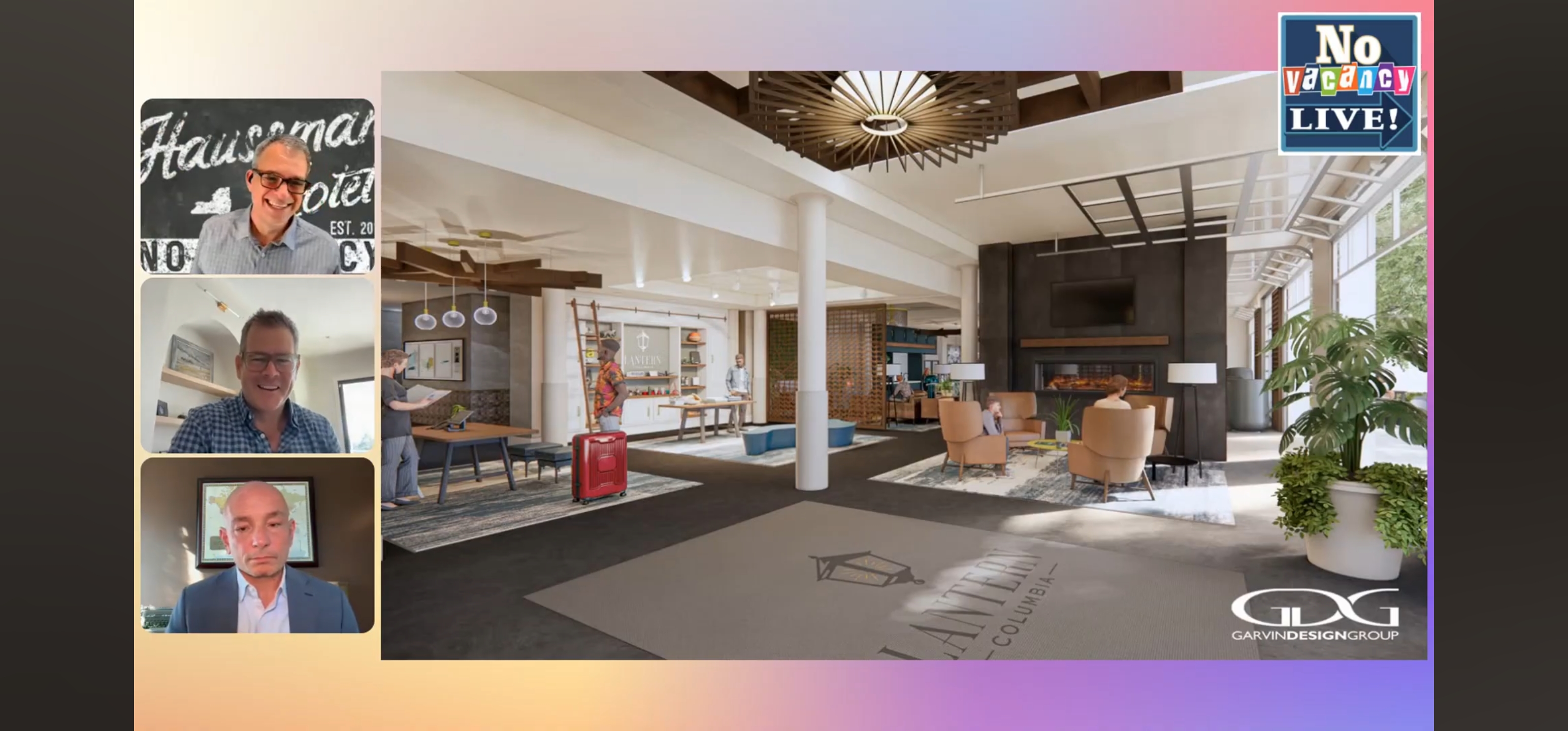
David: Up. And then there’s the tower. Right. So and then we have a connector that connects. So what you’re looking at here is the entrance where you’ve got the fire tower firetower on the left, which will have two rooms, and then a three story suite at the top. That connector that connects to the old garage where we’ll have rooms over there. And then to your right there is the main fire station that’s got the garage doors. And that’s where the that’s where the hang is, that’s where the lounge is. And but we’ve also got the second floor with guest suites up there as well.
Anthony: Now is that tower because you know, it’s historic that the outside. Is that what it looked like when you took it over?
David: Yes. And good question, because I immediately wanted to skin or do something there. The the authorities are, you know, would tell you, no, you can’t do that. So we’ve sort of embraced that concrete look I didn’t I had a I had an issue with it personally, but what you’re seeing there, once the windows went in it, it sort of transformed. It’s it’s amazing what windows can do sometimes. And once the windows went in, it sort of transformed the look a little bit. And it’s really cool when you get to the upper floors. You’ve got this view of the state House and this view of the vista, and it’s it’s I think it’s going to be I think it’s going to go viral. I think it’s going to be the reason.
Anthony: The reason I asked that question is because I knew the answer. Right. I’m going to say because you wouldn’t leave it like that normally. But what I love about it is it starts a conversation.
David: Right, 100%. You know, it’s it’s been there forever. And people always even before the Vista was the Vista. And I remember that that’s when I was in school there it was there it was this giant fire tower. And you knew they were doing training in there and everything. So I, I think it’s going to be pretty special.
Glenn: So was the the fire tower and the training. They had rooms in there. I see their balconies that were there. Was that part of it at all for some of the training? How did what was actually in that structure?
David: No, there was no it was essentially just stairs and floors for them to train inside the it’s just a concrete building and then the exterior stairs. That’s kind of what you’re seeing on the other side. They’re not balconies. They’re basically it’s the exterior stair climb. But what we did was we have an internal stair now connecting the first two. So the first two floors are just king standard suites. And then on three through six, you’ve got a three story suite that’s got, you know, call it a really entertainment area, a kitchen area. It’s it’s it’s tight space, but it’s it’s very, very unique.
Glenn: That’s pretty cool. That’s pretty cool. So here’s the main entrance.
David: Yeah. And you can see the lantern on the left. You know, our one of our mantras is led by purpose, lit by kindness. The lantern is something that you go through these exercises, I, I tell our, our, our teammates and and all of our folks. It’s the fun part of what we do sometimes is the creative creation of whether it’s logos the look, the color palettes and, and, you know, you go through these exercises and you have 20 different names. And we just kept coming back to Lantern because it fit we, we actually are, are calling ourselves Columbia’s living room, you know, and and it all really weaves in nice again with our employment of those with disabilities and intellectual disabilities. It’s, you know, at any given time, we’ll have, you know, 20 to 30% of our workforce in this hotel will come out of the life program or even in the community already. And, and it’s being embraced and led by Rick Haddock, who this was his, his this was he birthed this whole initiative. And and we really feel strongly that our industry, the hospitality industry is, is one of the best vehicles to train and teach job skills and life skills. And what better place to do it in a university setting? You know, right there with the Carolina Life program.
Anthony: And I love that because also a lot of people coming in and out of the hotels, there’s so many different people and so many people have people in their family with challenges. Right. And so they really connect to that and really appreciate owners that, you know, help everyone.
David: Yeah, I’ve sat down and had some very meaningful discussions conversations with family members, Anthony, that have said, look, I mean, you, you know, if it’s so in the downs community, you know, your your thought is what happens when I’m not here. Will my my child ever live independently? Will they will they have a job? It’s really meaningful. And we already have a lot of examples of how the again, whether it’s front of house or back of house, I mean, there’s, there’s different opportunities where we can what I like to say is, is find their superpower. Find you know, where they fit into our operations. And I think the guest and the community embraces that, too. And it and and it’s going to create hopefully something that well, what we really hope comes out of this is that the rest of the industry embraces this and sees this. It doesn’t necessarily have to be a lantern. It can be somebody else that’s developing a hotel where they embrace this initiative and they see that it can work and work effectively.
Glenn: So, yes. And David, not to mention another company during your show, but in the spirit of love and humanity, I know there’s another major management company I won’t name them now that’s really focused on trying to help career paths for people that are on the spectrum and have created a whole hospitality passport. So if you have someone who is on the spectrum, you can let the hotel know what their needs are, and it really just creates a better environment for both sides, you know, the guest and the the hoteliers.
Anthony: And to your point, you know, I have two friends that have children with special needs, and that’s their that’s their everyday question. What happens when I’m gone? I gotta set them up that way. And, you know, a hotel is, you know, no matter what your personality is, no matter what your abilities are, there’s some job that you can do probably really, really well. And, you know, one of the things, you know, I love the hotel business for because I am creative and I’m, you know, I bounce off the walls. I have a lot of energy. So this hotel has been, you know, no matter where I go, I can work on something. So I love the fact that, you know, you bring people in and that they’ll find their spot that they excel at.
David: Yeah. And that’s hard. That’s I think that’s where we step in. We you know, Rick calls it the secret sauce. And there’s, there’s little things that we’re going to have to do as a management company. As an ownership group as we identify talent that that also understands it’s both sides. It’s how we manage. It’s how we, like you said, find the right place. It’s challenging, it’s not easy. And and we were just at our annual leadership summit with, with all of our gems and our dos, and, you know, we stand in front of the room and we talk about embracing this, and it’s going to be a part of our company and our objective and how we grow. But it’s it’s not easy. And we’ll it lives and breathes, I think as you go along and you find best practices and whether it, you know, Glenn, it’s this other company or it’s I’ve met with folks in the fab industry. I mean, there’s the coffee shops and there’s the. I had a meeting yesterday with a local restaurateur here in Charleston who’s got a pizzeria, and he’s doing and he’s doing the same thing. That’s great. And we’re sitting there sharing ideas. Yeah. And and, you know, I’m like, God, the fab and the overlap of what we’re doing, just on the hotel side creates a whole another level of opportunity.
Anthony: And these people, you know, they’re they have so much to give and you just use the word talent. They probably haven’t heard that one that, you know, I’m part of the talent pool. Right. And just that, you know, as a parent, if I had a child with special needs that would really connect me to your vision.
David: You just have to find it. You just have to uncover it, you know? And again, back to what our industry, I think can offer that maybe some can’t is the breadth of our skill set and what we do in any given hotel. You know, and, and because not everybody, you know, would, would need to be at the front desk, not everybody would need to be in the kitchen, you know, you find where it really works.
Anthony: And it’s great.
Glenn: People that might work in maintenance, for example, or housekeeping or delivering stuff to rooms. I mean, there’s so many.
Anthony: I found laundry is a great opportunity as well. And, you know, there’s like I said, there’s so many different skills that are needed in our business.
Glenn: Yeah. For David, I would love to take it back to now, development of the the property. So let’s take a look over here. I feel like you’re kind of combining both worlds in this this picture here.
David: Yeah. I mean, this is the entryway into the into the the main lounge area. And we’re certainly again, the fun, fun part here is, is finding ways to celebrate the mission. And we’re going to be doing that through through interior design, you know, through a selective art. You know, it’s it’s, you know, what’s special about the Lantern Columbia is celebrating the history of the old fire station, but again, also finding ways to combine that with supporting the mission. Yeah. You can see here we.
Glenn: Did this drawing on a gorgeous day. So they were able to keep the doors open.
David: Yeah, yeah. Yeah. It was a perfect day to take that picture. Right.
Anthony: So.
David: We’ve got, like, we’ve got three of those main garage doors and look, I, I, I went to school in Columbia. It gets really hot in the summer. But the spring and the fall are absolutely perfect. And I promise you, those garage doors are going to be open a lot. But we’ve also got some nice trees and shaded area there on Senate Street, which is the street to the right, and Senate Street leads right up into the state House. So, you know, our opportunity for business in Columbia is not just the university and the parents and all that that Columbia has to offer, but it’s also the government and the state House and the legislative district and everything.
Glenn: How do you think about the the design combining the region, the historic nature of the property and that kind of collegiate vibe?
David: Yeah. I mean, I kind of call it sort of mid-century modern. We worked closely with, you’ll see there, the Garvin design group.
Glenn: You can see there.
David: Yes, there they were. They also our lead architect, have a lot of experience in adaptive reuse. And we used another group out of Myrtle Beach Resort Interiors, which is doing our procurement, but also contributed on the design. I probably sometimes in these projects, I sit in the room and, and I, you know, my team, we end up being sort of the final say so and we sort of blow through and and pick our favorite design. This was a nice collaboration of of our team members, our investors. It took a little longer, but we wanted everybody’s input. We also have a our restaurant partner is Kevin Johnson, who’s also a Gamecock. And, you know, he’s a James Beard nominated chef out of Charleston here. And he’s brought a, you know, a really cool concept into what we’re calling ladder 13, which is, again, paying homage to the fire station, small plates, craft cocktails. But that that there’s a nice flow from that lounge area that you saw right into a fab space. Not formal dining necessarily, but but great cocktails opportunities for private events celebrating wood fired pizzas. Small. Yeah. It’s it’s going to be really, really, really special.
Glenn: David, when when can I go? What are you hoping we.
David: We right now are scheduled to open mid to end of December. There’s nothing like you know, cramming it at the end of the year, which I always, I always tell my wife I’m not going to have deadlines at the end of this year, and I always do. But we’ll get placed in service before the end of the year and then roll into the first quarter really focused on 26 and ramping up our business.
Glenn: Yeah.
Anthony: You kept you keep the fire pole there so gas can go down the fire pole.
David: Yeah. That’s that’s a little bit of a liability. I’m thinking of ways I can make sure people actually don’t don’t do that. But Definitely is a cool feature of the building, you know, and we created a there’s like a mirror visual upstairs so you can kind of see what the fire pole was and, and because and and also too we actually I’m always in, in some of these if you can capture these old historic pictures when you, when you get these buildings. And fortunately we were able to do that. You know up above we’ve got these great pictures of where the you know, the living quarters of the, the, you know, the firemen and women and, and you can still see the fire pole and where it was, it’s really and well that the lounge will be decorated with some of those old.
Anthony: I love staying in hotels like that because as I lay down, I just dream of what was in that house. You know, how many fire trucks went out, how many people were saved, how many, you know, challenges they have? Like, I, I just love the history of buildings. You know, there’s when when you see a lot of these select service hotels, they’re great. They’re convenience, they’re too clean. But, you know, they were just built, and there’s no history to it.
David: Yeah, yeah, I tell you, I it’s probably the thing I get most excited about. I wish we could find more opportunity. They’re tough to find. You just have to uncover them. But I I’m like you, I, I walk in, and if I see something like that, I, I really I love that that experience.
Anthony: There’s nothing more I like than history in hotels. And last night I’m watching jeopardy with my family, as we do after dinner. And, you know, they have a scorecard. Who’s winning? And so I was behind, as I often am, and my wife and my daughter are in the lead. And I got the double jeopardy question. I was like, all right, I bet all of it. If I get the double jeopardy question, I win. Here’s what the Double Jeopardy question was. Right. Use questions about the round table. Where was the basically the round table? The the hotel. I used to be the general manager, the operator. And I was like, I win. And my daughter was arguing with me that it was the plaza. Both hotels. And I know which one it was. But my point being is, it was such a cool moment to say I was part of that legacy. You know, it’s a jeopardy question. And my daughter is watching it on TV, and I was honored with the ability to hold that in my hand for two years. And there’s nothing more that I love than taking history and combining it with the hospitality industry.
Glenn: Yeah, you should see what they did at the Foundry in Asheville. David, that was. That’s a triumph. I love that property.
David: Yeah, that was one where I kind of walked in in the beginning and I thought, oh, boy, what have I gotten into? But it’s it’s probably my favorite project I’ve ever. It’s, you know, it’s always. Yeah. So and then two, the cool thing is the unique room. And you’ll see it at the fire station, too. No, no room is alike. We probably have. We have 59 keys and I feel like we have 59 different room types. We don’t, but it’s what it feels like. And you can really offer different room experiences, which I love to, I love that.
Anthony: And David, when you walk into a project and you’re weeks in or months in and you’re sitting at your desk and you’re like, what the hell did I get myself into? This is insane. That’s when you say to yourself, I love this business. Yeah, that because a lot of people can’t take on those challenges. A lot of people don’t have the wherewithal, the knowledge, the creativity, the finance, the connections to take on those projects. Those projects take everything out of you. And, you know, that’s why we love the business.
David: 100%.
Glenn: B beautiful. David, any final thoughts before we let you go?
David: No, I mean, I think I want to I want to make mention that we’re already working on our second Lantern. No way. Yeah, it’ll be in Rock Hill, South Carolina. And I don’t mean it’s in the beginning. I mean, we’re we’re in it with our partners there the Warren Norman Company, and we’re excited about that.
Glenn: Were you able to find an adaptive reuse for that as well?
David: Yep. They purchased an old office building on Main Street downtown Rock Hill, and it’s going to be another. I mean, that I think while every location I know again, I’m hoping that we do multiple carries out our purpose. I think each one gets infused with the spirit of the local community. And again, especially if it’s a historic adaptive reuse. That’s not to say that everyone will be, but we really focus on the community. And then and then that creates the identity of that lantern, right? So Lantern Rock Hill is going to have a I’m excited. And what we should do, Glenn, is probably you know, sometime next year revisit and I can share with you the progress on that property as well.
Glenn: Totally. I would absolutely love that. I’m a sucker for these kind of properties. David, I wish you best for the brand, but I also wish you the best of finding a lot more cool properties. So every one of them could be an adaptive reuse. Not to wish that much trouble on you, but they come out great. David, thanks so much for being here. Really appreciate it.
David: Thank you.
Anthony: Hey. Thank you. So, Anthony.
Glenn: Give us one thing you’re going to take away from today.
Anthony: That you find talent everywhere, and everyone wants to feel needed. Everyone wants to feel like talent. And that’s what we’re in this for. You know, we all need to make money, but it’s about humanity. You know, I’ve never had more fun than when I saw younger people, older people feeling really, really connected to what they do. There’s nothing more fun than that.
Glenn: Yeah, nothing. And remember, all year I’ve been promoting what he just said. Keep humanity in hospitality. I want to thank you guys for watching. Make sure you like, share, subscribe, download this wherever you get your shows. And remember everyone, you’ve got one life. So blaze on and.
Anthony: Be kind yourself.
Glenn: See you next time. Bye everybody.

More Episodes
-
August 15, 2026
FNA 218: Red Roof, Red Jackets & Really Bad Advice
-
August 13, 2026
Why This 14-Room Fantasy Hotel Gets Millions of Views
-
August 13, 2026
The Dirty Dancing Hotel Lost Its Lake. Here’s What Happened Next
-
August 11, 2026
SBA Hotel Loans Just Got Bigger: How Owners Access Up to $10 Million

Subscribe