July 9, 2026
How Loews Hotels and Universal Orlando Built an 11-Hotel Resort Powerhouse
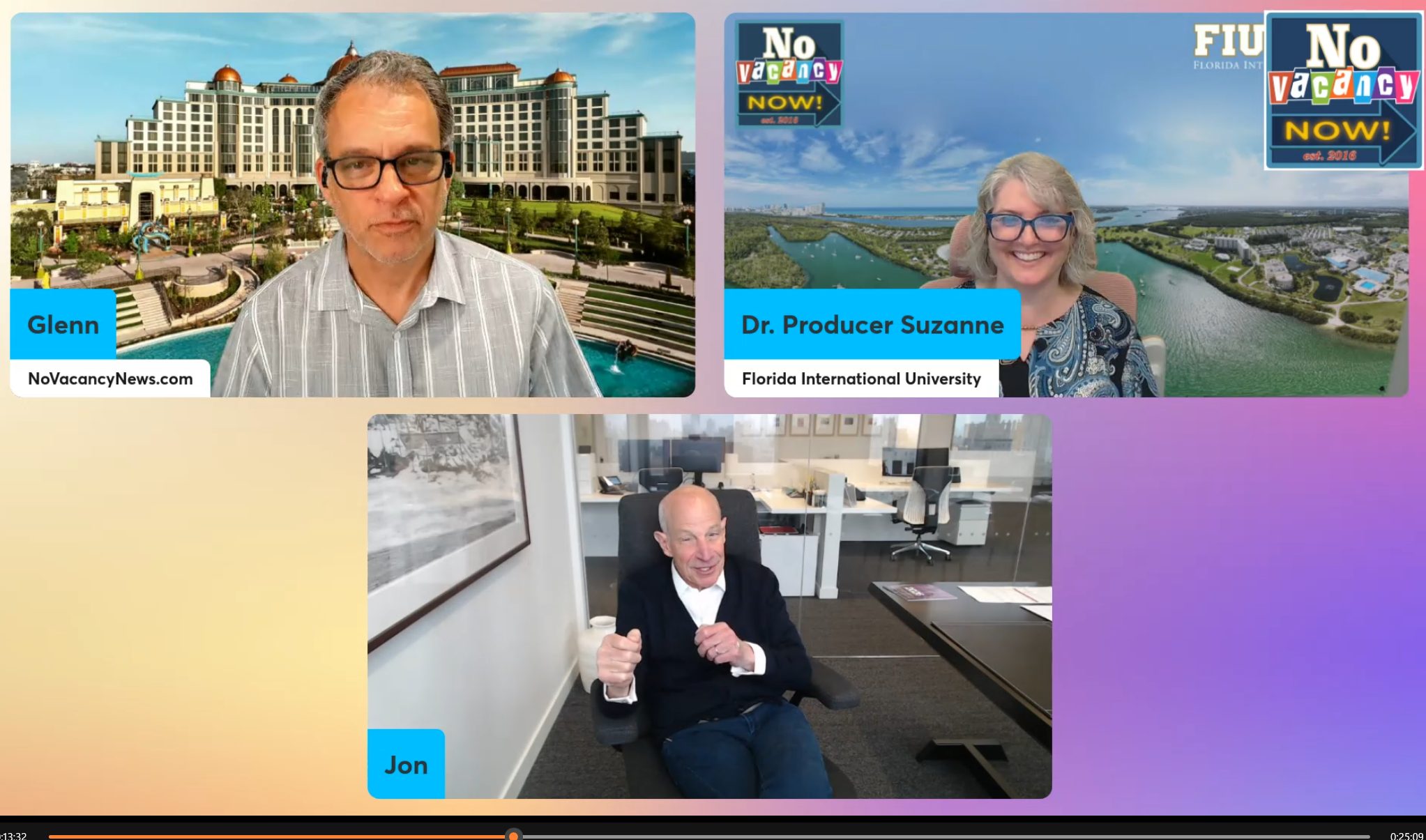
Jonathan Tisch just retired as Executive Chairman of Loews Hotels & Co . After 45 years, here’s his final message: respect the housekeepers.
He’s not being poetic. The housekeepers, kitchen staff, and pool servers do all the actual work. Executives sit in offices. You can’t exist without them. That’s the whole equation he told me and Suzanne Bagnera, PhD, CHA, CED.
Loews built 11 hotels at Universal Orlando Resort and 1,700 more rooms in Arlington, Texas because they understood this. They own real estate instead of just managing it. They invest long-term. They think about their people.
His first boss told him 46 years ago: never start a paragraph with “I.” Make people feel like you care about them. He’s still teaching it.
Actabl, they give you the power to profit. Visit actabl.com.
Want the weekly roundup of news, videos, and what you might’ve missed from hashtag#NoVacancyNews? Text HOTEL to 66866.
Transcript
Glenn: [00:00:01] Hey, everybody. It’s your hospitality friend Glenn here. And I got the one and only doctor producer Suzanne today. Suzanne, so great to see you on what I think is going to be a very special show.
Suzanne: [00:00:11] I think it is going to be an amazing show, and I’m so happy that our guest is able to join us today. I love when we are able to connect with people personally and make it happen in a virtual format for all of us.
Glenn: [00:00:23] Hey, first of all. Big thank you to Suzanne for pulling off this interview today. And also a big thank you to our friends over at Actable Actable. They give you the power to profit. Please visit actable.com. Okay, on with it. You know, every once in a while we get an icon that we talk to, right? I had this whole series of icons and experts and stuff like that, but this one is an icon among icons out there and somebody that helped me fall in love with the world of travel when I was just a, a young buck reporter back in the late 1990s. And I know I’m totally underselling it. Let’s bring on the incredible Jonathan Tisch, who’s now retired executive chairman of Loews Hotels. Jonathan, wonderful to see you. Thank you so much for taking time with us today.
Jon: [00:01:05] Hi guys. Thank you very much for having me.
Glenn: [00:01:08] This is exciting. So I got to know you as an integral part of the NYU Hospitality Investment Conference. And I remember sitting out in that, that audience not knowing much and then learning from you year after year. One of the things that always struck me is you were always about the love of the business of hospitality and bringing smiles on people’s faces, as opposed to an agenda for your company, Loews Hotels. And that was something that always amazed me.
Jon: [00:01:37] Well, I always say that you need to have a gene for hospitality to work in this business. And actually, as we’re interviewing new teammates, people that might want to join us, we look for that. We want to make sure that, like you have now developed over your amazing career that you actually care about what we do for a living. I liken it to the hospitality business and the business of hospitality. The business of hospitality has become global. Look at all the players that are investing in properties, whether it’s the REITs, whether it’s the C Corp, whether it’s publicly traded companies on Wall Street, sovereign wealth funds, wealthy individuals. There is so much money now that is investing in the lodging business, and it has become a very mature business for many. It’s a very profitable business. It’s a very hard business, but that is the business of hospitality. What hasn’t changed since the first time somebody used a form of currency a thousand years ago, which may have been a rock at the time when they paid to put their head down in some type of structure. That is the hotel business. And that hasn’t changed in a thousand years. And that’s the whole notion of understanding that people are leaving the safety and security of their home, and they have a mission. They have things they want to accomplish. It might be a trip with their family. It might be a trip with their partner. They might be there for a conference, a business trip. They are coming and staying with you because they have a goal in mind. They have a purpose for leaving their home. And we as hotel yeas need to understand that. And once again, that’s been the whole overriding notion for hundreds of years that people will compensate us for providing space for them to accomplish their mission.
Glenn: [00:03:50] So when I say, when did you fall in love with the hospitality industry? What was that moment where that switch flipped and you’re like, this needs to be the centerpiece of my life, as opposed to other businesses that you and your family are invested in.
Jon: [00:04:06] I would say emotionally, that connection probably started when I was five years old, and I was able to put a box under my feet so that I could look over the counter of a front desk and say hi to somebody. And certainly, my first memories are of the early days of our family being in Atlantic City, new Jersey, which is where I was born in Atlantic City General Hospital. And we had five hotels at that time in the late 50s. Then my father and uncle built the Americana Belle Harbor, which opened in 1957, which eventually became the Sheraton Belle Harbor and then got torn down to make way for what is today the Saint Regis. And so I have memories all through my early days, my teens, my early 20s of having a sense that hospitality was something that I wanted to do. But I did have a detour, which was quite deliberate on my part, to do something other than just going right from college into the lodging industry. And when I was a senior at Tufts University in Boston, I got an internship at the NBC station, the NBC TV station in Boston, WBZ at the time. And I learned how to first shoot and edit 16 millimeter film. Wow. And tell a story while I was there.
Glenn: [00:05:38] Just for the younger viewers, you were like literally in a room slicing film and taping it together and having stuff hanging all over the place. Right?
Jon: [00:05:46] Absolutely correct. But this was just as the industry was switching from film to videotape. Right? So I was working with the first generation of video recorders. And I was a camera person. I was an editor and I, when I graduated from Tufts in May of 1976, they offered me a job and I spent three years there and produced kids shows, public affairs shows. I was nominated for five Emmy Awards. And also, somewhat ironically, because we never know where the world will take you. When I was leaving WBZ in the summer of 1979, the New England Patriots offered me a job to be their head of public relations.
Glenn: [00:06:33] Wow.
Jon: [00:06:33] So this is way before my father bought 50% of the New York Giants in 19.
Glenn: [00:06:40] I believe that was 1991.
Jon: [00:06:42] 91. Good. Yeah. Good recall. It was 91 when he, it was announced that he bought 50% of the Giants. But somewhat ironic that the Giants Patriots have this rivalry through the ages. We beat them twice in Super Bowls. They beat us many times, but they offered me a job to be the head of public relations. But at that point, I had committed to coming back to Loews Hotels, where I officially started in a working relationship with the company in January of 1980.
Glenn: [00:07:15] So let me ask you this then. You’re coming back into the company, but you learn the art of showmanship and production and creating fans of whatever it is you’re doing. So how does that era of your life then start to inform your mission that you go on once you go to Loews Hotels?
Jon: [00:07:36] Great question, Glen, and it’s one of the points I try to discuss with young people who might be studying hotel management. Suzanne heard me say this a couple of months ago to her students at FIU. I had an opportunity to be with some really talented young people on campus for a day. We never know where we’re going. We can plan. We can think. We can educate ourselves, which is obviously those are all really good things to do. But the world takes us in strange directions and you have to learn from every experience. So I was able to translate my role as a TV producer, cinematographer, editor into helping me design hotels. And as you both know, Loews is a very small player in the industry with 27 hotels granted. But compared to the biggest names in lodging, Hilton, Hyatt, Marriott, you deal with these companies every single day.
Glenn: [00:08:40] Yeah, well, your sense of existence is very different from those other companies. I just want younger people to understand that. Please continue.
Jon: [00:08:48] So I started at Loews 45 years ago and had been running the company for the last 25 years with my two cousins at Loews Corp, the parent company. But I also during that period, I built 17 hotels, hiring the architectural firms, hiring the interior design firms, working, sitting in chairs, touching every fabric, coming up with ideas of what these properties should look like, long conversations with our partners. And I see the image of our Helios Hotel in Orlando right over your shoulder, which we can get to in a.
Glenn: [00:09:27] Minute, will at some point.
Jon: [00:09:28] But the years in Boston training my eye, understanding what people will remember were invaluable to what I eventually started doing in the hotel business. And it’s all about learning from every experience. And once again, I tell young people right out of college, you may not get the first job that you think you’re ready for, that you think you have been educated for. But you learn from every single experience and you never know what from your past will help you as you plan the future.
Glenn: [00:10:07] Yeah, that that makes sense. So okay, so the two outside Orlando, the two projects I recollect most early in my career was Miami Beach and then Philadelphia, two very different design approaches to that very of their space, one, really honoring the history of a historic city and the other the coolness of Miami Beach. How did you how are you looking at luxury back then when luxury was very different business back then, it still felt more old school. And I could be wrong here, but I felt like you were really pushing it more towards that modern era that is now represented today, and taking it out of that classic old school kind of feel of hospitality.
Jon: [00:10:56] Well, you mentioned two unique projects on the beach has been open since Christmas Eve, 1998. Right.
Glenn: [00:11:03] And the other was like 2000.
Jon: [00:11:07] Well, the backstory is that Lowe’s and 6 or 7 other very well known respected hotel companies responded to an RFP or request for proposals put together by the City of Miami Beach. They own the convention center. There weren’t enough luxury rooms. This is the early 90s. The mid 90s. Miami Beach was coming out of a pretty dark period. And it was funny because we had sold the Americana in Bal Harbor in 1972 to American Airlines, and my father and uncle, we were not involved with the company then. That’s when I started college. Yeah. But when they left Miami, they said, we’re never going back there. This city is never going to be anything. Well, we’re not going. Right. So we decided to respond to this inquiry put out by the City of Miami Beach. They wanted a partner to build a luxury hotel to fill their convention center that they owned. And I remember a conversation with my father, God bless him, where he was not keen on us spending a dime right to see if this opportunity made sense for us. The rest is history. The hotel opened has been hugely successful, and at the time that we were under construction, building on one piece of land owned by the city where we built from scratch, we built 690 rooms. And then also the other part of the project was the same Ritz building, which had been closed for ten years. Opened originally in 1927. That 100 rooms. So the entire project is 790 rooms with 40,000ft² of meeting space. Some people thought that I was making a colossal mistake At the time, there was one other property under construction. Two blocks from us, and that was the Delano being built by Ian Schrager.
Glenn: [00:13:04] Right. I want to just jump in and say that usually when people think you’re going to be a colossal failure, it means either you’re going to be a colossal failure or that you have vision that others simply don’t understand. And I’m sure you’re very clear on.
Jon: [00:13:17] The latter, because I didn’t want to be a colossal failure. Right. But Ian and I, who were friends from New York in those days, are friends. Ian and I would call each other and say, we’re the only two properties under construction. Are we, in fact, nuts? Are we making mistakes? That worked out for him, and it worked out for us. But in terms of the vision for the property, we knew we needed scale. We knew that we could, in terms of entitlement, get 790 800 rooms on the property and It’s worked out now, as I mentioned. The hotel opened some 38, 39 years ago. We’ve done 2 or 3 major renovations a year ago. We were just completing a $55 million upgrade of all the rooms. And to your point, Glen, is that every time we commit that kind of capital to upgrade the facility, you got to think about what the next ten years are going to look like. Right. You can’t spend $55 million every 2 or 3 years. You’ll go broke very quickly. So especially at a company that’s as fiscally conservative as Loews Corporation. So you’ve really got to spend some time work with designers. And this is where I once again am at the table with them touching fabrics, anticipating what it’s going to look like. Renderings are really important to make sure it’s the field that we’re striving for. So we finished that renovation about a year ago and it has been extremely well received. And try keeping a 790 room building open while you’re renovating. Not just the soft goods in the rooms, but also you’re touching every bathroom.
Jon: [00:15:12] Not an easy process. And I give our operating team such credit. Now, Lowe’s Philadelphia was another opportunity because we were taking an international style architectural building, which originally opened in 1927, was the headquarters for the Philadelphia Savings Fund Society. Psfs. We were taking that building and turning it into a hotel. And so a lot of the design decisions were dictated by the style of architecture that exists in the building. And Deco plays a role in the international style of architecture. And so many design decisions were there right in front of our eyes. Working with a bunch of different firms. So that hotel has now been opened some 25 years and continues to be very successful. But when you look at how the industry has evolved and how it has become so dominant in so many cities economies, a lot of these hotels were part of a limited number of hotels and hotel rooms. But today, with all the big names in the industry, there is so much competition. I think I was just in at the vote at the NFL that awarded the 2030 Super Bowl to Nashville. We bought Loews Nashville hotel, Loews Vanderbilt Hotel. We bought that hotel 36 years ago. Yeah. There were probably five nice hotels in Nashville. Yep. The head of the CVB made a presentation to the NFL owners just two days ago about Nashville getting the Super Bowl. And she said, by the time Super Bowl comes to Nashville, there’ll be 85,000 hotel rooms in Nashville, Tennessee.
Glenn: [00:17:04] Wow. That’s crazy. And Nashville just hit a million in population. And and John, we always joke around here that if you have a hotel company, you’re required by law to build in Nashville immediately. You know.
Jon: [00:17:16] We bought there 38 years ago and there was nobody there.
Glenn: [00:17:20] Yeah, it’s that’s pretty incredible. So before we move on to, I want to talk about the relationship with Universal in Orlando. But your your father, who was arguably one of the most successful business people of his generation, didn’t see it. How do you convince somebody like that that you have the vision and you should go ahead and do that?
Jon: [00:17:44] Look, risk taking is not an art form. It’s not a science. It’s taking the information that you have in front of you, hopefully making an educated decision. Yep. A little luck along the way. You got to make your own breaks. Yep. And there’s a lot of praying involved, especially when you’re talking about committing millions and millions of dollars to these projects. And you mentioned it a moment ago, Glen Loews Hotels is different than a lot of the companies that we compete with, because as your listeners know, the big guys are now asset light. That’s right.
Glenn: [00:18:29] And that’s what they started doing at this period of time when you were doing the Miami Beach property.
Jon: [00:18:35] Yes. So they they own virtually no real estate. They have some old, older properties still in their portfolio, but virtually they own no real estate. Real estate is held by other companies. And yet Loews, Loews Hotels and Loews Corp.. Like owning the real estate? Yep. We are willing to commit our dollars, our capital dollars to build some of these projects. Many of these projects are, and that’s a big difference between us and some of the companies that we compete with. The consumer doesn’t need to know all this. This is all going on behind the scenes, but this is why the big guys get bigger and Loews Hotels grows. But at compared to them at a snail’s pace, doing projects that make sense from a capital investment standpoint and from a portfolio standpoint. And so we’re very cautious about where we invest because it’s our shareholders money. Loews hotels is a wholly owned subsidiary of Loews Corporation, which is a public company. And so anytime, anytime we invest a dollar that shareholder money and we take that responsibility of trying to get the highest return possible? Very seriously.
Glenn: [00:19:52] Yeah, but you also seem to balance it with long term vision as opposed to just looking at the next three months, which is something I very much respect. So how did this relationship with universal kind of come together, and what was that like?
Jon: [00:20:10] So I’ll take you back once again to the late 90s, early 2000. Universal in those days was owned by a guy named Lew Wasserman. Yeah. Legendary Hollywood name. He was one of the deans, one of the icons of Hollywood. And his company owned and.
Glenn: [00:20:36] Had great glasses.
Jon: [00:20:38] Yes, yes, that is true. These big black frames.
Speaker 5: [00:20:43] Yes.
Jon: [00:20:45] Yeah. Good recall.
Speaker 5: [00:20:46] Thanks.
Jon: [00:20:48] So I knew Lew through my family. He was very friendly with my parents and during this period, Seagrams, the liquor company from Canada, bought universal. Seagrams at the time was run by Edgar Bronfman Jr, who I grew up with here in New York. So I’ve known Edgar forever. So this is way before we had the ways to communicate in today’s world. Those days, it was telephone calls. And so they closed down the company and I called Edgar and I said, I’m sure you’re still doing due diligence. You just bought universal. There’s so many pieces of the company, but as you know, they have a theme park in Orlando. And this part, you might not know through what your people are filling you in on. It’s a big acquisition you’ve just completed, but you’re about to build a new entertainment district, a new theme park, which is Islands of Adventure. And you’re about to build three hotels. And he said, well, you’re right. I haven’t quite gotten into that level of detail yet. We’ve owned the company for about a month. I said, well, you know, if if you want, we might be interested in partnering on the hotels with you. He said, let me talk to our team and I’ll get back to you. Calls me back a week later. He said, you’re right about everything.
Jon: [00:22:13] We are about to build three hotels and there might be an opportunity to work with you. And then over the next year, many twists and turns up and downs. We had the deal. We didn’t have the deal, but eventually we had the deal. And the first hotel, Loews Portofino Bay resort, was already under construction. They had started that, and we had virtually no say in designing the front of the house, the heart of the house. It was literally coming out of the ground. Understood 650 rooms And we made the deal. And then the second hotel, the hard rock we started to get very involved in. And I remember working with the creative team at universal on designing that. Now you have to understand, for former TV producer in me to start designing hotels with the creative team that are designing theme parks, they’re designing hotels with a vision. With I was a like a kid in a candy shop. I was having the best time. So we designed and built the hard Rock hotel. And the third hotel, which is Royal Pacific, was 1000 rooms at the time, about 100,000ft² of meeting space. And that was the third hotel. Yeah. So the three hotels open. We we do well, but there were moments where the.
Glenn: [00:23:42] Well, the theme park itself had trouble you know, coming into the cultural zeitgeist. Plus, they had a very famous bad marketing campaign that was kind of difficult to get through. Yeah.
Jon: [00:23:55] So during this period, yeah, on the universal side, there were eventually three changes of ownership. Seagram’s eventually sold to a French company called Vivendi.
Jon: [00:24:12] French public media company. Yep. Vivendi eventually sold to GE. And then GE eventually sold to our partner today. And they are wonderful to be in business with.
Glenn: [00:24:27] Comcast has done an amazing job investing in everything. And when they took over John they’re just like oh yeah, we’re we’re in it. And they have not stopped since.
Jon: [00:24:41] I’ll get to that in a second. Here’s the game changer. When Warner Brothers decided to sell the theme park rights to Harry Potter, to whoever was interested, and obviously came down to another name in town.
Glenn: [00:25:01] It did. And apparently J.K. Rowling did not like the way that that was headed. So gave universal.
Jon: [00:25:08] So either the House of Mouse or Universal and under GE, they acquired the rights to Harry Potter. I have said on numerous occasions, many, many occasions, I thank God for my wife, my kids and Harry Potter in that order.
Glenn: [00:25:29] You got that right, man. When that opened, I’m going to say 2009, right? It totally changed. For those of you who don’t know, it totally transformed the entire theme park industry. And I think it’s made Orlando a much better place. And I guess this is where you talk about how that’s kind of kicked off all the insane development that’s gone on in that complex sense.
Jon: [00:25:51] Yeah. So we went from three hotels to 4 or 5 and six, seven, eight, nine. And then to your point, Comcast comes in, commits $7 billion to building Epic universe. As part of that, three more hotels or two lunar hotels, as we call them and the one which is over your shoulders. Yeah. Helios. Helios Grand Hotel, which is a beautiful property that, as you well know, sits right in the park. So we have gone from an original investment of three hotels to today, 11 hotels and 11,000 rooms. And fortunately, business is really strong. Comcast, NBC universal are great partners. And we continue to look forward to a really bright future. And talk about investing in areas and growing our footprint. I’ll finish our development strategy with our story in Arlington, Texas, where we partnered originally to make the deal nine years ago with the Texas Rangers, the baseball team. They were building a new theme park.
Jon: [00:27:09] We’re building Texas Live, a downtown entertainment district. We partnered with the Texas Rangers to. And the Cordish family who owned Texas live with them to build live by Loews Arlington, 300 rooms, about 25,000ft² of meeting space. Sitting right next to their new billion dollar ballpark called Globe Life Field and Texas Live. That hotel opened was successful from minute one, and we opened into Covid. So obviously the first year was a little stressful. And then across the street, connected by a skybridge, we built another hotel, Loews Arlington Hotel, with 888 rooms, 250 zero zero zero square feet of meeting space, the Arlington Convention Center sits in our Texas our Loews Arlington Hotel. Wow. And on June 6th, I will be in Arlington, Texas to implode the.
Speaker 5: [00:28:08] Way.
Jon: [00:28:08] The implode Sheraton Hotel, which sits right next to these two existing properties which will become bringing back a name from our family’s past, will become the Americana of Arlington, Texas.
Speaker 5: [00:28:22] Hey, awesome.
Jon: [00:28:24] We will start construction on another 500 room hotel in Arlington, Texas. We will have 1700 rooms in three properties, and we can thank the Jones family for AT&T Stadium because that’s full all the time. We can thank our friends Ray Davis, Neil Liberman, who own the Texas Rangers. That’s busy all the time. So that that’s how we like the concentration of universal or in Arlington, Texas, where we can plant our flag and and have a couple of different properties.
Glenn: [00:28:59] And I will say Cordish Companies has done a great job in the emerging casino gaming market. They’re really expanding there. And eventually my guess is I don’t expect you to answer this when Texas actually legalizes gambling at some point because they see what’s going on in Oklahoma. That’ll be a great setup for them to for sure, I would say. I mean, it just makes sense.
Speaker 5: [00:29:20] I’m retired.
Glenn: [00:29:21] Yeah. So you’re retired. You’re retired now, which is great because this helps me with the segue, you know what are you thinking about now? I know you’re all about giving back, and that’s one of the things I admired about you early on was, again, you putting ahead the general travel industry over yourself. And now I see you doing the same sorts of things to help bring along next generations and stuff. And might I say, I’m a proud former adjunct professor at the Jonathan Tisch School of Hospitality as well.
Speaker 5: [00:29:53] Yeah.
Glenn: [00:29:54] Yeah.
Speaker 5: [00:29:55] So.
Jon: [00:29:56] In retirement, I retired at the end of last year, 2025. I’m very pleased to say that my nephew, Alex Tisch, is the president and CEO of Loews Hotels.
Speaker 5: [00:30:07] And a couple of.
Glenn: [00:30:08] My competitors out there have got great stories with him out there right now. Be sure to check those out.
Jon: [00:30:14] And his cousin, another nephew of mine, Ben Tisch, is now CEO of the parent company, the public company. And the two of them are very talented, and I feel good about the future. So in my retirement, I’ve got a couple different areas of focus. One is an institution here in New York called The Shed, which is built to create original forms of culture. We don’t. We have no permanent collection. We have nothing on our walls. We have an architectural masterpiece sitting in Hudson Yards that’s been open about six years. The building cost $640 million, and it is designed to have different spaces so that creators, originators, the people who are thinking about the world we live in today can show what is on their mind in all different forms. And I’m the chairman of the board of the shed. In the education space. I am very involved with a boarding school that I went to for high school up in Connecticut. I am still very involved. I was on the board for 31 years at Tufts University, my alma mater. I’m now emeritus. I’m still involved with them. And to go back to where you did spend some wonderful years at NYU, it is the Jonathan Tisch Center for Hospitality Management, the sports management program is named after my father, Bob Tisch. There is the Shaq Real Estate Institute. They all sit in the School of Professional Studies, and on this past Thursday, I was honored to be the commencement speaker at graduation. On the stage at Radio City Music Hall, 800 graduates. 4000 people. Family members who got there, their kids or their spouse, their partner through this education and handed out 800 diplomas last Thursday.
Speaker 5: [00:32:18] Congratulations.
Jon: [00:32:20] I’m spending more time at NYU thinking about how we can expand these programs to be even more effective. So I’m very busy. And maybe the most important title that my wife and I got five and a half weeks ago is that we became grandparents for the first time.
Speaker 5: [00:32:36] Hey.
Glenn: [00:32:37] Congratulations. That is absolutely incredible and wonderful. So before we wrap up with you today, I’m going to let Suzanne ask something because I’ve been stomping all over her. How do you how do you want to?
Suzanne: [00:32:51] I’m so excited. So I would love to get your take. After your 45 years in this industry, what do you see or wish that you would like to see happen for our industry moving forward to continue?
Jon: [00:33:11] Expressing what I’ve tried to do for decades, what others have tried to do. And I must say that if I can interject. Yeah, these hotel companies are run by fantastic women and men. And you see it. You you’ve come to the NYU conference for as many years as I have. You see it on stage that there is such respect for the other leaders of the industry or the other CEOs for the other C-suites, The men and women who occupy those offices. And I don’t think it happens in other businesses. And I think that there’s something about hospitality lodging that we really like each other. We’re competitors and we’re tough and make it’s not easy to negotiate deals, but we like each other. So as a sort of a back way to get into your question, I hope that people continue to treat individuals, women and men who want to make a living in this industry with respect. Yeah. Many, many of the jobs that take place in lodging are not glamorous. If you are a housekeeper, if you’re in a kitchen, if you’re in the laundry, if you’re out by the pool delivering cocktails, there’s nothing sexy about these jobs.
Jon: [00:34:35] But we can’t exist without these people. They do all the work for us. We sit in our offices and can make decisions about the future. But I’m not making a bed. I’m not delivering a bag to the room. I’m not cooking when it’s 100 degrees over the stove. And we need these men and women to know that these are good jobs run by good businesses, run by good people that care about them, and we need to keep delivering that message. And for our elected officials, and some of which still don’t get it, they need to know that the tourism sector is an important, important part of the economy of the states, that they’re a senator from a member of the House from and treat us with respect. Don’t treat us like a roadkill. Treat us with respect, stop taxing us to oblivion, and understand how we support the economies of the communities where everybody lives and we create jobs properly supported, we continue to be a vehicle for economic development and job creation. Treat us with respect.
Glenn: [00:35:46] I find it very surprising that after 30 years myself in this business, that you’re still talking about these same issues that are out there, the fundamental lack of understanding by public officials to understand the incredible benefits that travel and tourism has to their communities. It’s like free money just coming in. So I don’t get it. But John, I’m going to stay out there and keep fighting for that. And one of the things that I like to say about hospitality careers is whatever it is in the world that you have a passion for, hospitality has it. And I want us to get that message out as much time as possible. One piece of advice to everybody out there listening, something that maybe you’ve learned that we all need to know.
Jon: [00:36:31] I started as a sales rep at Loews Hotels in January of 1980, and my job was to make cold calls on companies. And in those days, Obviously, it was on the phone where people didn’t know I was calling, and I was there to sell hotel rooms and meeting space. And my first boss, who was the head of sales for Loews Hotels at the time, I think the company had 12 hotels. Maybe we had. The big one was big new shiny hotel was Loews Paradise Island Hotel, which is now part of Atlantis. My first boss at Loews Hotels in January of 1980 said to me, John, never start a paragraph with the word I. When you start a paragraph with the word I, you are immediately sending a message that you’re more important than the person you’re communicating with. And that has stuck with me now, 46 years later. I have told this tale many times. In those days, obviously, you were typing and you were hand-writing something way before you were emailing and texting. And but I don’t care the the means of communication. It’s still the same message. Find a way to include the person that you’re communicating with to make them feel that you care about them. Never start a paragraph with the word I.
Glenn: [00:37:55] Yeah, I love it. That’s a great way to end. Any final final thoughts that you want to add? Anything that you want.
Jon: [00:38:01] I love the business. I still I’m a consultant to Loews hotels. So they they know where to find me if they need me.
Glenn: [00:38:08] Yeah. Yeah. So yeah, I mean, or go, go to a Giants game. Go say hello to him over there. John, thank you so much for being here. Really, really appreciate it. I’m gonna. I’m gonna, like, hold on one second. I’m going to keep this real quick. That was amazing. That was awesome. I just want to say, make sure you like, share, subscribe, all of that kind of good stuff. Thank you so much, everybody. Remember, you’ve got one life. So blaze on and.
Suzanne: [00:38:37] Follow your passion.
Glenn: [00:38:38] All right. We’ll see you guys next time. Right back here on.

More Episodes
-
August 15, 2026
FNA 218: Red Roof, Red Jackets & Really Bad Advice
-
August 13, 2026
Why This 14-Room Fantasy Hotel Gets Millions of Views
-
August 13, 2026
The Dirty Dancing Hotel Lost Its Lake. Here’s What Happened Next
-
August 11, 2026
SBA Hotel Loans Just Got Bigger: How Owners Access Up to $10 Million

Subscribe