July 17, 2026
Why Hospitality Should Study Retail (And Vice Versa)
Liza Amlani, The Chief Merchant, spent 20 years as a merchant at Ralph Lauren. She now studies what retail can teach hospitality.
The parallels are closer than you think. Both industries live and die by customer experience. Both rely on frontline workers whose voices too often get ignored. Both are trying to figure out how to bridge strategy from the corporate office to what actually happens on the floor.
Liza translates retail’s playbook for hoteliers who want a fresh perspective on customer experience, employee voice, and what the future of guest engagement actually looks like.
Visit retailstrategygroup.com.
Actabl, they give you the power to profit. Visit actabl.com.
Want the weekly roundup of news, videos, and what you might’ve missed from #NoVacancyNews? Text HOTEL to 66866.
#RetailStrategy #Hospitality #CustomerExperience #FrontlineWorkers
Transcript
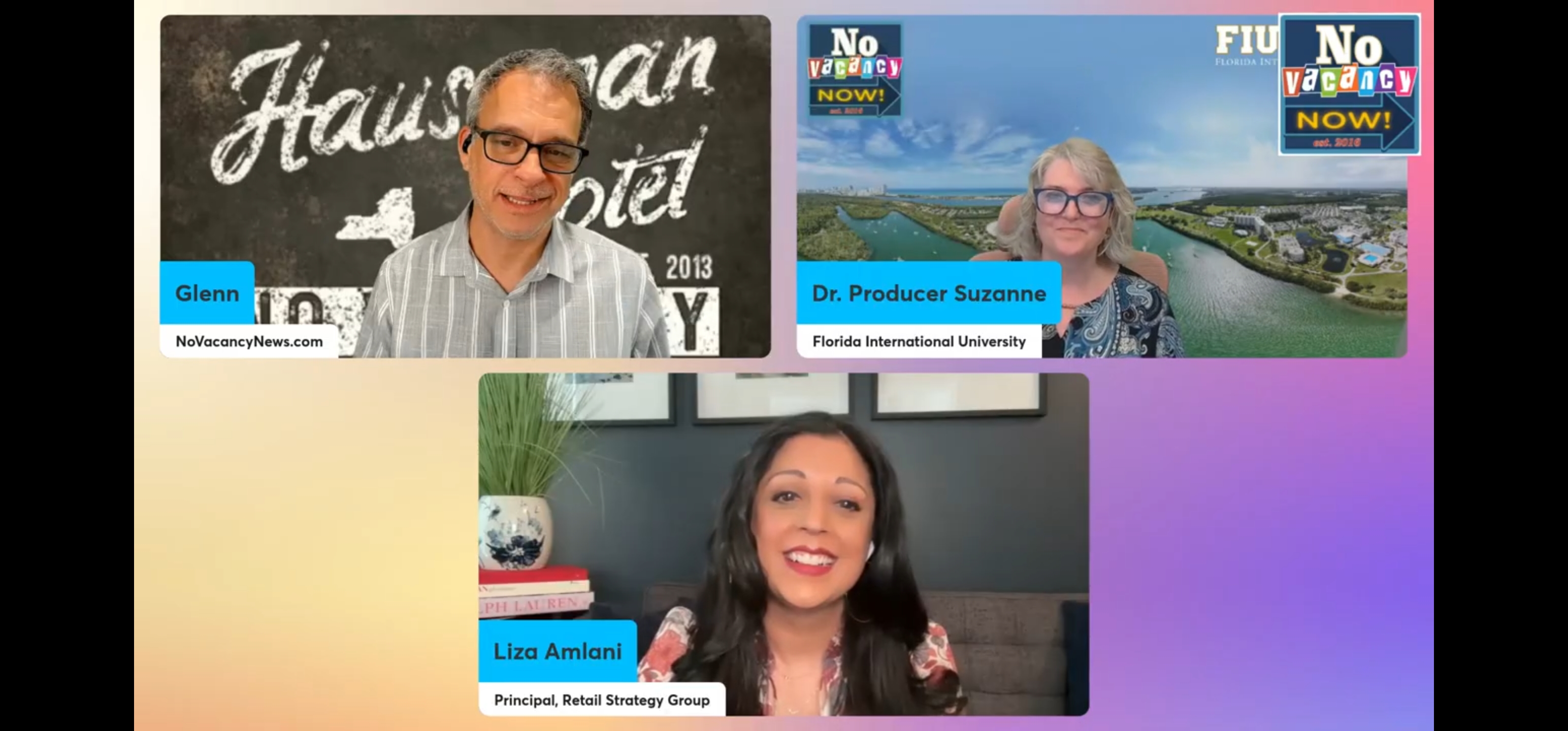
Glenn: [00:00:01] Hey, everybody, it’s your hospitality friend Glen over here. And once again, I’ve got the incredible fabulous doctor producer Suzanne in the house. How are you doing, Suzy.
Suzanne: [00:00:10] I am good, I’m excited to see you today and really dive into some really unique topics that.
Glenn: [00:00:17] Yeah, it’s going to be, there’s definitely going to be a fun one and a little different from the kind of stuff that we’re we’re typically doing out there. But you know what? I’ve got to thank our friends over at Actabl before we get going. Actabl, they give you the power to profit. Make sure you visit actabl.com. They have your ability to help you with that labor issue. We were just talking to our guest about labor issues over there, weren’t we? But anyway, Suzanne, I just want to set this up. So back in the day when I was an adjunct professor at the Tisch School of Hospitality at NYU, check out our interview with the John Tisch in our catalog below. So Suzanne, it was really cool because one of I taught PR and advertising, but I also taught a class in consumer behavior and I learned a lot about consumer behavior through the world of retail. One of the cool books from back in the day was this guy Paco Underhill. Have you ever heard of of Paco Underhill?
Suzanne: [00:01:17] Yes.
Glenn: [00:01:18] He kind of like created the science behind retail and stuff like that and gave us terms like transition zone, that area when you first walk into a retail environment. And he really got, I think me and a generation of other people inside excited and inspired about the world of retail. Now we’ve got this awesome next generation of retail experts out there. And I had the awesome opportunity to meet our guest at a conference back in in January at a gig I did in the retail world. And I’m like, oh my God, we could learn a lot from this awesome woman over here. So let’s bring her on. Liza. Amlani, principal of the chief merchant, retail expert, trendsetter, trend knower, all that kind of good stuff. How are you?
Liza: [00:01:59] I’m great. How are you both doing?
Glenn: [00:02:01] Pretty good. I’m excited. I’m super excited to talk to you because we have a siloed mentality in the world, right? Gotta keep our eyes focused on stuff. But it’s so important to look at other industries to see what’s going on. And a lot of hotel companies, while they’re trying to figure out tech, they’ve been bringing in people from other companies. And I want to bring the parallels between retail and hospitality a little bit closer together. So maybe they intersect. But before we get into that, please tell us a little about yourself. Where’d you come from? How’d you start strategizing for retail, and what is it exactly that you do for hospitality focused audience that doesn’t know you?
Liza: [00:02:41] Okay, well, my name is Lisa and I’m the principal of Retail Strategy Group, where I partner with market leading companies to bridge the gap between strategy and execution, driving breakthrough results, of course, for my clients. And I’m an expert in consumer facing industries. And what I see in retail absolutely applies to hospitality and travel, which is I know why we’re talking today. I started off on the shop floor. I was a merchant for 20 years, and I worked in the fashion industry in Softlines. And my last industry role was with Ralph Lauren, where I was the head of buying for the Lauren brand for UK, Ireland, Scandinavia, the Baltics. So I’ve definitely traveled a lot. I think over 40 countries and counting. And I’ve lived all over the world. So I have a very interesting point of view.
Glenn: [00:03:38] Excellent. And my experience relates to I worked at two separate gaps in the area. One, one, I was like, hello, welcome to the gap. And the other was in the the storeroom when they realized my personality does not fit with the gap vibe so.
Liza: [00:03:56] Well, the gap has changed a lot. I’ll tell you that.
Glenn: [00:03:59] Yeah, it sure is. But back. Back then, you know, I was falling right into it, as the ads would say. So, Liza, what fascinated you about the world of retail that you transitioned from you know, being on the floor to somebody that analyzes it and helps move forward the thinking behind it.
Liza: [00:04:19] So my, I actually started off as a designer and it’s very fitting. My claim to fame is that I designed.
Glenn: [00:04:28] Yeah.
Liza: [00:04:28] Pardon me.
Glenn: [00:04:29] That’s a very good pun. Yes, yes.
Liza: [00:04:32] I, I designed all the bags for FIFA World Cup 2002. So wow. Very fitting for today. And then I quickly actually transitioned into, into the world of buying. And what I learned as a merchant is that the customer and the voice of the customer is so important in what we put on the shop floor. But it’s also, I mean, a wealth of insights. So treating the front line with respect and giving them opportunities to win at retail is really the job of of a merchant and everyone in the corporate office.
Glenn: [00:05:13] Awesome. Suzanne.
Suzanne: [00:05:14] I was.
Liza: [00:05:14] Going.
Suzanne: [00:05:15] To say, talk about FIFA World Cup. Great experience down in the Miami area. And from your perspective on top of that, we’ve got a great new program that just launched at FIU that supports educating those in the, the event space and the mega event space to make sure that you are able to take care of those customers and those guests that are traveling from the world into that space. So it’s an exciting connection that that was one of your first design.
Glenn: [00:05:42] And that’s one of the reasons why their number seven executive education ranking in the US because of great classes like that one. Sorry to interrupt you, Suzanne.
Suzanne: [00:05:53] Thank you.
Liza: [00:05:54] Well, I’m really excited to hear about that. Suzanne, we should definitely take that offline. I was an adjunct at fit for for a little bit. And I mentor a lot of students that are very curious about how to improve the customer experience. And a lot of them actually do work in, in retail and on the front lines. So, so lots to talk about there.
Glenn: [00:06:16] What have you learned then about the gap between strategy and execution on those front lines in retail?
Liza: [00:06:24] Well, I think that this actually applies to so many industries that are consumer facing. This is not just a retail problem. I’ll give you a short story. Actually, when I was a merchant at Ralph Lauren this was back in 2017 and I was the merch lead. And what was the hottest thing was jumpsuits. Okay. And it was literally we added it to every single by us. We put it in like all of the uniforms had jumpsuits. I mean, everyone was very excited.
Glenn: [00:07:01] I by the way, I dress every Saturday night.
Liza: [00:07:04] Oh, yeah. So it was really interesting because, you know, as a, as a buyer, as a merchant, we plan about a year ahead. Right? So it was, it was the week that these jumpsuits were going to deliver. Super excited to see the sales. You know, Monday comes around, no sales, Tuesday comes around, no sales. By the third day I was really, really nervous. And I, you know, I started calling all my stores across Europe. And then I went to see some of my flagship stores in London, and we couldn’t find any of them on the, on the shop floor. And we finally, you know, went on this like crazy wild goose chase for these jumpsuits. And they were actually sitting in the stockroom. And the reason why was because the fixtures were not tall enough to hang the jumpsuits. So the. The store teams, the managers, they didn’t know what to do with them. And because they were so busy selling and making sure that the shop and the shop looked amazing. They didn’t even they couldn’t even figure out how to hang them up, so they just put them away. Wow. And I think what I really learned there was that not only are retail teams, we’re working in these silos, but our expectations of how product is being executed on the shop floor. We just assume that, you know, some things will work out. And if we don’t have that line of communication and open communication, we’re going to see a lot more of those types of gaps and breaks. From a strategy to execution standpoint.
Glenn: [00:08:45] That’s a, that’s a, that is a great tale because you see this sort of thing in hospitality all the time where one part of the I’ll make the parallel with one part of the company thinks it’ll be a great idea, but they haven’t really thought about how that’s going to work operationally. So a lot of times like like a software program or something like that, they’ll use it once and then that’ll be kind of like the that end of it if it’s not well thought out. I’m curious as to when you were, when you were figuring stuff out, how do you plan a year ahead to really think about what the trends are going to be? And again, I think the parallel to hospitality is if you’re doing design, it has to be something that’s going to have impact, but also last for a while. So what do you do to get your brain thinking about that?
Liza: [00:09:37] Well, it’s something that many merchants are used to and designers are used to. It’s it’s really the standard, sadly, of the industry right now. And it has been for decades, you know, it takes about 52 weeks to go from concept to market. And that includes designing the product to figuring out what that would look like on the, on the shop floor, but also what the marketing is is going to look like all of those functions work together. And it does take about a year. Now we’re seeing that a lot more brands are thinking about this because the customer is moving so quickly and they’re shifting and they’re changing the way they dress their their consumer behavior is shifting body shapes and sizes. And so when we’re planning so far ahead, it’s very difficult to plan for markdowns in season that are unexpected. For example, a product that you’ve bought and designed or assorted so far ahead. And what we’re seeing is that this is something that impacts every single industry. And it’s not just a retail thing. You know, you with hospitality and travel, we think so far ahead that it’s very difficult for us because our processes are so rigid to, to really react to what the customer wants right now. And, you know, I’d love to give another example that you know, is happening right now, which is.
Glenn: [00:11:17] Listen, Lisa, I’d love it. We have a one example maximum.
Liza: [00:11:21] Oh come on.
Glenn: [00:11:23] Sorry.
Speaker 4: [00:11:24] This is a good one.
Glenn: [00:11:26] Go for it. Go for it. I’m just messing with you.
Liza: [00:11:28] So what we’re seeing today is that there are there’s an excessive amount of returns, and more so than we’ve ever seen.
Glenn: [00:11:37] I definitely see a lot of that on like the Amazon kind of stuff, but I’m curious to see it everywhere.
Speaker 4: [00:11:43] Yeah.
Liza: [00:11:43] Across every single type of product. But if we’re thinking of just soft lines. So think of apparel. What’s happening today is because customers are on things like GLP ones. More women are strength training. There’s this a lot of, let’s say the golden age are they’re also living longer. So there’s all these shifts in consumer behavior, but these shifts are happening so, so fast. And if you just think about GLP one, for example, 1 in 8 households are on a GLP one and that number is going to increase. So that means your customer segment where their body shapes are changing so quickly. And I’m talking like 2 to 3 sizes within a span of a couple of months. That’s, that should be a red flag for you if you are a brand, if you have any sort of business where you’re your front line or your teams require a uniform, this is very common in PPE in any, any, even a hotel chain. Right.
Glenn: [00:12:59] Right.
Speaker 4: [00:12:59] So what you’re.
Glenn: [00:13:01] Saying is if someone’s going to be wearing a uniform, it might not fit for all the right reasons.
Speaker 4: [00:13:06] Exactly. It might.
Liza: [00:13:07] Not fit. And also that front line associate might require a change in size quite quickly more quickly than you plan for. So these are things that are happening right now that are impacting every single industry.
Speaker 4: [00:13:26] In the world.
Suzanne: [00:13:26] Forum standpoint, it almost might make better sense to do uniform rental as opposed to uniform purchase. Because of that swift moving size change.
Liza: [00:13:40] Yes. And I think that’s, that’s definitely one solution. Once the product’s already been made. But what we need to do is in fact be more proactive and in, in adjusting our fit sizes and what we’re designing and buying into because it’s not just a matter of, oh, let’s just buy more smaller sizes for our frontline teams because we know they’re losing weight. There’s also this rebound effect that’s also happening. So it’s difficult to plan how many people are going to get off of GLP one? That’s going to, in fact, in fact, really impact the amount of sizes that you’re creating. It’s also the body shape is changing too, right? Because we have surgery trends, we have weight lifting trends and more women leaders, for example, who also travel a lot are also on GLP one and our strength training. So their body shape has completely changed. So how do we account for that? We have to innovate our process.
Glenn: [00:14:46] Yeah. So how do you go about getting in your head to innovate and rethink things? Because sometimes I believe we get so rigid in our thinking, we fail to see the obvious in front of us any longer.
Liza: [00:15:03] Yes, that is very common again, across every single industry.
Speaker 4: [00:15:07] Yeah, I think.
Glenn: [00:15:08] We all get entrenched, right?
Speaker 4: [00:15:09] Yeah, yeah we do.
Liza: [00:15:11] And I think this is where spending time with the customer, spending time with your frontline is so, so important. So for example, if you are in leadership, no matter the industry, let’s say you’re in the hotel industry or in the hospitality industry or retail, you should always be spending time with your front lines, you know, spend time behind the customer service desk, right? See what is what putting your shoe, putting yourself in your employee’s shoes is more important than ever because they’re customer facing. They have challenges that you can’t see in a spreadsheet.
Glenn: [00:15:48] Yeah. Let me say, let me bring up this example. Walt Disney used to insist that the people who work for him walk in the shoes of their guests. Literally get out there and experience what it’s like. And I’m finding Lisa, at least in our kind of world, there’s a little bit more of a disconnect than ever before between the people that are making the decisions and the people that are executing those those actions. And I’d like I, it always amazes me, like, Suzanne, you were like part of our, our, we do a show Friday night. Autumn. We have a lot of hotel pet peeves that we’re going through right now to.
Speaker 4: [00:16:20] See how.
Glenn: [00:16:21] Annoying of them all. But a lot of it is just this weird disconnect, as if the people that own, operate and design hotels have never stayed in them before. And it’s just like, it’s this this weird kind of thing. So it’s interesting to see that you see that across other industries as well.
Liza: [00:16:36] Oh yes. I mean, definitely.
Speaker 4: [00:16:39] Yeah.
Liza: [00:16:39] You know, I think that there’s there’s a very interesting shift that’s happening right now where we’re seeing generations who we typically thought they wouldn’t love being in a store. They love to be in a store. They love experiences. I mean, you know, there was there was an article in the Wall Street Journal, I think yesterday with the, the CEO of Airbnb and he talked about you know, following the customer and serving them with the right experiences and really meeting them where they are. And I think that again, it’s every single industry. We need to start thinking that way.
Glenn: [00:17:19] I got, I got a question for you. My Gen Z kids are looking for more offline experiences and I’m hearing a lot about culture where they like my day, where we used to all go to the mall or the idea of all of that. Do you see a return then to that third place of. All right, you know where I’m going. Take it from.
Speaker 4: [00:17:39] Here. Yes.
Glenn: [00:17:40] I’ll just. Yeah.
Liza: [00:17:43] Yeah, definitely. And we’re seeing that across generations. It’s not just Gen Z and Alpha.
Speaker 4: [00:17:49] That.
Glenn: [00:17:49] We’re getting.
Speaker 4: [00:17:50] Time in the mall.
Liza: [00:17:51] Yeah. We’re seeing it across generations. We’re seeing a lot more co collaboration with brands and their customers, which is really exciting thing to see. We’re also seeing a lot more avenues for customers to spend time with brands in a third space, right? Whether it is a gym, whether it’s a mall or whether it is a hotel with a coworking space.
Glenn: [00:18:20] Which is an idea, by the way, I love hoteliers out there.
Speaker 4: [00:18:24] Yes.
Liza: [00:18:25] And I think that there’s this, this real need and real, real need for community more than ever. Because I think a lot of people have been really lonely, especially since the pandemic. And and I know, you know, the pandemic seems like it was so far away, but I think we’re still feeling a lot of the, the impacts of being isolated. So bringing community activities, engagement into any experience that is consumer facing retail or hospitality and travel. It’s all to bring the customer together and, and build that sense of belonging. I think that’s really important right now.
Glenn: [00:19:08] Yeah. Suzanne.
Suzanne: [00:19:11] I think from that, I think that also turns back into that conversation about the injections and the wellness community, like just bringing it all together. So are you seeing other progressive moves in the wellness space in, in what you’re looking at?
Liza: [00:19:28] Absolutely. I think today I just read about J.W. Marriott and, and they’ve opened a an all inclusive in Costa Rica, which I think is really interesting because we’re seeing that golden age and more boomers traveling and staying in places like Costa Rica because it is because of the activities, because of the experience, because of the luxury aspect of places like Costa Rica. So when you bring in a J.W. Marriott, a luxury hotel into a place where you’re offered activity plus luxury, I think that’s really meeting that customer where and how they want to travel and spend their time. And there’s, it was a really interesting read actually, because I think there’s more and more older generation customers who are looking at activity and strength training, and also they’re on GLP ones as well. So, you know, health and wellness is really important to that customer. So how do we adjust things like our menu offering, our spa services, our super luxury experiences to, to meet the needs of that customer?
Suzanne: [00:20:53] Well, just so you know, Glenn, to be safe, I did get offer to go for the injections, but I declined because I don’t want to have drastic changes in my clothing attire because, you know, my podcast budget doesn’t cover.
Glenn: [00:21:07] That’s true. I appreciate you clearing that that that up for everybody out there. Lisa, I’m curious as to in retail, I feel like you could get away in a lot of environments with more technology than personal touch. At least I like to be left alone. How do you see the overall vision for bringing technology and the human element to create an overall positive retail experience in the real world.
Liza: [00:21:39] Well, I.
Speaker 4: [00:21:39] Think.
Liza: [00:21:40] Tech keeps getting sold as the fix for an execution and people problem, but no industry can automate its way to a great customer experience in a hotel or in a store. Right? And the more technology we have, the more touch is needed. So take, think of self-checkout, right? Self-checkout is a real interesting.
Liza: [00:22:07] Challenge that, that a lot of brands, retailers even when we look at, you know, your hotel, like my Marriott app, for example, I keep plugging Marriott for some reason. I do love Marriott, but you know, when they send me my room key on my mobile like that to me is awesome because I travel so much. But if I’m in a store and I’m buying beauty. I don’t necessarily want a self checkout. I want the customer the full customer experience. So it’s really about meeting that customer. How and why they want to shop with self checkout versus having that personal touch. And that really applies to, to pretty much everything, right? We have to have that balance. And the more technology you have, the more human touch is required. We’re seeing that with the implementation of AI tools, LMS across every single industry.
Speaker 4: [00:23:09] Yeah.
Glenn: [00:23:09] In our, in our world, we’re preaching, keeping the humanity in hospitality, you know, using technology to get rid of the annoying stuff so we can enhance the interpersonal communications.
Speaker 4: [00:23:19] Absolutely.
Liza: [00:23:21] And I think that there’s, there’s a lot of great uses for technology, especially in learning about the customer reacting to customer trends a little bit more quickly scraping social data customer feedback and actually closing that loop instead of leaving it open for months and months. And that’s just going to make a better customer journey. So it is about that balance. And finding that balance means the leadership team needs to put themselves in their customer’s shoes as well as their operators shoes.
Glenn: [00:23:57] Beautiful. And I love that you said customer journey. Now I’m getting I’m getting excited. Over here, we’re, we’re seeing a big uptick, uptick in customer journey conversation over the last couple of few years. It’s been very interesting story to follow because as technology continues to embed itself in hospitality, we’re able to anticipate the potential customers needs earlier on. And hopefully we’re getting to a part of real mass customization where individuals are really cared for and catered to in a way that’s going to get them to spend money while having a great experience. Lisa, I gotta say, I’m not a huge fan of Self-checkouts a lot, but I do like the ones at Uniqlo where you throw them all in the bin at once, and somehow it knows everything. That’s pretty.
Speaker 4: [00:24:41] That’s right.
Glenn: [00:24:42] That’s pretty cool. Instead of me having to do each, like, find each tag and then show it and stuff like that. So I find that neat because it’s, it’s easy and it’s removing friction.
Speaker 4: [00:24:53] Yeah.
Glenn: [00:24:53] I find a lot of these things are adding complications unnecessarily to my life.
Speaker 4: [00:24:58] Yes.
Liza: [00:24:58] And I mean, that’s a great example because decathlon is also one that does it really well.
Liza: [00:25:06] So does so does Inditex, the Zara group when I was in Spain in the summer, that was really interesting because they also had your tax free VAT savings. As soon as you exit the fitting room, you can actually self checkout. You don’t even need to go.
Speaker 4: [00:25:23] To.
Liza: [00:25:23] The checkout area. And they had the very easy You could apply for your tax free because so many tourists were this is in Granada. But again, you know, meeting that customer where they how and where they’re shopping, you’re in this beautiful country, you want to go and climb, you know, the Sierra Nevada mountains. You don’t have time to stand in a huge line to self to check out your product. That’s, that’s a great way to, to meet the customer, how they want to shop.
Speaker 5: [00:25:54] That’s awesome.
Glenn: [00:25:55] I love it. Suzanne. I got one more question for Lisa, but you got anything else to say?
Suzanne: [00:25:59] No, I think you’re going to be great at wrapping up with the last question. I’ve learned a lot today.
Glenn: [00:26:04] Well, I appreciate your confidence in this last question. Quality over there. You’ve traveled to like 40 countries. That’s pretty cool. So you’re on the road a lot. What’s one thing that you swear by to make your life easier when you’re gallivanting around the world and jaunting across time zones.
Liza: [00:26:25] Outside of my password, I would say you know, I think the ease and any way that I can simplify my travel, whether it is you know, having the right luggage and the right bag and whatever can fit my Dyson era. It’s like when I travel with, but just having everything I need on my phone that’s really helpful for me. So all of my loyalty apps like I said, you know, my Marriott.
Speaker 4: [00:27:00] My.
Liza: [00:27:00] Room key, like things like that, that’s going to really remove the friction. For me, that’s, that’s what I, I love about, I guess my travel experience is to have it frictionless as possible.
Glenn: [00:27:15] Awesome. And Lisa, you’ve made it to the hardest part of the show. You gotta sell yourself.
Speaker 4: [00:27:19] Over.
Glenn: [00:27:20] Here. Oh, let me hold on. That’s my fault. Let me see if I could fix that.
Speaker 4: [00:27:24] No. You’re fine.
Glenn: [00:27:25] I am not doing well with that one. Oh, now, now I’ve made a mess of things. This is why Suzanne is supposed to run stuff. Tell us about your life.
Speaker 4: [00:27:35] Sure.
Liza: [00:27:36] The The Material Life is our second book. It’s It actually came out during NRF, so that was really exciting.
Glenn: [00:27:42] That’s where we met back in January.
Liza: [00:27:44] That is where we met. Exactly. So the Material Life is, is really a book on process innovation across your entire consumer facing ecosystem, whether it is creating product, whether it is simplifying and enhancing your supply chain. It is truly about how to innovate your process versus what you’re selling.
Glenn: [00:28:10] Awesome.
Speaker 4: [00:28:11] And it is based.
Liza: [00:28:11] On a lot of the work I do with, with global leading brands and companies.
Glenn: [00:28:17] Yeah. Be sure to check it out. There’s definitely a lot of cross industry learning that you can do. It’s so important for you to get out of just hospitality dogma. Look at things from the outside, look at how other people are doing things. And that’s going to better, better inform you. That’s why. That’s why Paco Underhill back in the day excited me. And now Liza and Lani, you have taken the the the crown and run.
Speaker 4: [00:28:41] Well, thank you, I appreciate that.
Glenn: [00:28:43] I appreciate you, it was so much fun meeting you in January. I’m so glad we got to do this. Make sure you guys get the book. And, Liza we’ll put you in the back and we’ll see you again real soon.
Liza: [00:28:53] Sounds good.
Speaker 4: [00:28:53] Thank you.
Glenn: [00:28:54] Great. Thank you. I appreciate you guys. Watching Suzanne, what’s your one big takeaway for for tonight?
Suzanne: [00:29:00] You know, I did not realize the the ripple effect with the GLP injections. Right. And what that really is doing, I know we’ve had some conversations about the increased level on mocktails, but really also that protein. I know I’ve sat down with some folks and they’ve talked about, well, you need to have this in terms of what your food is. And so, you know, just really taking it to that step into terms of the uniform and the clothing and how you make those impacts.
Glenn: [00:29:31] So yeah, yeah. So I also, you haven’t seen this video yet, but we recently ran a video. I did something with the head mixologist over at Westgate Las Vegas. She was telling me off air that every one of their signature cocktails, they have a mocktail equivalent. They even found like a prosecco that’s alcohol free.
Speaker 4: [00:29:51] For example.
Suzanne: [00:29:52] Friday night on a guest Ryan was just telling us that in their off strip locations.
Glenn: [00:29:59] Yes. And I interviewed the, the, the woman the day before. All right. Whatever. Now we’re getting too far into the weeds one way you could get yourself out of the weeds, at least when it comes to business, is watch, learn, listen along with us. Be sure you subscribe, like, and share all of this kind of stuff. Remember everybody, you got one life. So blaze on and.
Speaker 4: [00:30:18] Follow.
Suzanne: [00:30:18] That passion.
Glenn: [00:30:19] Yeah, baby. See you next time. Right back here on know.

More Episodes
-
October 31, 2026
FNA 224: Groom Guy v. Ungroomed Guys
-
October 30, 2026
Why Travelers Keep Shopping After Booking Their Hotels
-
October 28, 2026
How Hotels Cut Costs Without Sacrificing Quality
-
October 28, 2026
Marriott Vacation’s New VIP Perks: What’s Changing?

Subscribe