November 6, 2025
988: WaterWalk’s Big Move: Hybrid Living Meets Wyndham Power
Extended stay has officially become the darling of hospitality — and WaterWalk is changing the rules again.
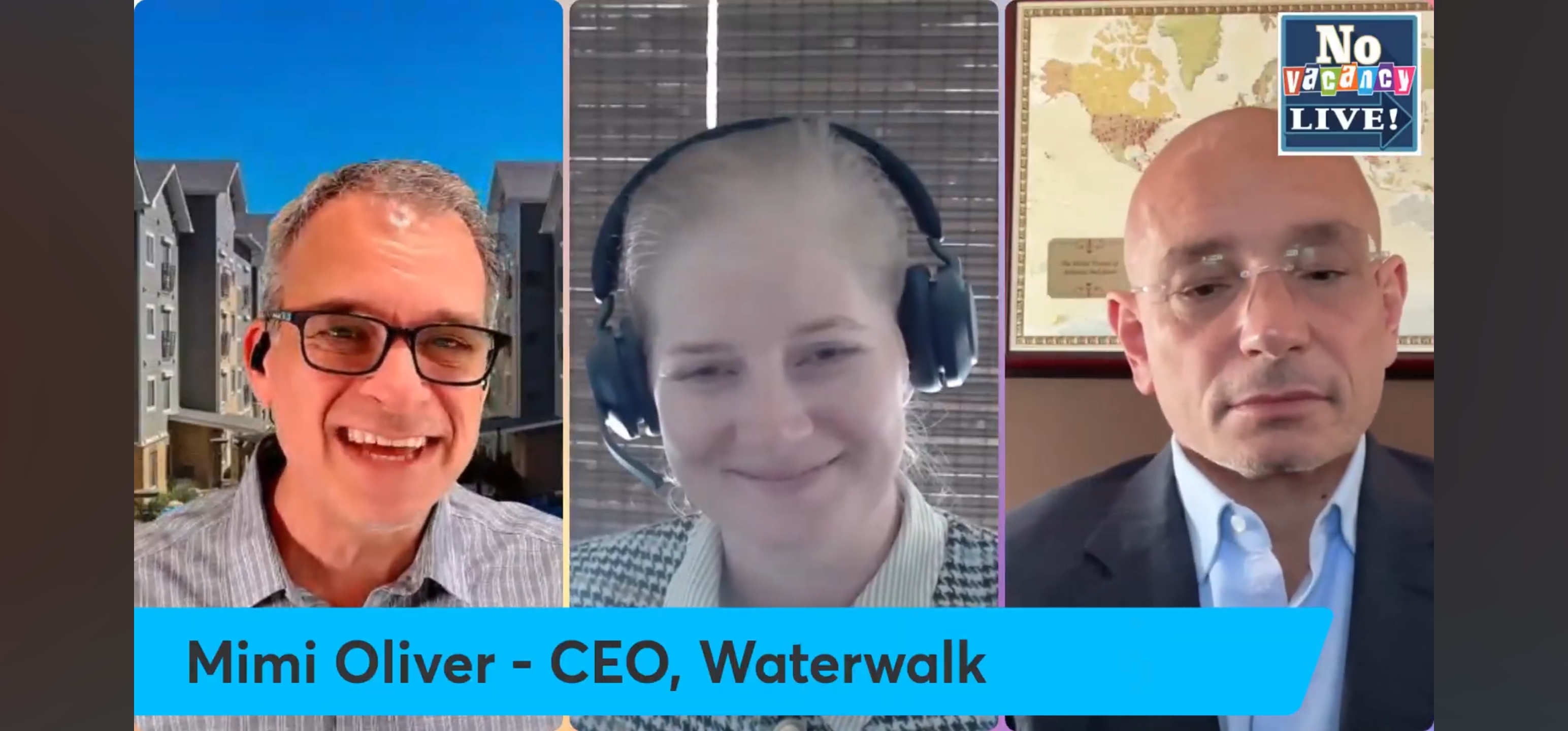
In this episode, Glenn Haussman and Anthony Melchiorri speak with Mimi Oliver, CEO of WaterWalk, about how her family invented the extended-stay category and how she’s now pushing it further with a hybrid model that balances fully furnished and unfurnished suites for maximum flexibility, profitability, and guest choice.
We discuss how WaterWalk thrived through the pandemic, why its partnership with Wyndham is scaling the brand nationwide, and how AI and automation fit into operations without losing the “ladies and gentlemen serving ladies and gentlemen” ethos.
What we cover
🏗️ How WaterWalk’s hybrid model kept occupancy strong during COVID
🤝 Why Wyndham was the right partner for franchise growth
🏢 Real-estate strategy — choosing high-potential suburban markets
🤖 AI & robotics driving efficiency in operations and housekeeping
💼 Sales culture that still believes in handwritten notes and direct relationships
👩💼 Mimi’s journey from Wall Street to Wichita and carrying on Jack DeBoer’s legacy
🎓 Student housing as a new frontier for extended stay
🙏 Special thanks to Actabl — Actabl gives you the power to profit. Visit Actabl.com.
And to HotelData.com — helping you budget smarter for 2025 and 2026.
If you love stories about innovation, legacy, and how hospitality keeps its heart while embracing technology, hit like, subscribe, and drop a comment:
How do you see extended stay evolving over the next five years?
Transcript
Glenn: Everybody. Hospitality. Friend. Glen here. Listen, we already know gives you the power to profit. But now they’re giving you more actionable insights to drive that profitability. Do me a favor. Take a moment and check out Hotel Data.com. You’re getting set for budget season, right? And this new benchmarking data is going to help compare your hotel’s performance for the rest of 2025 and into 2026. Please check out Hotel Data.com or the classicactabl.com. Have a great day and enjoy the show! Hey everybody, thanks so much for tuning in to No Vacancy Live. We got Anthony Melchiorri in the house today. I’m Glenn Haussman, thanks so much for spending time with you. Hey, Anthony, how’s it going?
Anthony: You say thanks so much with such, like, heartfelt emotion.
Glenn: Because it’s it’s awesome. How cool is it that people take time out of their lives to, like, learn and hang out with us? It’s a real privilege, man.
Anthony: Right? Our one guest, your mom, she really enjoys this show.
Glenn: Yeah, she just called and she said, Glen, keep doing what you’re doing. One day you may double your audience. So she’s calling around to the family. No one’s picking up the phone, so we’ll see. We’ll we’ll see.
Anthony: So we have a very interesting guest on today.
Glenn: Oh. We do. I’m really looking forward to it. I’ve been promising to get her on for a while, because I love what this concept is all about. Anthony, we’re all about extended stay in our business. But she and her family’s lineage have always been rooted in inventing extended stay and creating a new concept and twists on it. The latest one, which is not so late ist because they’ve been around for a while innovating. We’re talking water walk, water walk today, and this is going to be a lot of fun because we’ve got Mimi Oliver, CEO of Water Walk On. Mimi, great to see you. How are you?
Mimi: Great to see you. Hey, Glenn. Hey, Anthony. I’m great. How are you both?
Glenn: It’s great to see you. And you know, I got I got one right behind me.
Mimi: Love it.
Glenn: What I really love about how you change the dialogue of extended stays, you’re really moving it beyond that shorter stays of, let’s say, 28 days to five days on the minimum side to hey, now you have options beyond it. Some furnished, some not. I thought that was a hoot. Just when you think you guys can’t figure out new angles. There you go.
Anthony: Before we go forward, could we just. For some people that don’t understand, you know, where your background and kind of your company family invented basically the extended stay model especially, you know, I did a Staybridge suites back in the day in New York. It was the first urban extended stay. And even then, about 20 years ago, we were like the redheaded stepchild, right? Yep. So now the extended stay is the stoop, the supermodel of our industry. So tell us about that, how it started and where it’s going.
Mimi: That’s right. So started back in the 70s and 80s with my grandfather, Jack DeBoer, who is, you know, considered the pioneer, the creator of extended stay. And he was actually the second largest apartment developer in the US in the 70s. And as you know, a couple of his garden apartments were not leasing up per proforma and everything. He decided he actually had Boeing I believe it was Boeing. Come in and say, hey, we’ll we’ll if you furnish this, we’ll take the whole building. And so that was one of the light bulbs that went off for him and saying, if I furnish these rooms, I can make double or triple the money, and I’m still keeping the building full. And so that was.
Glenn: Discount on buying bulk furniture.
Mimi: Yeah. Yeah, exactly. So that was one of the kind of the starts of extended stay. And that’s where residents in came in. So back in the 80s and then of course, built that brand up to 100 properties, sold it to Marriott. That was number one. And then we’ve had this amazing family legacy of building other extended stay hotel brands, going on to Summerfield Suites, which is now Hyatt House, and then Candlewood, and then to Woodspring and then now Water Walk is number five. So I’ve been.
Glenn: At Woodspring is now value place for for.
Mimi: Value place.
Anthony: So what’s amazing is, you know, there’s so many brands now like Marriott has I think what like 36 brands or something. Right. And residency when it came on the market, I remember it was like it was like a rock star came on like Residence Inn was like literally took over and everybody’s like looking over the fence, like, what’s that? It was really, you know, right now there’s so many brands that are coming in and out. You don’t really can’t keep track. It’s like restaurants in New York. People say, where should I eat? It’s like, dude, I stopped keeping track of New York City restaurants 20 years ago. It’s too many. Same thing with the brands. But but Residence Inn and your brand, like, they just they just stick, you know, they just they just have a real value to that segment. To starting their own segment. And now everybody else is trying to build their segments. But you know, I love when you someone just gets it right and then is able to go through generation, generation, generation and keep building because we’ve all heard the stories of weapons, right?
Glenn: I just think it’s funny that.
Anthony: And then Tommy gets to your generation usually doesn’t work out. And then it’s flourishing. Really says a lot about your family and about your company.
Glenn: Yeah. I just think it’s great that in order to get all the brands, all these companies started, they bought all your family’s brands that were developed over the years. But we’re here to talk about you, your CEO of of Water Walk. And I’m curious as to how you’re thinking about the world of extended stay currently and how it fits into your brand. And, of course, you guys did a great deal with Wyndham, which we’ll get to in a in a little bit.
Mimi: Sure. So extended stay obviously continues to be you know the hot topic right now in the industry and so many brands popping up left and right and left and right in all different categories Water Walk continues to be pretty different than just your typical extended stay, because I still think, you know, Jack was one step ahead again with this brand of the industry always. But with our hybrid model of the unfurnished and furnished offering. So we do have our fully furnished, upscale extended stay suites paired with our unfurnished, more residential like offering. And so none of these other extended stay brands are doing that or having this hybrid model. And so it’s really beneficial to see the synergies of that from an investment perspective of, you know, keeping basically having flexibility in a, in a down market pandemic. We ran 60, 70% occupancy when the hotel market tanked to 20. And so because of this unique model, because we’re really, really focused on that true average, you know, longer length of stay. So on our furnished side average length of stay is 90 nights unfurnished side average length of stay is one year. So we are again, very different than even all these other new brands popping up. Staying true to our legacy, our heritage of extended stay, not the three night extended stay that.
Glenn: We got to come up with a new term because this is a super, super extended.
Anthony: I have a secret for you. If you haven’t figured this out yet, that your model of furnished or unfurnished extended stay, everyone’s going to copy it. And in four years there’s going to be a lot of competition.
Glenn: That’s all right. Mimi’s got good genes. She’s going to be coming up some more concepts anyway.
Speaker4: Great idea. We’re going to keep going. You know I agree with you.
Mimi: It’s it is it’s the next phase for sure.
Anthony: Especially with this generation of people not really wanting the gold watch after 20 years. Everybody’s jumping job, you know, wanting, wanting new experiences, going to different cities. So you’re going to I people aren’t buying houses at the same rate. They were buying houses. So I really think that this model is brilliant.
Mimi: Exactly. Yep. Some people BYOB bring your own furniture. I mean, we have a lot of customers now who you know, construction nomads, they they travel with their trailers, with their armchair from their house and their pictures and, you know, their bed, and they’re perfectly comfortable, you know, lightly furnishing a room you know, for their four month project and then go on to the next one. And so that that really is happening now.
Glenn: Well, that makes a whole lot of sense. You know, why not if you’re going to be there for that extended period of time and then and you use that word flexibility, which I really like because you have let’s, let’s just say X amount of units, let’s say 100. For math purposes, you can play with how many rooms on either the furnished side or the unfurnished side is, depending on the demand in that market over the long term or just the next year or two.
Mimi: Exactly. That’s right. Yeah. So when we go into a market, our baseline model is typically 60% furnished, 40% unfurnished. And then again, given certain market conditions, demand generators, everything we we flex that. So and then going into our annual budget season. Annual planning. You know, season we look at the next year. So as an example, in our Overland Park property, we’ve been at that 55% furnished, you know, 45% unfurnished mix. But we just landed a huge piece of Panasonic business. They’re bringing a big chip factory into that market. And so we now have we’ve furnished an additional 30 rooms in that property to because this business is booked all the way through 2026. And so we will, you know, increase our EBITDA by 40% next year, year over year because of that, capturing that demand. And we have the flexibility with this model to be able to do that. And then again, if a, God forbid, recession pandemic comes back, we’re able to unfurnished and really maintain that stability in.
Anthony: In Overland Park is one of those little cities that nobody really knows about that has been a Titan for years because there’s been a lot of companies there. I started my career there at Embassy Suites, and I lived there for because I was in the Air Force, and then I stayed for a couple of months, and I lived in Overland Park, and there are so many companies there, and it’s really a tremendous hub for business. And it’s the second most fountains of any city outside of Rome.
Mimi: Oh, wow, that’s a great fun fact. I did not know that, but I agree Overland Park is a is a powerhouse, and that’s kind of the markets that we’re in for for water walk there. We’re not in, you know, the urban core of these larger cities, but we’re in these really special, you know, high density suburban areas where they have, you know, all this office and demand nearby.
Glenn: So people like, just so people know Huntsville, Alabama, Phoenix, Raleigh, Tucson, you mentioned Wichita, that sort of stuff.
Mimi: Right?
Glenn: Yeah. So I love this flexibility thing. So what what happens now? You got this big he’s got this big deal with the factory. How do you deal with the furniture and getting it in and out and making sure it’s still profitable, and, you know, how’s that all work?
Mimi: Yeah. So the beauty there is, again, we have flexibility. So we can either purchase the fee if we feel it’s a longer term strategy and keeping that furniture longer term, or we have a great partnership with Court Furniture, which is a furniture rental company. And so a lot of times we will just actually rent the furniture for six months at a time. You know, a year at a time. And it’s still you still are getting those margins. So it still makes sense to, you know, lightly furnish a room and and then you have the flexibility to, you know, obviously take the furniture out if you want.
Anthony: So if I can answer a question with, with what you’re doing, and I’d like to ask this question on every podcast, because what’s been, you know, taking over our world is AI. Where are you using AI in your in your model or in your business right now?
Mimi: We are constantly learning and evolving, but there are there’s AI happening in our operations. So even back of House trying to figure out how to get more efficient with you know, housekeeping with out of order rooms. I mean, we’re we’re really leveraging some new systems. And even when we look at our panels and try to analyze across properties with our management company you know, labor effectiveness and things, there’s some great AI tools now to really help us just, you know, the tools go into our panels or go into our systems and just help kind of spit back out. You know, these are this is what you need to focus on. This is the efficiency here. And so I think it’s helping us look at the business in a whole different way. Bring more to the bottom line. Of course. And we’re really focused on, first of all, the guest room experience and the check in experience. I do think that there will continue to be AI you know just developments that we need to really stay close to, whether it’s an enhanced check in, you know using AI to just again, with, with the connectivity to your phone and your key and all of that and just, you know, a seamless concierge experience. And so there’s a lot there. And then we’re actually kind of I kind of not, but more robotics. We’re really, you know heavily researching. Housekeeping, robotics and a lot of things to help, again, drive that efficiency in the operations.
Anthony: You know, and one of the things I want to talk about is that people say, well, you’re getting rid of people. No, you’re not like those efficiencies you’re talking about that helps the guest really have a great experience with the employees that are in the building. And plus we’re underemployed in our industry by what, 40% now? So so right now at the front desk you have one person doing 27 things. So the more so you’re not getting rid of people. You’re just improving the experience for both the employee wants, because we want to keep these young people in the industry, and a lot of them run out because there’s too many things and too many tasks at the hotel to do for one person.
Mimi: Absolutely, yeah. Eliminate some of those tasks, and then you really, truly focus your people on the hospitality aspect of the business, which is what people still want.
Glenn: Yeah. That’s really that’s really what it comes down to at the end of the day. And hey Anthony, you nailed it on that. I’ve been saying this over and over again. We need more people in the business. No matter what technology happens. We’re keeping the humanity and hospitality. So we need people there. Mimi, I’m super. I’m super curious. I think it’s been about 18 months since you did some sort of strategic partnership. I would call it. Tell me if I got the wording wrong with our friends over at Wyndham. So now it’s water walk extended stay by Wyndham. What was the impetus for you to get involved in that sort of deal? What is it like, and has it been panning out for you?
Mimi: Absolutely. It’s been a fantastic partnership and very, very grateful. We we went ahead with it. And so it’s been a busy 18 months. We we got into the partnership because we felt that Wyndham was the right partner to help us expand our franchising and grow the brand that way. They obviously are the, you know, number one largest hotel franchising company in the world. And.
Glenn: People on those teams.
Mimi: Absolutely. And we felt and they felt as well that, you know, they had this white space in their portfolio for upscale extended stay. They didn’t really have that yet. They have Hawthorne and they have they have echo now, but they still had this opportunity. And so and a lot of franchise interests in that space and these franchisees that want to do, you know, extended stay at all different scales, it’s really important to have all of those offerings. So that was yeah, that was a natural fit for us. And they have been very focused on growing the franchise pipeline. We have multiple deals signed. We have, you know, conversions and ground up strategies going forward. So it’s been a great partnership and also just felt, again, with that bigger brand engine and system to really help drive our top line. And we are a direct sales brand. So we have a dose at every property and that’s at least 50% of our revenue. But to be able to really, you know, capture more brand.com and more from the Wyndham loyalty system versus being an independent brand prior, that’s been significant for us. So relying less on those OTAs and more on that brand has been a great shift.
Anthony: And I imagine that’s also a challenge because those people are real salespeople, right? Backyard sales, though, and that’s kind of a lost art of really digging in, because we’re so used to picking up phone calls or looking at emails or, you know, giving 18% to OTAs or whatever it is. But real salespeople that really have to bring that business, you know in, you know, that’s a lost art completely.
Mimi: I mean, frankly, we are doing it again. You know, Jack, my family invented direct sales back in the the residents in days, and we are, frankly, not doing it much differently than then. I mean, that we we are holding true to that culture, that training module. I mean, this is how you get out in the market, in your backyard, you know, unearth those those contacts and those relationships and companies that sometimes you just can’t find over the phone or, you know, online.
Anthony: And what was so typical back in the day. A handwritten note is so, you know, unusual today. We were just on a podcast and I asked the gentleman, when was the last time someone gave you a handwritten note through the mail? And I remember who it was, but he was like, I don’t know, 20 years. So now those little notes will get.
Mimi: To that.
Anthony: One little handwritten note will get you a piece of business.
Mimi: Absolutely. Yeah. It’s a differentiator. Now, very interestingly, just to go back to some old school tactics.
Glenn: Yeah. Anthony. Sorry.
Anthony: People like they want immediacy. They do. But also like if you look at some of these podcasts that are on for an hour or two, three hours, people will commit to time. So people will commit to opening a letter and reading it and appreciating, because one of the things that we lose in AI and technology is we lose that individuality. So if you’ve really taken the time to write me a letter, there’s a difference. When you go into a hotel and somebody writes you a handwritten amenity card, or if you write me a card and you just sign it and it’s. It’s typed. I tear it up. I’m telling it, don’t worry me anything. Just leave my little fruit basket and don’t write me anything.
Mimi: Right. Totally agree. The high touch is has been lost, and it is a differentiator and something that you’ve just got to get back to those roots and and you will win business when you have those high touch points.
Glenn: So how are you thinking about keeping it like high touch with your burgeoning like franchisee community, for example?
Mimi: How are we staying high touch with them? Yeah. So we have again, wonderful franchisees right now. And they are big believers in Water Walk and hope, you know, they’ll continue to grow with us. And so we are always talking to them and learning again. We are still relatively a young brand. So they’re they’re a part of this growth story. And so we’re asking them what would you change about this model, about this product, about, you know, in your market, are you learning certain things even with some of the new franchisees through Wyndham, they’re really helping us think a little differently about the design of Water Walk. And, you know, what have they learned in their past. And so it is so critical to be, again, as a newer brand, be very much hand in hand with our franchisees to develop the growth strategy.
Glenn: Yeah, that’s always that is absolutely the the way forward. Maybe what I want to talk about before we let you go, I got to ask you about this Tucson property because you said you’re near campus and there’s some opportunity for, like, student housing and that sort of thing. So as a parent of kids who need student housing, I’ve been curious as to why our industry hasn’t been able to really gun on that particular category. Tell me a little bit about where you see opportunity and how that’s being recognized in Tucson property.
Mimi: Yeah, I totally agree. So I mean, wouldn’t you love for your kids to be able to live at a hotel? Yeah. Because then they have 24 over seven, you know, they do. Front desk.
Glenn: Back here. That’s pretty much.
Mimi: Yeah. Well, there there we go. There we go. Yeah, that’s that’s right. But No, but I think there’s, there’s something we’re still trying to navigate and figure out here, but we are really trying to increase marketing and appeal to the student population and and be more of a unique student housing. You know, option because we have these unfurnished suites. And so the pricing actually is pretty on par and similar to what their other student housing options. But again, now you live at a hotel, right? So you have all the amenities and services of living at a hotel. And I think the parents feel more comfortable and, you know, with the safety and everything like that as well. So and as a student, I mean, are you kidding me? I would love to go to a place where you don’t have to hook up your Wi-Fi, your cable, your utilities. You have a front desk, all, you know, 24 over seven. I mean, that would be ideal. So so I do think we’re, you know, we really need to continue to expand our focus there.
Glenn: All right. Yeah. The like, one of the places I lived in college was so bad, it got condemned a couple of years later. Yeah.
Mimi: There you go. You know. Yeah. You want your kids in a, you know, a very safe and and nice place.
Glenn: So how are you thinking about when you’re working with potential franchisees. What markets and stuff to to to go to. Are you looking at the big growth markets like the Dallas Fort Worth corridor or you know, other places, because the flexibility of your model, maybe it opens you up to different locations.
Mimi: So we are, again, just like we’re kind of always been one step ahead of the industry and the trends there. That’s that’s our strategy with real estate and markets as well. So we take a little bit of risk going into a little bit of greener areas. But where we really feel confident in the growth. So we came into Huntsville, you know, on the early side. But now that that city has taken off, no pun intended, it’s Rocket City. You know, we’re we’re looking at Albuquerque. There’s a great little pocket there similar to an Overland Park, you know, 20 years ago that is just going to take off the greener areas around Dallas greener areas around Savannah, just some of those really high, high growth potential markets that we believe getting in earlier on. And that’s worked very well for us, our Phoenix market, we went to North Phoenix when, you know, a couple of years ago there was not a lot going on. If you go there now, there’s 20 cranes around you.
Glenn: Yeah. Phoenix is one of the top five markets right now for hotel development.
Anthony: Yeah. So we’re going to make a quick right turn, as we often do when I open my mouth.
Glenn: Oh, boy.
Anthony: You were born into the business, but a lot of people decide to go and do something else. Become neurosurgeons or bike across America. You listening to you? You have more passion for this business than I do. I didn’t think that was that was anybody had that ability. Because I love this business as much as I love anything more than I love anything. And so what was it? At what age? At what moment, when you were exposed to this at the very early age that you decide, because this is not something that was handed to you. You can see that you’ve worked your way into your position because of your love for the business. So what was the moment? Do you remember a moment when you were a little girl that you’re like, I’m doing this the rest of my life?
Mimi: Yeah, it’s interesting because so first of all you know, I guess I’ve been raised in the business, but actually, my parents, when I was born, my parents both worked for Ritz Carlton. And so they carry they to this day still carry their credo card in their wallet. And so that gives you another glimpse into my childhood, you know. Ladies and gentlemen, serving. Ladies and gentlemen. That’s how I was raised. That is just the culture that we all believed in. And so I was born and bred in hospitality. But interestingly, I went to college and left college thinking I would never want to be in the family business. I just said, I want to forge my own path. I was a math major, believe it or not, and I went into finance and so I spent some time abroad, worked at a big bank.
Glenn: Helpful.
Mimi: And just wanted to kind of forge my own path and banking. And it’s, it just all came back to me because I ended up on a commercial real estate team where I started working on large hotel deals. And the minute the moment for me was the minute I started doing these these site tours and I went into hotels and again, it just all came back, right? And I was like, oh my God, I love this. This is my passion. This is it for me. I want to be in hotels and hospitality for the rest of my life. And so at the time, I actually had a mentor at the bank who got to know me, and he you know, got to know that Jack was my grandfather. And he said, Mimi, I have your grandfather’s book on my bedside table. He is a god in this industry, and you are crazy. If you don’t move from Wall Street to Wichita to help him start his fifth, you know, national extended stay brand. And so three weeks later, my bags were packed. I moved from Wall Street to Wichita and helped Jack launch Water Walk. And that was ten years ago.
Anthony: So that’s the name of your book, right?
Mimi: Wall Street from Wall Street to Wichita How to Propel Your Career. Yeah.
Anthony: I’m so glad I asked that question because some people, you know, maybe not want to really get into it. But I love, love that because that just taught somebody, some somebody listening to us that just taught them something from Wall Street to Wichita. And you got a skill that helped your business, right? So you didn’t learn your skill in your business. You learned your learn your skill outside your business and that skill helps you know the next generation. Because now that’s in your DNA and that’s so critically important. And you just made my day by telling me that story.
Mimi: Oh, thank you, I appreciate it. It’s it’s been an amazing journey. I love it. And again, like you said, this is who I am now. I mean, I just I’m once you get bit by the bug, as you know, you just you never leave.
Glenn: Yeah.
Anthony: I know the only seven year old that wanted to be a general manager of a hotel.
Mimi: I love it.
Glenn: In your little, little.
Anthony: Last the last podcast that the the double jeopardy question last night was the Algonquin Hotel, and that was the general manager of Algonquin. So I love history in hotel so much that what prime city, what my 23 year old daughter and my wife and we’re watching it and I won because I got the question right, obviously. And but just to be part of such a historic hotel and it’s the double jeopardy question, you know, it just it just there’s there’s so many opportunities in this industry and this business. And, you know, the hotels have have been the backbone of our industry, whether it’s building roads, whether it’s, you know, building big cities, you can’t do anything in a in a country without hotels. I remember during, during Covid when Chip went into the white House and they were like, well, you’re not a mandatory business. And he’s like, where are your nurses and construction people going to be? You, of course, weren’t mandatory business, right?
Mimi: Right, exactly.
Anthony: And so so this business is so important and it’s you can make money. You can you can be inspired in every single day is different. There’s never and you can like again you need finance creativity. There’s so much to it. So just to hear your enthusiasm excites me.
Mimi: Oh thank you. Well, ditto for you both as well. I just love being passionate together about this.
Glenn: Yeah, well.
Mimi: The passion.
Glenn: Yeah. Our love for hospitality. We are three lucky folks out here, and, I think you guys are lucky out there too, because you get to learn along with us. And Mimi, thank you so much for being here with us.
Mimi: Thank you for having me. It’s been a lot of fun. Thank you.
Glenn: A long time coming. Finally.
Mimi: Yes I know. Yeah.
Glenn: You on here. I will see you later. I’ve been trying to get this together for way too long, and I’ve dropped too many balls in making this happen, so I’m glad we got it worked out. And because it’s such a momentous occasion that I got this going, you’re definitely going to need to relisten to this. Be sure you follow us on all of the socials out there and wherever you get your shows. So thanks so much for being here, everybody. Any final observation that you’d like to.
Anthony: That was fun. And I, you know, Wall Street to Wichita. I want to read that book.
Glenn: I like it too. And I will say one of the things I’m worried about is there’s a little too much Wall Street, not Wichita in our business. And Mimi is making sure that will not happen because she is all about serving, ladies and gentlemen. So we’ll see you all later. And remember, you’ve got one life. So blaze on and.
Anthony: You find yourself.
Glenn: See you all later. Bye, everybody.

More Episodes
-
October 15, 2026
The Hidden Cost of Hiring the Wrong Hotel Employees
-
October 14, 2026
Outrigger Is Reinventing Its Hotels. Here’s the Strategy.
-
October 13, 2026
The Hidden Inefficiencies Costing Hotels Money
-
October 10, 2026
How Raines Finds More Profit Inside Existing Hotels


Subscribe