March 27, 2026
1025: Aftershock to Farm-to-Fork: Sacramento’s Tourism Growth Playbook
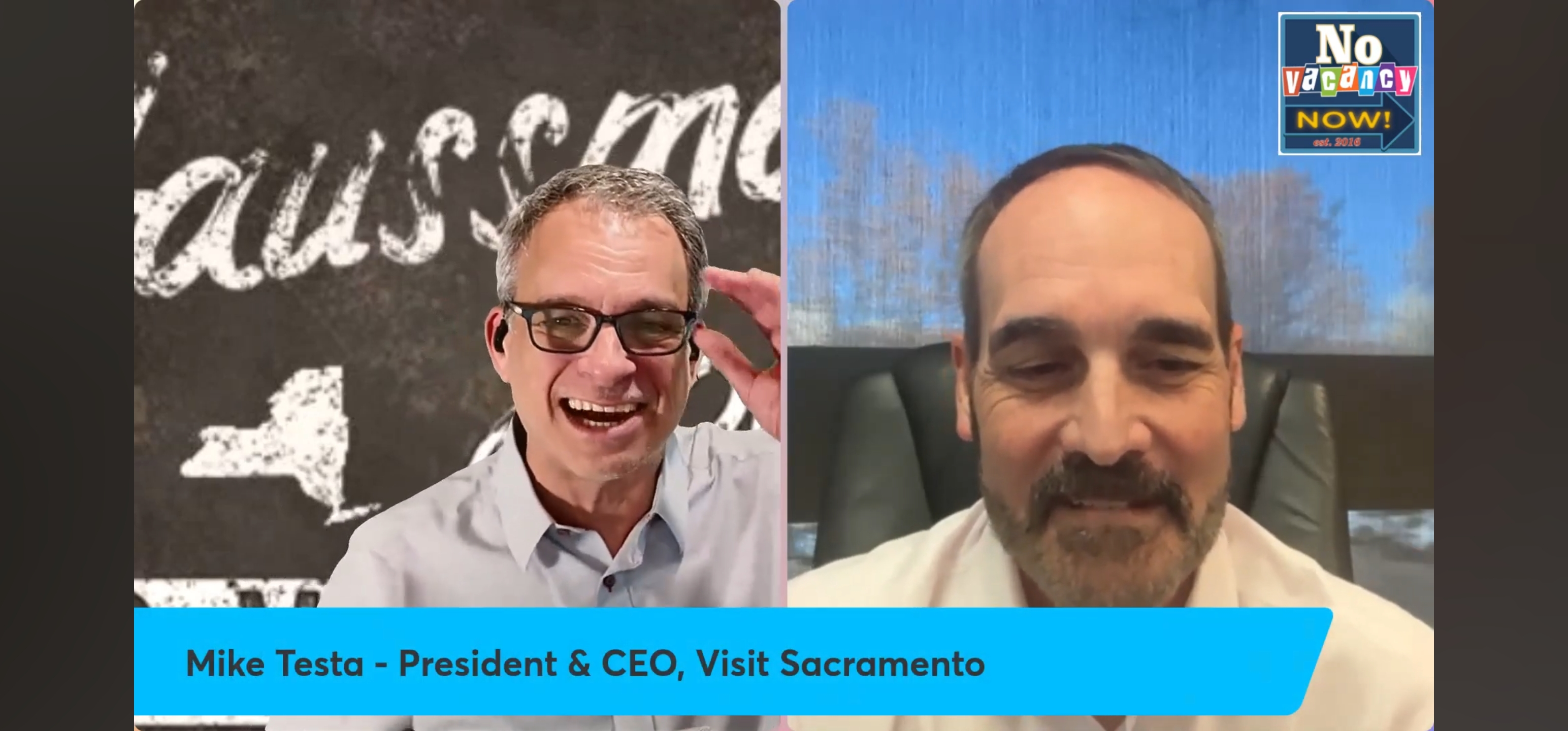
Glenn Haussman talks with Mike Testa (President & CEO, Visit Sacramento) about how Sacramento positioned itself around farm-to-fork and then stacked events that drive real overnight stays from different customer groups.
• Why “farm-to-fork” fits Sacramento (food often gets harvested that morning)
• Sacramento 365 as the event hub that keeps the calendar working year-round
• Aftershock growth: one day (11,000) → four days (165,000), 67% from outside the region, about $40M in four days
• Ironman and NCAA strategy: women’s Sweet 16/Elite Eight as the path toward a women’s Final Four conversation
• The measurable outcome: room nights going from ~280,000 pre-pandemic to ~409,000 after adding the event portfolio
Thanks to Actabl for supporting this episode. Actabl gives you the power to profit. Visit Actabl.com.
Transcript
Glenn: [00:00:00] Everybody. It’s your hospitality, friend. Glenn here. Thanks so much for spending some time with me today. I’m excited today because as you know, I love experiences and, you know, maybe a couple of hundred videos or something. I do other experiences besides that, I promise. But what I really love is that when people are really focused on experiences, you know it. That’s what a lot of your guests are doing. And I see a lot of you out there adapting. But I found one city out there that seems to be doing an exceptional job at it. So I thought we would talk to those folks over there, learn a little bit about that strategy and how it works. But before we get going with that, I want to thank our friends over at Actabl. Remember, Actabl t give you the power to profit, help you save that money on that labor and all sorts of other things. They got great products out there. Check them out. Com all right, let’s bring them in. Mr. Mike Testa, president and CEO of Visit Sacramento. Other folks tasked with getting people excited about Sacramento. It is so great to see you, Mike.
Mike: [00:01:00] I’m so glad to be here. Thanks for having me.
Glenn: [00:01:02] All right. So, Mike, I’ll start off with the the obvious the obvious place. We’re about the same age, and I feel like Sacramento has always been wrapped in a cloak of mystery. Ever since. Ever since I learned about the Sacramento Bee. And eight is enough and and all of that kind of stuff. That’s how I learned about Sacramento right from that TV show. But I never really thought about it until ever again. Until you guys popped in and I was just really excited about how you are focused on making sure the Sacramento spirit comes alive and you’re a diehard Sacramento guy. You’ve been working with them for forever, it seems 25 years.
Mike: [00:01:44] Yeah. And it’s interesting you think about cities in California, like if we if we were standing in Europe and I said, name five cities in California, Sacramento probably wouldn’t be in that top five. And that’s been a challenge for this market. Right. You’ve got San Francisco, you’ve got Napa, you’ve got LA, you’ve got San Diego, you’ve got Lake Tahoe. There’s some bucket list cities in the state, so we’ve really had to work to make noise and drive attention to our city because as you saw from eight is enough. It’s a really cool place. It’s just a little bit under the radar.
Glenn: [00:02:09] No, it’s just it’s absolutely beautiful. And it’s one of those places to have. But the you really put out the problem. Great. But I’ll do the yes and thing with you and say people are sophisticated, they travel so much. So you’re not just competing against those California cities, you’re competing against everybody else that’s out there. So how do you go through the process of trying to figure out and define yourself, to create a positioning that actually resonates with the consumer and sticks in those brains when it’s at that right moment to plan a trip.
Mike: [00:02:38] I think you have to look at something that’s authentic to your market. And I see a lot of cities picking the same taglines and kind of the same, you know, rah rah speech. And the reality is, the best things in marketing are when you can say you’re the only or the biggest or the best. And I think in Sacramento we talk a lot about food. There are, you know, we grow so much of the food that feeds the rest of the country. And we looked at these different identities over the year and farm to fork was really it. Because when you eat in Sacramento, a lot of times what’s on your plate was harvested that morning from from a farm. And what I always love behind our building, we had this great restaurant and we wouldn’t see semi trucks dropping off food. We’d see little 1986 Honda Civics dropping off a bushel of things of produce. And that’s something that’s really authentic to this market. So food is something that we’ve leaned into in a big way.
Glenn: [00:03:24] Yeah. But not only have you leaned into it in a big way, but again, going back to the topic of Event City, it’s not just leaning into food and saying we’re farm to fork capital, then you have to back it up. And for some reason, I actually decided to do some research today. And doctor producer Suzanne, who just showed up backstage, is already laughing at that. But you have a site, Sacramento 365. And what I learned is that you have all these events that go into the farm to fork. So you’ve created an umbrella and then with it you could build all sorts of you know, events underneath that.
Mike: [00:04:00] Yeah, absolutely. And again, it’s that idea of we don’t have a Statue of Liberty or a Golden Gate Bridge. So we created things that that drew attention to the market. And you mentioned some of the different events that we’ve done. We host an event called aftershock. It’s the largest hard rock festival on the West Coast, started as a one day event with about 11,000 people. It’s now a four day event with 165,000 people. 67% of the attendees don’t live in the Sacramento region, and they dump $40 million into this market over four days. So great for the locals who like hard rock music, but it brings in people in the market who probably before didn’t have a reason to come here. But what’s great about events is you get them in for the event they’re exposed to the market, and then they come back on non-event weekends.
Glenn: [00:04:38] Yeah. And I will say, Mike what’s interesting is you’re doing those big giant tentpole events and there’s another massive one coming up later this month and also filled out with more intimate experiences that are geared towards those smaller audiences. So you appeal towards getting the local to come in on like a Saturday afternoon, but at the same time then you can have massive events like the festival you just talked about.
Mike: [00:05:05] Yeah. That’s right. I mean, you know, you have to cater. We always say that tourism isn’t about the tourists. It’s about improving the quality of life for the people who live here. So whether we’re doing a small event or a large event, you know that it is seeded by people who live in this market and, you know, the visitors coming in and spending money in the market is kind of the cherry on top of that. But you have to get the locals to buy in first. You can’t just build something for people from the outside to be attracted to. The locals have to be the champions of what you’re doing. And we’ve certainly seen that in Sacramento. When we look at the demographics of the events we host, the foundation is always made up of people who live in this region. I think that’s critical.
Glenn: [00:05:39] Yeah, and you’re definitely focused, I guess, on what would it be like that three hour drive, 100 mile type of.
Mike: [00:05:46] Yeah, about 100 miles is typically what we do far enough that that you probably want to stay the night because after having fun at a festival or whatever event you’re at, you don’t want to drive home?
Glenn: [00:05:54] No. Yeah, I like that. So how do you go about getting, like, the community to back you with some of these ideas, and then we’ll get into some of the larger events that you guys have.
Mike: [00:06:06] You know, some of it is partnering with local media and letting them tell the story. Right. We host the largest iron man in North America happens in Sacramento. So them doing profiles on athletes and talking about, you know, their training regimen to get to that race in Sacramento and those those real life stories I think are really important. And then they’re talking to businesses and see how do they benefit over the aftershock weekend with the hard Rock Festival? How many jobs it creates. So you start to paint a picture of because, look, the reality is not everybody likes live music. Not everybody wants to go to a music festival. And the parking and the traffic that it can cause can be, can be a pain. But when you start to understand the big picture of, oh, wow, that generated 10,000 jobs for Sacramento, then I can probably deal with three days of inconvenience.
Glenn: [00:06:47] Oh yeah, and listen, you may not like that event, but maybe you’re going to be spending the last few days of March at the NCAA Women’s March Madness tournament, for example. Correct. That’s pretty. That’s pretty impressive. How do you go ahead and get into the conversation, let alone being able to get something of that nature to your town?
Mike: [00:07:08] You know, some of some of that is resume building. You prove that you can host NCAA events over the years. And look, we would love to host a men’s Final Four in Sacramento, but we don’t have the hotel infrastructure to do that. So if you can’t do that, then then you look at what you can do. And what we can do is women’s basketball. We can host the women’s Final Four in Sacramento. So getting the sweet 16 and the Elite Eight in March madness for women is a coup for Sacramento, because then it leads to that next conversation about the women’s Final Four. We host the men’s first and second rounds in Sacramento, which will host next year. But if we want to host the bigger parts of the tournament, we had to look at the women’s and our track record with the NCAA is positive. So I think they had confidence in us that we could bring that to the market and run it smoothly with them.
Glenn: [00:07:48] That’s a that’s interesting. It’s kind of like my life too. Like, I would have to get certain guests and then you just kind of build up the food chain until people start paying attention to you and take you seriously. Right. So what is this process been like for you? How long from you all realized that you needed to differentiate yourselves, to break through that consumer mindset to you were able to start ideating and then creating action and then starting to see those results.
Mike: [00:08:18] I think part of it was studying what’s been successful in other markets. And frankly, we looked at a lot of state capitals. You take Austin, for example, 30 years ago, Austin isn’t the Austin that it was today. And what changed that market was music. You know, South by Southwest and Austin City Limits had been there for a long time. But again, you talk about authenticity of a of a brand. And Austin’s brand has been music since the 1920s. And so what what happened in Austin after those music festivals, you started attracting high tech companies the Motorolas, the Dells and people moving there. And what happened after that is you got a younger workforce that moved. So when we saw the opportunity with these music festivals, we saw that the chance to change this market. And so what started again as a one day festival is now a four day festival, really widened our eyes on. We should be going after more events. Conventions were always the largest driver of tourism to Sacramento, but it’s a it’s a one trick pony, right? When the economy is bad and you’re not driving as many conventions the, the, the monetary of it goes down, the money that comes in and goes down. So we look to diversify our portfolio like you would a stock market. And that’s when those events started coming in.
Glenn: [00:09:22] And listen, the convention center never besmirched how awesome a convention center could be. But if you get XYZ event, typically the nature of you having that event means you’re not going to get them back for a number of years, if at all. Right? There are very few events that go to the same place every year. So you think about the amount of resources that go into trying to get that one single event that’s only going to be there that one time versus Iron Man Sacramento, which is becoming like an annual tradition. Right? So that must make things really good and help create that sense of dependability of the economic engine that you’re helping create.
Mike: [00:09:57] Yeah. It’s consistency. Exactly what you just said. And you think about prior to these events in Sacramento, pre-pandemic visit, Sacramento was driving about 280,000 hotel room nights overnight stays. Right. If you look after we added these these events, we’re now driving 409,000 room nights a year. So it added more than 100,000, not visitors, but room nights to the market and in the tens of millions of dollars in economic impact. So it’s changed this market dramatically.
Glenn: [00:10:23] Oh well, there’s definitely some hotel developers listening going right now going, whoa. Yeah. So how do you think about creating the type of events you’re going to? I don’t mean the specific events. I mean the catalog of events that you have to appeal to different groups of people at different types of year and all of those kinds of things.
Mike: [00:10:46] So. So that’s it. It’s really looking at the different demographics. Aftershock, we know, is going to drive a specific hard rock audience. So the next weekend we started a country music festival. Leave the stage up, leave the infrastructure up, bring an entirely different demographic. And we brought Terra madre Americas to to Sacramento, which is the largest food conference in Europe that attracts a totally different client client, 160,000 people. So, so in Europe, it does 300,000 people a year from 120 different countries in our first year in Sacramento, and the first time it’s ever been in the US, we did 160,000.
Glenn: [00:11:19] So incredible.
Mike: [00:11:20] It’s amazing. And from a from a food standpoint. Right. That’s part of our brand. So to bring in Europe’s largest food conference and make it home to Sacramento, we signed a ten year deal with Slow Food International. So to your point and you said this very, very well. We are trying to create things that attract different demographics of people. So we’re not just, you know, focused on on one group.
Glenn: [00:11:40] Right. And you know, one of my favorite cities out there, there’s a very good job at, you know, bringing all sorts of different events throughout the year and has really transformed more into an event city as opposed to a gambling city for for, for example, in order to make that happen. But, Mike you know how did Terra madre come together? Did they approach you, or did it have to do with the fact that you had already had an established food culture kind of vibe there? How does something like that even happen?
Mike: [00:12:08] You know, it’s it’s sometimes just just great luck, Glenn. You know, I Alice Waters, who the famed chef Alice Waters, she was doing a 50th anniversary of Chez Panisse and was looking at Sacramento to do a celebration here. She had with her.
Glenn: [00:12:20] People don’t know if you don’t know that restaurant, you don’t know her. She’s one of the most transformative chefs of modern American history. Sorry.
Mike: [00:12:28] Very right. So one of the people tagging along with her was Paolo Rossi, who is the executive director of Slow Food International. He and I struck up a conversation. He told me about Terra madre in Italy. I said, have you ever thought about bringing that to us? And he says, I’ve been talking about that. And I said, you know what? I’ve got the perfect city for you. That conversation started in 2018. The pandemic got in the way, but we kept in touch and brought it to fruition. So some of it is again just the luck of timing, but also seeing who we were as an evolving food destination and knowing that this could be a catalyst to really cement that reputation for us is really what motivated me.
Glenn: [00:13:02] It really does is and it sounds to me the problem that you might have is not enough hotel rooms at certain times of year, but you’re.
Mike: [00:13:09] Exactly the problem that.
Glenn: [00:13:10] Neighboring communities. So they got to like you.
Mike: [00:13:12] Yeah, that’s exactly the problem that we have. But Airbnbs and all those things, you know, we always make it work as every city does.
Glenn: [00:13:18] Oh, yeah. No doubt that you you do. So this is a really fascinating to me. And it just it really just goes to show that what I really like to do with some of this, particularly for our younger viewers, I don’t think people really understand. So how much time and effort goes into creating these things? And I just recently closed a deal that literally took me more than five years of doing what you do. Right? Yeah. Meeting people, hanging out with people, getting to know people drive the conversation forward a little bit. So tell me a little bit about your strategy, because you must have like a funnel of stuff that’s that’ll happen next year, stuff that I’m looking at for two years from now, stuff that’s going to happen ten years from now.
Mike: [00:13:59] These things require a lot of different partners. You know, someone once told me that success has a lot of mothers and fathers, and I think we’ve seen that in Sacramento, that sometimes we need the city of Sacramento to step up for us. Sometimes we need the county to step up. If I’m trying to get a music promoter to invest in Sacramento, I have to understand that he’s taking most, if not all, the financial risk. Right? So how can I make it easier for him to to choose Sacramento? So again sometimes that takes four partners and would always drives us is data. If I can show the data of what these events will do to Sacramento, the revenue they’ll drive not only for civic partners but for local businesses. It makes it easier. You think about what would convince you to invest your money, right. It’s it’s the it’s the return on investment. If we can prove that we get those partners.
Glenn: [00:14:41] All right. So this just thinking of this. I’ve spoken to a couple of other folks in your position before, but I never thought to ask. Are you able to help move things along governmentally for like, permits and all of that kind of stuff to simplify the process?
Mike: [00:14:58] Yeah, part of our job is to cut through the red tape. Right. And when you convince the city that this is a worthwhile investment, whether it’s with Visit Sacramento or with their help, if there’s something for them in this deal, it somehow quickly gets easier to make these things happen. So without question, our job is to smooth the road in front of folks.
Glenn: [00:15:13] Yeah, because it must be like if I was just showing up and say, hey, I want to do a festival for 50,000 people, right? You know, like take a number, wait online, and I’ll probably be waiting for, like, you know, 30 years or something.
Mike: [00:15:25] Well, one of the things that the city has done is they do it one stop shopping. So in the same room, you’ve got traffic control, you’ve got fire, you’ve got police. So you’re not having 30 meetings, you’re having one meeting and everybody’s telling you what’s needed.
Glenn: [00:15:35] I’m going to take a guess because you’re together. Guy. I bet you have like a success guide to give people on how to do everything to get it done right.
Mike: [00:15:43] You know, somebody actually recently said that to me. You have a guy for everything, don’t you? Mike and I said, I absolutely do. You know, because it’s amazing how often the same issues come up. Yeah, with different topics. So that’s what’s great about, you know, I’ll just say experience, which just means I’m old, right? There are very few things that come up that I haven’t seen before with another event. So you just you know who to call when you’ve done it a few times.
Glenn: [00:16:05] That’s that’s great. What’s your favorite? What’s your favorite part of the job that you’re doing right now? Visit Sacramento.
Mike: [00:16:11] So there’s a couple of things I love live music. So I love the festivals that we do. You know I’m working at them. But I do get to to catch some of the songs. Honestly, aftershock specifically, it’s such a community of of rock fans. You see people that have traveled. I mean, we get people coming from 32 different countries to aftershock, and this is their vacation. So you watch them in their element with their people enjoying their music. That, to me is incredibly rewarding.
Glenn: [00:16:37] All right. So I’m going to I gotta look up to see who’s who’s who’s playing.
Mike: [00:16:41] They announced the whole lineup tomorrow. And it’s a it’s a good one.
Glenn: [00:16:44] So it passed as we’re doing this. But it’ll be October 1st, second, third and fourth. So schedule’s out now. I guess I’m going to be looking forward to seeing who’s your who’s your favorite band from this previous year’s festival that you saw?
Mike: [00:17:00] So we’ve had Metallica, Metallica play a couple of times. That’s an amazing show. You know, I like some of the smaller up and coming bands. What I’ve noticed about aftershock is people have played and then four years later, they hit it really big. Turnstile was one of those bands that we’ve had there. The headliner is always good. I mean, you know, guns N roses played a couple years ago. That was part of my youth, so it was cool to see them.
Glenn: [00:17:19] So I’ve never.
Mike: [00:17:20] There’s 115 bands. You can find something you like.
Glenn: [00:17:22] Yeah. No, I love it. Hey, listen you know, I’m. I’m old school like you. I love going to festivals back in the day. They really like one of my greatest days in musical history. And you should know, I. After I got out of college, I was a music and entertainment for a ride before hospitality. Because I love live music so much. So in one year I found like several of my favorite bands all at one event called the Horde Festival.
Mike: [00:17:47] Oh I know.
Glenn: [00:17:48] Yeah, it was like in like 1991. John Popper from Blues Traveler put that to together. Before you wrap up, did I see any truth that you were at the University of Maryland in 1990?
Mike: [00:18:00] I was so my parents moved from California to Maryland for a job for my father, and I went there. I was a I was at Saint Mary’s College, where I did my undergrad, and I had some credits to make up because I had, you know, too much fun at Saint Mary’s College. So I went to the University of Maryland for summer school and had a blast. It was a cool place.
Glenn: [00:18:16] I was having to. I was at University of Maryland having too much fun, which is probably why I never. I met you at the time. So give us before we wrap up, give us a couple of pieces of advice for other areas out there that want to go ahead and try to separate themselves. How can they go ahead, create a point of differentiation. What’s that process like, and how are they going to be able to cut through the clutter?
Mike: [00:18:44] I think again, I look at other markets that have have done successful programming, and you don’t want to copy anybody. You have to make it so it’s specific to your market and fits with your brand. I think that’s really important. Honestly, I think sometimes hiring different consultants, I look at our industry, a lot of people use the same consultants over and over. When you bring somebody else in, that’s maybe not in the hospitality industry, you get a different set of optics. We’ve had a lot of luck just bringing in new thoughts and new ideas, and I think the last thing is be willing to invest. You know that too often we take our budgets and we spend them in the same places over and over. I think you have to measure the return. Are we getting the right money back for what we’re spending? And if you’re not, be willing to allocate it and take a risk somewhere else. That’s certainly paid off for us.
Glenn: [00:19:26] Yeah, I think that part of the human condition is people are afraid to try new things because they don’t want to fail at it. So it seems to me like you’re willing to try stuff. How do you deal with recognizing failure and then moving on from it and then recuperating.
Mike: [00:19:42] Yeah, failure is tough and it’s inevitable, right? That there’s some things that just aren’t going to work the way you want it to. And, you know, the other side of that is when it works, it works really well and it is really positive. I think you just have to be willing to to walk into these things, knowing it may not work. You do as much due diligence as you can to make sure that you have as many facts as you can, but there’s a lot of things you can’t control. For instance, music festivals. There could be forest fires in the area that impact the air, that the singers don’t want to come out and sing, right. You can’t control that. So I think you just have to be willing to, to try the things that you think will work. And when they don’t move on to the next one.
Glenn: [00:20:15] Oh yeah. In fact, speaking directly to that point, there was a major festival for the band Phish that was supposed to take place, and there were storms and it wiped everything out. And the town is just like there’s not there’s no potable water. It’s canceled. And they canceled it when people were already there.
Mike: [00:20:32] Yeah, but but what else are you going to do? Right? You gotta cancel it. That’s not control.
Glenn: [00:20:37] It’s just one of those things, Mike. You just feel pain and compassion for everyone that has to deal with that situation. It’s It’s really rough. All right, let’s end on something positive. What are you looking forward to besides aftershock in 2020? Six.
Mike: [00:20:52] I’m looking forward to March Madness, for sure. Women’s basketball is a lot of fun. I’ve got a daughter who’s into it, so that’s going to be fun. And then we’re hosting some big food events later this summer as well. And honestly, Glenn, after our Iron Man for me is is a ton of fun just because of the quality of these athletes and how hard they work. And watching people cross the finish line as they weep is an incredibly touching moment.
Glenn: [00:21:12] That that is awesome. And I may not go to Iron Man festivals, but when I do go to food festivals, they call me the Iron Man, because there you go.
Mike: [00:21:19] Nice.
Glenn: [00:21:20] I can put it down. Mike, thanks so much for being here. How about a good final plug for visit Sacramento and I’ll throw in check out Sacramento 365. Com says all their events. Which brings me now I got another question. How do you keep track of it all. That’s a lot. And you’re really on top of it. I go to some sites they’re talking about events in like 1987. They haven’t updated the website yet.
Mike: [00:21:42] So what’s great is we have people put in their own events and we approve them. So we don’t have to chase everything. We just make sure that people know that there’s an opportunity to publicize with us. And then, you know, we rise the the bigger ones to the top. But make sure that people have the opportunity to tell their story, too.
Glenn: [00:21:56] I love it. That’s absolutely fantastic. Thanks, man. I really appreciate you being here. This was awesome.
Mike: [00:22:02] I appreciate it too.
Glenn: [00:22:03] Thanks. And listen, no matter what you’re doing, you can apply some of the lessons that we learned here today. Right. It’s it’s think rethink everything that you’re doing. Conventional thinking isn’t going to get you far. Doing the same thing you’ve always done isn’t going to move that bar forward. So even if you’re not running events for a city and trying to get tourism to your town, there’s a lot of different ways to do it. So go ahead and do that. And while you’re doing that, why not continue to learn with us? Watch share, subscribe. All of that kind of good stuff. Remember everybody, you’ve got one life. So blaze on and we’ll see you next time.

More Episodes
-
March 28, 2026
Hunter Hallway Talk: How Trust Turns Into Repeat Hotel Deals
-
March 28, 2026
FNA 206: He’s Been Here Arlotta
-
March 26, 2026
Hotel Profitability in 2026: Work Every Line Item
-
March 25, 2026
Customer Journey 5: Turning Strategy Into Guest-Facing Moments

Subscribe