
October 6, 2026
What Higher Interest Rates Mean for Hotel Deals
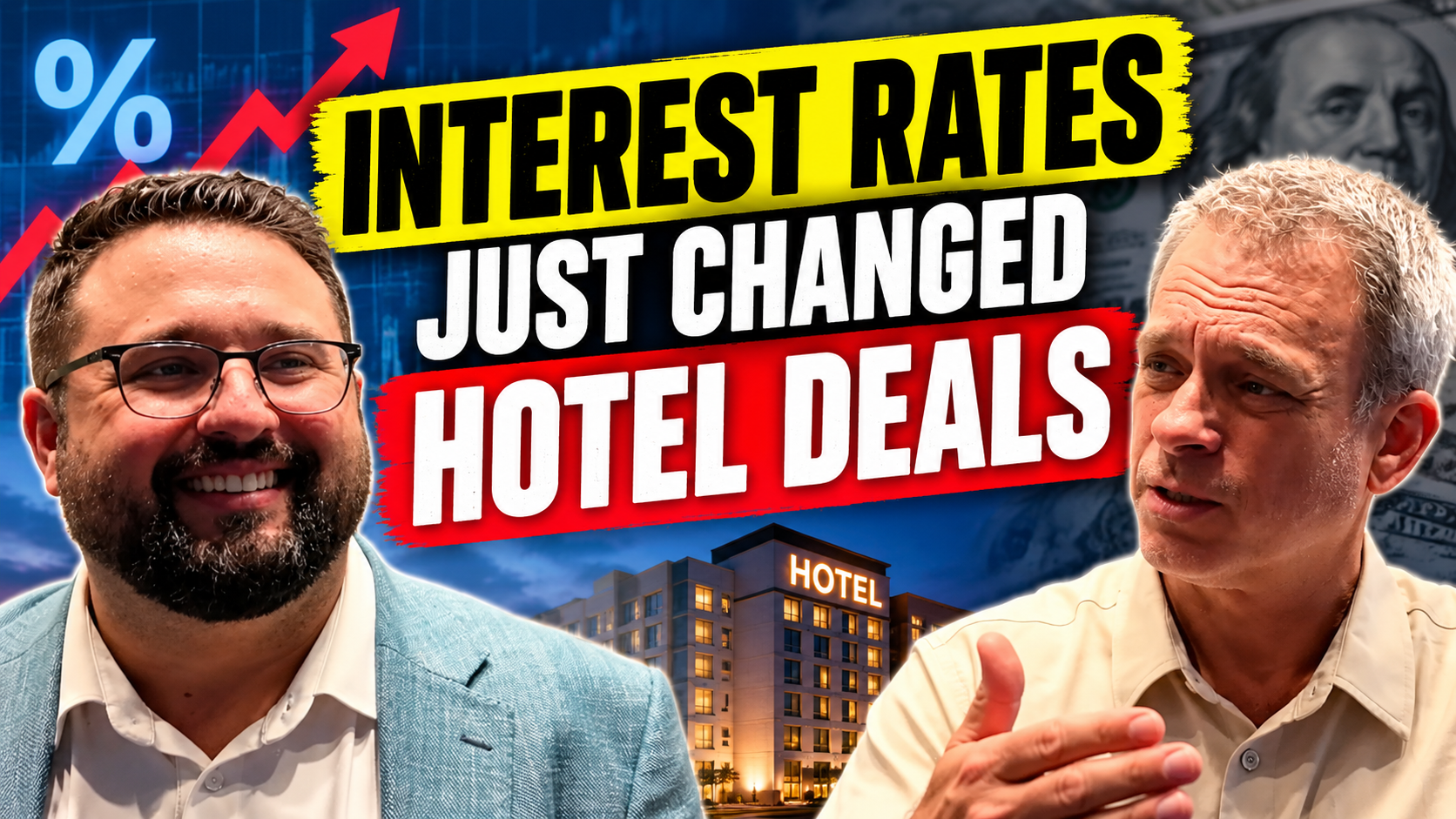
Ryan Bosch of Arriba Capital joined me at The Lodging Conference to talk through one of the toughest parts of the hotel investment market right now: the numbers keep moving faster than the deals.
Treasury yields jumped more than 100 basis points, refinancing got more expensive and buyers started reworking assumptions almost overnight. Ryan explains why that could slow acquisitions, push some owners toward a sale and put more pressure on hotel values as the market adjusts.
At the same time, there’s still plenty of debt capital looking for a home, which creates a very different dynamic than you’d expect in a higher-rate environment.
That tension between expensive money and available capital is where the #HotelInvestment story gets interesting.
Thanks so much to Actabl for supporting this podcast. Actabl gives you the power to profit. Visit Actabl.com.
Want the weekly roundup of news, videos, and what you might’ve missed from #NoVacancyNews? Text HOTEL to 66866.
Transcript
Glenn: [00:00:00] Hey, everybody. It’s your hospitality friend Glenn, here at the lodging conference where I found my friend Ryan Bosch of Arriba Capital. But before we learn what’s happening out there with those interest rates, you know it. You know you want to know. I want to thank our friends over at Actabl. Actabl, they give you the power to profit. Do me a favor, check them out at actabl.com. All right. So big question. What’s going on? What’s new, what’s different since we last spoke?
Ryan: [00:00:22] All right. I’m trying to think of the last time we spoke.
Glenn: [00:00:24] Don’t don’t even bother. I think it was Hunter. Maybe it was at NYU. I don’t know what’s been. Let me rephrase that. How about the last few months? What’s been going on?
Ryan: [00:00:31] All right, so the last few months, we’ve seen treasuries explode over 100 basis points higher, right? So higher interest rate environment how that translates. Right. I think this morning I looked it was 5.36 last I looked. And you look at that. That’s your risk free rate. So you could go park your money in treasuries at 5.36. Right. Versus hotels at an eight cap. That math starts getting hard. So you know what’s going to happen over the next couple of months. We see acquisitions you know quieting down a little bit until I think people see where this ends up, where rates shake out. And then at the same time, you’ve got a very flush debt market right now. That’s what everyone’s been talking about for the last couple of years. That’s what we’re seeing on our side. It’s going to get tougher for them to put out that capital. So hopefully the silver lining is we see a little bit of spread compression while these rates stay elevated.
Glenn: [00:01:20] Now like I feel like I understand what all of that meant, but let’s see if I actually do understand what all that meant. The one thing that I don’t really get is how do like treasury bonds and stuff like that. And I understand that there are like over 5%. And I also heard and understand that last time it was like, this was very much pre-great recession and all that stuff. But how does that directly tethered to interest rates, how does that work? I thought it was more like the fed says, hey, we’re going up or going down, and then everybody adjusts accordingly by X percent.
Ryan: [00:01:49] So you’ve got two two key benchmarks to watch, right on floating rate debt. You watch what the Fed’s doing directly correlates to sofr on fixed rate debt, which is what you see prevalent in permanent financing for stable.
Glenn: [00:02:01] Like what I did for my mortgage at home.
Ryan: [00:02:03] Exactly. That typically ties a spread above a treasury, and that’s where it fixes at the time of closing. So most bank financing that we see in the market right now, CMBS financing, all correlates to those treasuries more than they do off of Sofr. And again, 100 basis points in the last month that that went up.
Glenn: [00:02:22] So and that’s just kind of like changes everybody’s attitude whether or not they’re going to want to do deals. Because something that might have been profitable in August isn’t the same. Today particularly is set against the uncertainty with fuel prices and everyday supplies, of course.
Ryan: [00:02:38] And but then the other side of that also is you also have a lot of hotels that are, you know, going up for a refinance, right? That math just got harder. So we might see some more properties hit the market. Because of that, refinancing gets more challenging. They decide now’s the time to sell versus refinance.
Glenn: [00:02:54] Yeah, that makes a lot of sense. And so what we’re really saying is it’s not a one size fits all scenario. It depends where you are with the property, what your the life cycle is of what you think that investment is going to be, and a lot of fundamental factors that kind of play into it. So I think what I hear you saying is that generally speaking, while the market seems to be tougher on one level, there’s another layer of people that will probably be forced to make some decisions that will keep the market moving.
Ryan: [00:03:20] Exactly. And I think that’s the silver lining if you’re looking at it from the outside.
Glenn: [00:03:24] All right. So last thing I have to ask you. Everybody talks about interest rates, interest rates, interest rates. It gets very tiring that I say this over and over again. But the one thing I say is before the Great Recession, interest rates were so much higher to begin with. How does that play into the attitude of investors today? And the whole concept of we’ve changed a generation of people to expect something cheaper, and things are just different now.
Ryan: [00:03:46] Well, look, I think that interest rates also affect value, right? If you’re looking at how much money can I make off of a property, what you’re paying in debt service is a factor in that. So, you know, when interest rates were much higher, historically property values were much lower. Now we’re at this point where it’s like, where’s the gear? Right? If the same yield isn’t there on an asset that I would have bought a year ago than it is today, is it worth the same price? Right. And I think that’s the part that takes time to work its way through the market.
Glenn: [00:04:13] Fascinating. Well, thank you for educating me and educating all of you. Hopefully out there, a lot of this stuff is a little bit more complicated. And I got to be honest with you, I’ve been in this business 30 years and I still don’t understand it because if I was, I’d be down there on the floor making deals instead of talking to him about deals. Anyway, check out our friends over to read The Capital. I’m Glenn. He’s Ryan. Thanks so much for watching. We’ll see you next time.

More Episodes
-
October 5, 2026
How Hotel Leaders Build Relationships at The Lodging Conference
-
October 3, 2026
Red Roof’s Growth Strategy as Economy Hotels Gain Ground
-
October 2, 2026
Hotel Marinas Turn Boat Traffic Into Revenue
-
October 1, 2026
Hotel Staffing: The Talent Pool Hotels Keep Overlooking



Subscribe