
November 12, 2026
Hotel Financing in 2026: Why Borrowing at 7.5% Beats Raising Equity
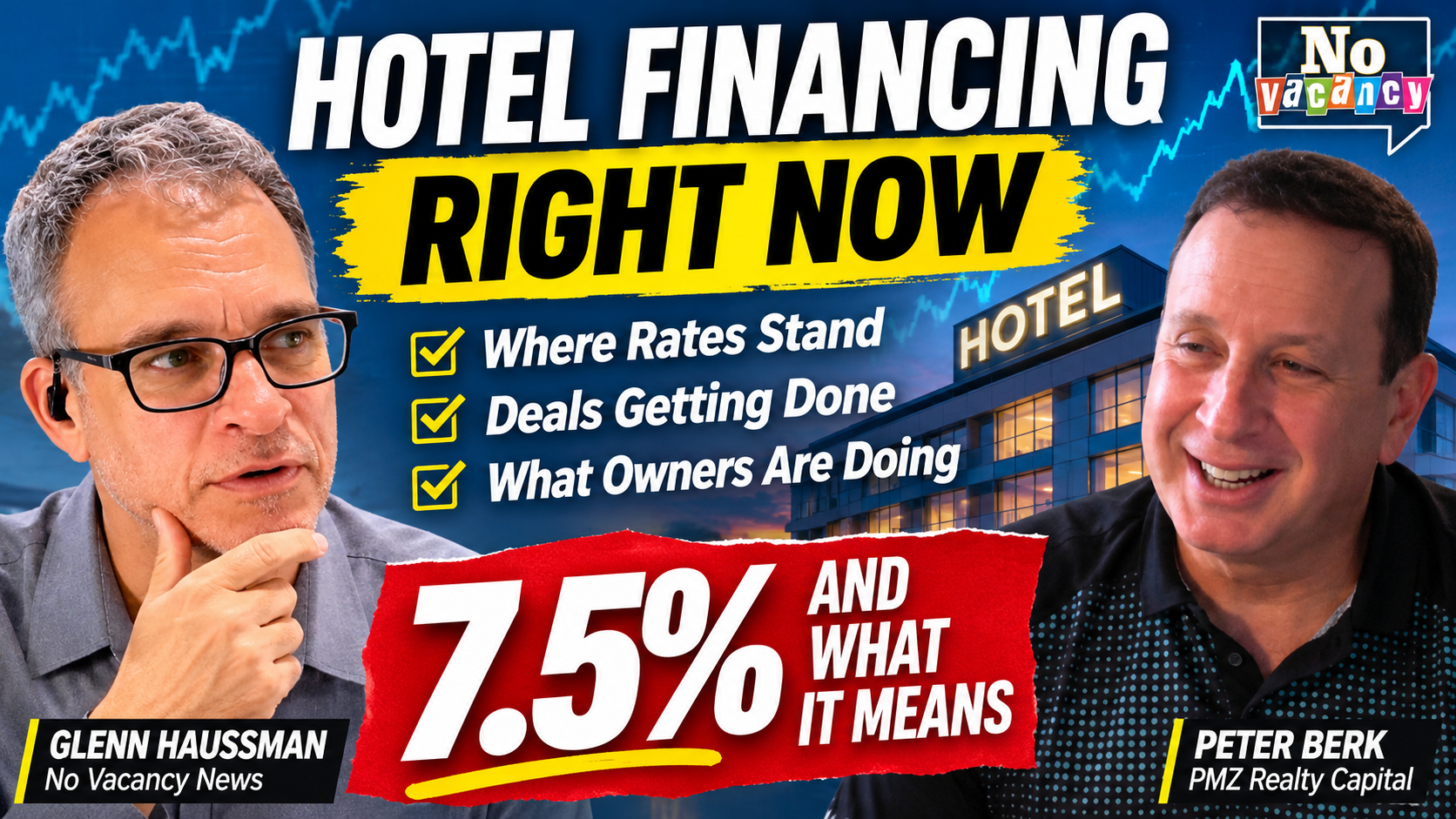
Hotel brands want PIPs done now, and many hotel owners don’t have the cash to pay for the renovations. Peter Berk, president and CEO of PMZ Realty Capital, tells Glenn Haussman of No Vacancy News how owners finance a PIP and keep their flag with a five-year, interest-only hotel loan around 7.5% that allows a cash-out.
Glenn and Peter recorded this on November 11, 2026, the same morning an inflation report pushed the 10-year Treasury up 20 basis points, so the numbers show where hotel lending and interest rates stand heading into 2027. Peter explains when owners should choose floating-rate debt instead, why a cash-out loan beats mid-teens equity from investors, and why some hotel owners refuse any loan with recourse.
Chapters
00:00 Where hotel capital markets stand
00:51 Why headlines move hotel loan rates
02:13 Today’s hotel loan rates
03:45 Who uses the five-year interest-only loan
04:35 Hotel brands lose patience on PIPs
05:00 Cash-out loans as cheaper equity
06:27 Floating-rate loans and recourse
08:16 How today compares to 30 years of hotel lending
10:29 What it takes to close a hotel loan
11:02 How to reach PMZ Realty Capital
Thanks so much to Actabl for supporting this podcast. Actabl gives you the power to profit. Visit Actabl.com.
Want the weekly roundup of news, videos, and what you might’ve missed from #NoVacancyNews? Text HOTEL to 66866.
#HotelFinance #HotelInvestment #HotelLoans #PIP #Hospitality
Transcript
Glenn: [00:00:01] Hey, everybody. It’s your hospitality friend, Glenn. Thank you so much for tuning in, which I think is going to be a really valuable episode of No Vacancy today, because I’m going to be talking about the capital markets, what’s going on real quick. So you get an understanding before we go into the holiday season of where we are at today. In order to do that, I got to thank our friends over at Actabl Actabl. They give you the power to profit. Please check them out and request a meeting. You know that they’re going to help save you money. Let them do that for you. All right? Right now I got our friend Peter Berk, president and CEO of PMZ Realty Capital, joining us, Peter. Been too long since I’ve had you on. So I’m writing to you. I think it was at the lodging conference. You’re like, look, we gotta talk. We gotta talk. And I’m like, you know what, Peter? We do have to talk because I have no idea where we are today with what’s going on. So I’m going to let you take it away. What are owners thinking? What are you thinking?
Peter: [00:00:51] Okay, Glenn, I think first of all, thank you for having me on. I watch all of your podcasts. Hey, thanks. Last time we spoke, I think it was about 3 or 4 years ago.
Glenn: [00:01:00] Too long ago on air.
Peter: [00:01:01] I told. And I told you interest rates were three and a half to 4.5% at ten year deals. And And here we are. Fast forward to the end of 2026. And there’s been a lot of volatility in the capital markets, a lot of event driven stuff. So the markets bounce around a lot more than they used to. Used to be able to tell people, oh, you know, rates are whatever they were at the time, 4.5%. And that kind of is where they were. But now with everything, it’s a lot of headliners. So what most people want to know is where rates are today, where deals are getting done.
Glenn: [00:01:43] Yeah, totally. We’re going to let me ask you some questions around that. So what you’re saying is there’s some volatility out there. So that’s kind of that’s kind of messing with people. Usually it used to be like we’ll just see what’s in store with the election. Then we’ll make a decision or some other one thing. But now it’s like every single day we’re getting boom, boom, boom, boom boom. There’s a lack of confidence going in. So how does that affect where interest rates are and where are interest rates today?
Peter: [00:02:13] Right. And even though I mean this is being recorded on November 11th, and there was an inflation report that came out this morning and it wasn’t favorable. And the ten year Treasury went up 20 basis points. So that was my conversation as of this morning is different than a conversation I would have had yesterday. But to answer your question right now, rates in our most popular loan product is in five year interest only loan. The rates around 7.5%. But that rate floats between now and when we close. So the rate could be a little higher or a little lower. But the rate is locked when we close. It’s an interest only product. Five years PA no lender points. And it allows for a cash app. That loan product probably accounts for about 50% of our business. Rest of it being floating rate money. And if you’re not sure where rates are going to go, floating rate money, you know, is what you’re probably want to do. The problem with floating rate money is it generally doesn’t allow for a cash out. And it’s generally priced higher than fixed rate money. So you can get floating rate money at something like 400 over Sofr, which is around eight, eight, 8.5%. But then when. So that resets every 30 days. So and sofr goes up or down. So does your rate.
Glenn: [00:03:45] Yeah. Right. That’s that’s complicated. So that first loan that you’re talking about five year interest only, what are people getting into that for. Is it is it for new construction. Is it for refinancing. Is it for maybe they’re going to buy property and convert it. What how’s that work generally.
Peter: [00:04:01] Generally not for new construction. New construction is almost always floating rate money. It’s for acquisition loans, and a lot of it’s for refinancing with a Pip. So a lot of the brands, you know, have deferred Pip. So somebody comes to us and they have just to make an example of a deal. We just closed that million dollar loan, but they have a $3 million pip they need to do in order to keep their flag. They don’t have the money or they only have some of the money, but the hotel’s doing well. But nonetheless, the flag’s breathing down their neck to complete the pip or the flag.
Glenn: [00:04:35] So absolutely, let me just give the listeners, the viewers, a quick history lesson. During Covid, the brands were really awesome. They pulled back on a lot of the Pip requirements because there was just no money to get it done. But now we’re at a, we’re at a point if you don’t have a hotel that’s in great condition, not only are you unable to push rates, you’re unable to really book those rooms, and the brands need them to be in a certain shape. So that’s where we are today. Peter, please continue.
Peter: [00:05:00] Yeah, that’s where we are today. The brands have lost patience. And as I alluded to, you know, during Covid it was patience because the hotels were making money. Now the hotels are making money. I mean, there’s a lot of other discussions that aren’t part of this about brand creep and expense creep, creep and all that type of stuff. But if you’re in the hotel business, you need to keep your hotel in tip top shape if you want one of the brands, because you know, that’s where the that’s where the value is for the hotel and. Right. And, you know, the brands are very concerned. So that’s, that’s probably the number one reason somebody would use that five year product in order to pull out money for for another reason is if they want to start a new project and they just need a cash out loan, they pull out that same example. Maybe they don’t need to do a Pip or a much smaller, but they pull out a couple of million dollars, $3 million, 4 million, whatever the hotel figures to. And they use that as their equity for their next project. And that equity, of course, they have to pay it back in 7.5% is the cheapest equity you can get, borrowing money from friends and family or other sources. Nobody’s giving equity money at 7.5%. That’s usually mid-teens money. So that’s another wow that they use it.
Glenn: [00:06:16] So yeah, go on please.
Peter: [00:06:18] Let’s just finish with the flooding rate.
Glenn: [00:06:19] Yeah. Please. I’m learning a lot here. Peter and I don’t know, I don’t know when to stop talking because I don’t know anything about this. You know? And you’re gonna stop talking to me. Go on. Please.
Peter: [00:06:27] Yeah. No, I just watched a YouTube video about this earlier. Hit me up myself. So the floating rate money is good for stuff like flag changes and closed hotels. So you buy a hotel, maybe it’s an economy brand that you’re going to convert into a midscale brand. We don’t know how it’s going to perform as a midscale brand. We have projections, right? Things like that. Maybe a feasibility study, but we really don’t know. So it’s hard to underwrite for a fixed rate loan, which generally looks back on past performance. So floating rate loan does that you, you you execute your Pip, you’re paying a higher rate, but once you get a good trailing 12, then you execute some sort of fixed rate product, whether it be CMBS, an insurance company, a bank, a credit union. There are lots of different sources we use for our fixed rate money, and a lot of that depends on people’s appetites for recourse. There are two types. You know, I’ve been doing this a long time. The two types of people with recourse, there’s clients who come to us and say, you know, show us some loan products from all the different sources of lenders, but we will only do a non-recourse loan. We do not want a recourse loan. None of our partners will do it. We won’t do it. And that’s a hard stop on that. Other clients say to us, give us a recourse loan. I’ll never walk away from my hotel. Offer a full recourse day one. And that’s another type of loan. And why people choose that is kind of a personal thing. I can never predict what they’ll do. But what recourse people and non recourse people and that kind of dictates in terms of what we’re doing in source lenders, who we speak to and what the loan will ultimately look like.
Glenn: [00:08:16] Okay. So Peter, you’ve been at this for more than 30 years, something like $10 billion plus in loans executed over that time. This period of history, how does it compare towards the other periods in your in your career? And where are we at using that point of view as a lens?
Peter: [00:08:36] Yeah, I mean, I think a lot of it now this particular time, let’s call it the last 12 to 18 months, the headline risk. And again, you know, things change so quickly depending on, you know, what happens with the with the war. The strait is oil going to flow? Is it not going to flow? You know, are we going to be in recession because the price of diesel is, you know, going to be $7 and it’s very event driven. And I think, like you said at the outset of this, of this call it just depends on, on what’s what’s going to happen. So, you know, we, there’s a constant dialogue we have to have with our clients and almost a disclaimer saying this is where we are today. I’m not smart enough to know what’s going to happen in 45 or 60 days. Read the news just like I do. But we’ll be with you. We’ll hold your hands. And then that also goes to our lender relationships. You know, look, it’s event driven for the lenders too. But the lenders make money by putting out loans if they.
Glenn: [00:09:38] Know you’re going to have.
Peter: [00:09:39] To, right? If they don’t make any loans, then they won’t make money and then they won’t have jobs. So we’re all kind of towing on the same war here and trying to figure this out as we go. But it changes a lot more than, you know, when I did this in the past. And I can say with confidence, this is exactly how the end product is going to turn out. You know, I can tell you exactly where it is today. And I tell you exactly what’s going to happen in 45 days, which is the typical time it takes to close a law now. But we’ll, we’ll, we’ll stay with you and we’ll work on it together.
Glenn: [00:10:13] Hey, listen, I think everybody out there understands the incredible volatility that’s happening. But I think if you’re going to do a deal, I mean, developers gotta develop, lenders have got a loan. And you know, guys like you have got to make it happen for them. So. Right.
Peter: [00:10:29] There’s a lot of other people involved in the loan process. There’s us who arrange financing, but there’s appraisers, there’s there’s lawyers there, environmental and engineering people. There’s title people. I mean, I kind of think of our job as an orchestra leader, right? There’s, there’s us, but then there’s so many other sources involved in closing a transaction that, you know, everybody has to work collaboratively to kind of get it done, you know, to, to get it, you know, the sausage to come out the other end so that everybody’s happy.
Glenn: [00:11:02] Yeah. For for sure, I like it. All right. I’m going to do, I’m just doing this because we want people to be able to find you. How can we learn more about PMS Capital. Peter.
Peter: [00:11:15] Oh, yeah.
Glenn: [00:11:16] Yeah. Promote yourself, baby. I’m giving you a shot.
Peter: [00:11:18] Yeah. Thank you very much. Yeah, well, I see you have our website there. Go to our website. You can see me. My my cell phone number is on there. Always happy to have a talk. Even if you’re looking at a deal, you’re not sure. You know, there’s no cost and obligation to, to have a conversation with us. You know, we’re happy to underwrite it. Give you some, some ideas for financing. You know, you let us know whether it works or doesn’t work. And, and we can take it from there. We’re headquartered in New York City, but we do deals all across the country. So happy to have a dialogue and see where we can go.
Glenn: [00:11:54] Yeah. So give him a ring. I’m not getting I’m not getting compensated for it. He’s just doing good stuff out there. Peter, thank you so much for being here. Thanks, guys. All of you, for being here today. Do me a favor. Give me a shout out, like, share, subscribe, all of that kind of good stuff. Thank you so much for being here. And we’ll see you right back here next time. In another episode of No Vacancy. Until then, see you.

More Episodes
-
November 12, 2026
Why Hotel Guests Who Try Mobile Keys Never Go Back
-
November 10, 2026
Staypineapple’s Plan to Cut OTAs Out of Hotel Bookings
-
November 6, 2026
Why More Women Aren’t Becoming Hotel General Managers
-
November 6, 2026
The Art of Turning Neglected Historic Buildings Into Extraordinary Hotels




Subscribe