
September 16, 2025
974: Why Every Business Needs a Hospitality Mindset
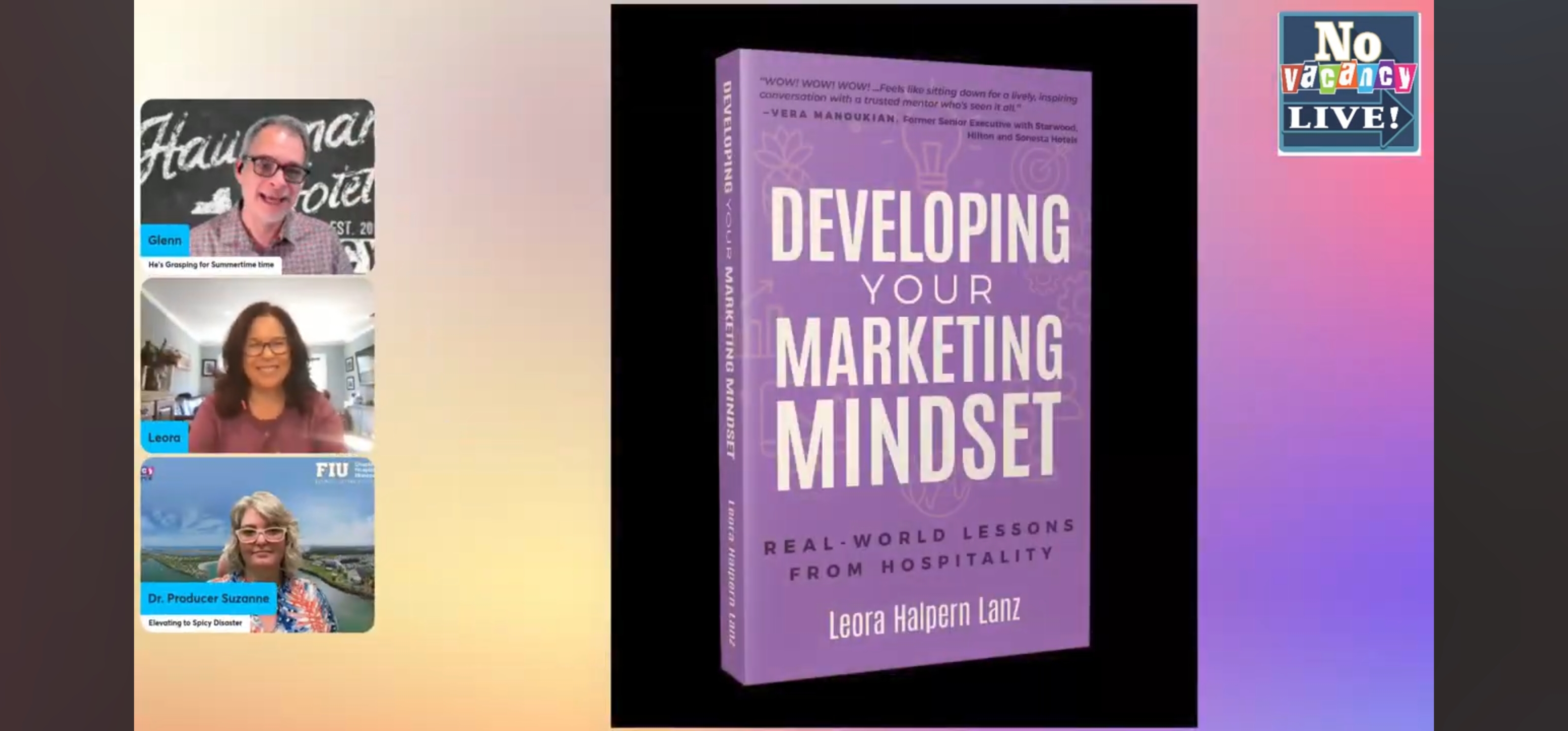
In this episode of No Vacancy Live, Glenn Haussman and Dr. Suzanne Bagnera welcome Leora Lanz—author of Developing Your Marketing Mindset: Real World Lessons from Hospitality.
Leora, who has spent more than a decade teaching at Boston University, shares why every business needs a marketing mindset—and why adopting a hospitality mindset is just as critical.
What we cover:
✔️ The difference between critical and strategic thinking
✔️ Why authenticity in #hospitality, sustainability, and wellness initiatives truly matters
✔️ How marketing with meaning builds loyalty and profitability
This book is packed with case studies, stories, and practical scorecards that every business leader should explore.
📘 Get the book: https://www.amazon.com/Developing-You…
🎥 Watch more episodes: www.NoVacancyNews.com
Special thanks to Actabl for supporting the show. Learn more at www.Actabl.com
Transcript
Glenn: [00:00:00] Everybody in hospitality. Friend. Glenn. Here. Listen, we already know Activel gives you the power to profit, but now they’re giving you more actionable insights to drive that profitability. Do me a favor. Take a moment and check out Hotel Datacom. You’re getting set for budget season, right? And this new benchmarking data is going to help compare your hotel’s performance for the rest of 2025 and into 2026. Please check out Hotel Datacom or the classic.com. Have a great day and enjoy the show! Hey everybody, welcome to No Vacancy Live. I’m Glenn Horseman. That’s the awesome, incredible doctor Suzanne Bagnara. You might know her doctor doctor producer Suzanne, although maybe she’s trying to be Doctor Suzanne. I don’t know, I’m just a I’m just a podcaster. How are you, Susie?
Suzanne: [00:00:48] I’m doing really good today, Glenn. It just I just.
Suzanne: [00:00:53] Is because I totally.
Glenn: [00:00:55] Lost my mind, you know?
Suzanne: [00:00:57] Hey, listen, you you clearly have. It was really funny the other day I was talking about somebody had started talking about podcasts and they’re like, oh, I listened to this one, and they started going, There’s No Vacancy live show. And they just started rolling with it. And I was like, yeah, have you ever heard this producer person, that doctor producer Suzanne, she’s like, yeah, yeah, yeah, yeah, yeah. I was like, well, that would be me. And they’re like, light bulb went off. It was awesome.
Suzanne: [00:01:20] That’s hysterical. I love.
Speaker4: [00:01:22] Doctor Seuss.
Suzanne: [00:01:23] Yeah. Oh.
Glenn: [00:01:26] All right. Theodore Geisel, are you ready to go on to our show? And I will tell you, Susie, as you can tell, I’m having trouble today. I need to lock in to a particular mindset, the marketing mindset. Because today we’re going to be talking to our friend Laura.
Suzanne: [00:01:45] Lamb for you.
Leora: [00:01:47] I see you and Glen. Awesome.
Suzanne: [00:01:52] I love it.
Glenn: [00:01:53] We are so great to see you. Hey true confessions I’ve known for a Long time, and I’m so excited for you that you have created developing your marketing mindset. Real world lessons from hospitality. This is going to be an awesome conversation. Sorry, I just screwed that up. Suzanne I’ll hit the right button over there. What a struggle. Today as Suzanne tries to control the show like she’s supposed to, and I continually mess things up for her. Well, then we won’t mess up or you won’t mess up out there as you’re marketing as we go towards thinking about 2026 because you you’re not written one but two different books over here on marketing. First of all, that’s insane. Second of all, I’m extremely impressed. Third of all, how the heck did you do it?
Leora: [00:02:46] Thank you and thank you and thank you. And Suzanne knows because we’ve worked together, I can be insane. So that’s not a surprise. I you know what? I’ve listened to you podcasting for all these years, Glenn, I know that you’ve been interrupted in the past by a certain co-host that you’ve had. So I’m going to interrupt to start this as well.
Glenn: [00:03:06] I love.
Suzanne: [00:03:07] It.
Glenn: [00:03:07] That makes me feel comfortable not being able to speak freely on my own.
Leora: [00:03:13] Well, you did allude to the fact we’ve known each other since we were like babies in school together. I think you were at Coleshill Interactive. Or maybe even. No.
Glenn: [00:03:22] No no, no. I think I was at Hotel Business Magazine in 1996. Yeah.
Leora: [00:03:28] Okay. So those were my Sheraton days. So we go way back.
Glenn: [00:03:34] I think we are because we are. Did public relations and stuff like that back in the day. I’m pretty sure you took me on a tour of the Sheraton New York or Manhattan, whichever was the bigger one after a renovation had. Yeah.
Suzanne: [00:03:49] Oh my gosh.
Leora: [00:03:50] Oh my gosh. Yes. So that was when we ITT Sheraton spent over $100 million dollars just in the New York properties. And yes, it was. You were hotel business. Good grief. That was a long time ago. Yeah. That’s how far back we go. But I did want to comment about the fact that we have championed each other all these years. We have been great friends, and I’m so grateful for your friendship. And it helps that we happen to be in neighboring towns on Long Island. Oh, that helps a lot. Because we at least get our annual lunches in person together. So that’s a that’s a big deal. And I’m going to have one more interruption before we get into my marketing mindset.
Speaker6: [00:04:36] I love it.
Leora: [00:04:39] A few weeks ago, a few months actually, with about a month ago, I was going through some difficult stuff. And you, my friends, were my alarm clock. You were my wake up call. You woke me up to just sort of handling things. I thank you for your friendship.
Glenn: [00:04:55] Sure. Well, thank you for being an awesome friend and an awesome human being. And the best part is we are at this point in our careers, we’re really about giving back, helping people that are younger than us or in similar positions as us ultimately find their excess. That’s why you know, my mantra here is educate, empower, entertain. Because all of us together can be more successful. And one of the issues, honestly, that I’m seeing out there, there is it’s really complicated to develop that marketing mindset right now because things are changing so rapidly. So I’d like to go back to you talking a little bit about the book. How are you addressing marketing in general, and how are you thinking about getting people into that right mindset to find opportunities to be to be more efficient and effective with their marketing?
Leora: [00:05:45] There’s a lot to unpack there, so I’ll start.
Glenn: [00:05:48] If it’s okay to ask one question, I’d have to talk for the rest of the show.
Leora: [00:05:51] Oh, good. That’s that.
Speaker6: [00:05:52] Makes me.
Glenn: [00:05:53] Scared today. I mean, what is it, September 15th as we’re running this. So I’m getting ready for my fall malaise, so I’m building up to that.
Leora: [00:06:00] Fair enough, fair enough. I started to write this selfishly. Yes, I’m an education. Yes, it’s one of probably the most rewarding role I’ve ever had professionally, because I am watching these students who want to be in our industry and aspiring to university.
Glenn: [00:06:18] You should go there or go to FIU.
Leora: [00:06:21] Yes, yes, both amazing programs and hospitality education. We I can’t say strong enough words about the power of hospitality, education and the power and the amazing folks who are in the classrooms inspiring young people to want to be in the business that we love so much. And Suzanne knows what I’m talking about. So I my opportunity at Boston University was a happy accident that was not on my professional trajectory to be in a classroom, but being in a classroom all these years has really been And enlightening and rewarding and satisfying. And it’s been a dream because I’m now in touch with students who I taught ten, 11 years ago. They’re professionals in the industry. I consider them kids now. It’s the best feeling in the world.
Glenn: [00:07:13] And after I did teaching at NYU for all those years, and I just saw somebody, an event that I was at recently, he’s like, do you remember me? And I’m like I’m like, oh my God, it was so awesome.
Suzanne: [00:07:26] I’m a light bulb moment and take some time for a hot minute. They’ve changed their hair color and they’ve grown up and I’ve.
Leora: [00:07:32] Changed my hair.
Glenn: [00:07:32] Color. Like that guy, that’s for sure.
Leora: [00:07:34] You know what’s even what’s really great is when you get a text or an email from one of these young professionals now who says, I remember something from class because you’ll never believe what happened today. And it made me think of this. That’s when you know it’s awesome. Or when I reached out to a former student recently and he said, oh, I’m going to pull out my notebook. And I just fell off my chair. I went, oh gosh, Lawrence, you have a notebook. Because I do, because you had some of the best lines in class. But actually that’s kind of how the book came about. So I’m someone who documents things. I’ve kept a journal since I was 13, so writing things down. Yeah, I if you I may not remember it, but I can.
Glenn: [00:08:17] I can’t believe what that boy did to you in the 10th grade.
Leora: [00:08:19] I’m just like, right. And it’s in my it’s in my journal. But I’ve documented things for a long time. And last year I celebrated ten years of teaching, which I never would have imagined, and I wanted to document. I’m going to start. Selfishly, I really wanted a personal souvenir of my ten years of teaching, and so I started to jot down what did I learn in teaching? I might be in the front of the classroom, but I learned a ton. Yeah. And then I started reaching out to many of these former students. So in this book, there’s at least 30 or 40 and they’re all acknowledged in here. Of my former students, both at Boston University and from France. I had the wonderful honor of teaching in France a year ago when I was on sabbatical. I taught at the Essec Business School in their hospitality program, which is phenomenal, by the way. Phenomenal program. And so I’ve got about 30 or 40 of the students, professionals now mentioned in this book. And I started to structure the book in a way that I thought was methodical. I’m a very structured person, and I realized there’s actually more here. This isn’t just a personal souvenir. This can actually teach something. This there’s lessons in here. There’s a lot of lessons in here. And I am hopeful that students will read it. But by the way, a student doesn’t have to be in a classroom. Everyone should be a student. We should all keep learning lire.
Glenn: [00:09:52] That is so essential. I gotta let Suzanne talk because I’m being a hog.
Suzanne: [00:09:56] I was going to say lifelong learning is critical. And that’s really where my passion has continued to thrive in taking and I don’t want to admit I think I’m going into year 24 of teaching. So I feel like now I’m going to have to do something for 25. I don’t know what it’s going to be, but are you up to start figuring it out right?
Glenn: [00:10:15] Yeah. All right. So let’s get let’s get real. Leora, you writing this book has now sent us both into extreme depression. We can’t.
Suzanne: [00:10:22] Oh, don’t.
Glenn: [00:10:23] Do you? Professionally. You’re starting to go bars too high.
Suzanne: [00:10:27] Read.
Leora: [00:10:27] Read the book and you will get out of that depression. Because when you when you hear the examples of the marketing, think from the former students or frankly, from my own experiences, or there are examples that are not just hospitality in here too, because I am hopeful. Yes, I’d love students of every age to read this. Yes, I think folks who are in hospitality will appreciate this because the examples are going to be so relevant and relatable and familiar, but I really hope that people in any service business who deals with people can take these examples that are familiar because they are, most of them are from hospitality and apply it to their business. I’d like to consider this a business book.
Glenn: [00:11:13] To be honest, I think that’s awesome. So naturally speaking, we should actually, now that we’re almost 11 minutes into this talk about talk about what? What is a really good, like, real life lesson shared in the book and some of the knowledge that goes behind that, that you’ve you’ve gleaned that’s really applicable to what people are facing today in their, in their marketing missions.
Leora: [00:11:37] Okay. So I’m actually concerned about the concept of critical thinking today.
Glenn: [00:11:43] Are you. It’s way beyond concern.
Leora: [00:11:46] Yeah. So so then I don’t have to argue to defend that point.
Glenn: [00:11:50] No, I will say everybody out there that this has been a this is an issue that’s out there. And I’ve said this a lot publicly. We tend to hear something and parrot it back and take that as sacrosanct without actually thinking about it. And we’re not focused enough on the speaker’s internalize motivations that might be shaping their language to go in a direction that’s not really advantageous to you finding success, but backs up what they’re trying to promote. So we are take it from there.
Leora: [00:12:21] That’s already a marketing mindset, Glenn, because the fact is we’ve got to conduct the yeah, you’ve got it. You may not think so, but you do. Everyone and everyone should have a marketing mindset. And by the way, every business should have a hospitality mindset that comes through in this book too. But I talk about critical thinking and strategic thinking, and I share what the differences are. Critical thinking, to your point is, how do we analyze the situation, not just take it at face value? Strategic thinking is how do we plan ahead and plan for the future so it becomes part of the DNA. Always remember the hospitality. So that’s definitely a message in here. But then I try to take it a step further. And what I impress upon folks through this book, at least I hope so. I’m doing it in my classrooms. If we connect to audiences with messages of wellness, sustainability or community, wellness, sustainability or community, we will connect more meaningfully. And it is better for business, which will result in more profit. And the good news is the data is there to back that up.
Glenn: [00:13:32] Yeah, I agree with you, Liora. I think that the biggest issue that we’re facing right now is that we’ve convinced ourselves that stripping the humanity out of hospitality is something that the public is searching for when the opposite, I think in reality is true, is finding ways to bring us closer to the customer in order to get them to want to willfully spend with us in a more robust way than they would have otherwise.
Leora: [00:14:01] Absolutely. And I use wellness and sustainability and community. I don’t want to say use. I really believe that these three issues are important to all of us in everything we do. So if we’re trying to promote the gym at the hotel, and I’m using that example because it’s pretty fresh in my mind. If we’re trying to promote, we want people to use the gym in our hotel. We just renovated this gym, spent all this money. How come our guest satisfaction scores aren’t going up in this gym, for example? But if if we’re not communicating about it, and if we’re not authentically and genuinely sharing that we care about your wellness, why on earth would I be thinking about your gym? Unless I made a point of going there for that gym specifically. But if I didn’t know about it there, and I’m using Boston as an example because Boston, the landscape of hospitality in Boston is the classroom that’s basically our classroom, and there are lots of hotels that have certifications and credentials because they’re doing well. All these initiatives for eco friendliness and sustainability, which is marvelous. But if no one knows about it, what what are we doing? And the truth is, I had asked the former CEO of Panera Brands years ago, when you do all this philanthropic work for your company, is it exploitation? When you brag about it, you’re marketing what you’re doing. Are you exploiting that? Like, is that actually a good thing to do? And his answer was smart. If we don’t tell anyone about it, how do we get more loyal customers to encourage us to do more of this?
Glenn: [00:15:44] That’s interesting.
Leora: [00:15:45] And when you read McKinsey reports and BCG reports, which I have some of that data, people want to be informed. They want to know that you’re doing good. They will be more brand loyal, and they will be more willing to spend more money with you when they know about it.
Glenn: [00:16:02] I agree, but I think that it’s got to be done in a way that’s harmonious with the universe, because every Christmas season you see brands bragging about all the money they’re giving away, and then it’s in the fine print at the bottom where it says up to a ridiculously low number for a corporation that’s worth hundreds of billions of dollars, up to $100,000. You spent more on the ad bragging about how you’re helping people and actually helping people. So I’m skeptical when I see stuff that like that. So how do we transmit that message without me going, yeah, you’re only doing that to try to trick me.
Leora: [00:16:45] I think the key is how do we incorporate that messaging into the brand DNA so that it is genuine, not just this one hit wonder. So, for example, the reason there’s two books, I’m going to cut to that for a second, because this is mentioned in the second book, which is coming out in February. But I guess I wrote a lot. And the publisher, the publisher said, this is really good, but you really better make this two books. And so this is about developing the marketing mindset, whereas the follow up companion book is about putting that mindset into motion. So, Glenn, to your point now, one of the things I talk about in the follow up book is internal communication should come before external communication. A lot of companies don’t get that right. And if that commitment to philanthropy or charity is truly genuine, it’s got to be embedded within the culture of the associates and the team members who are working there, so that they can generate the pride and tell that to the other stakeholders or guests or diners or patrons or customers. So it can’t be just this one time thing. That to me is like a gimmick. That’s a one hit wonder. But when it’s actually embedded into the DNA and becomes strategic. Right. The difference between critical thinking and strategic thinking. Then it’s authentic. And that’s what people want to work with. We don’t want to wellness wash. We don’t want to green wash. Right. To the skeptics like you mentioned, it needs to be done genuinely, which means it needs to start from within. And this way it can be generated outward.
Glenn: [00:18:30] So what you really need to do then, I think what you’re saying is you need to use critical thinking in order to understand truly what your brand is. Then make sure that you are insanely authentic in expressing that brand, and then you’ve earned the right to be able to share that sort of stuff. Because I know consumers can see through stuff that’s not authentic, and that’s why that smacks me in the wrong way. So I think the larger issue here is whenever you’re thinking about your marketing mindset, authenticity is really the key to making that emotional connection with your potential customer.
Leora: [00:19:05] Bingo. Yeah, it’s got to.
Speaker4: [00:19:07] Be a good student.
Speaker7: [00:19:09] Yeah. Yeah.
Speaker8: [00:19:11] That’s all you are. I mean, before.
Glenn: [00:19:13] Walking into this interview. So thank you for teaching me.
Leora: [00:19:17] I think you’ve nailed it on the head. You know, I the examples that are used in here, for those of us who are in hospitality, they’re probably pretty simplistic. But I know I’ve had numerous friends in the industry at all varying levels of organizations. Pre-read the book to be able for everyone to say, oh gosh, it made me remember this, or oh, I needed to remember that. That to me, is where I want this to be a useful tool for the readers and not just the author’s personal.
Speaker7: [00:19:46] So let me, let me do.
Glenn: [00:19:49] Let me guess. And you on that one, even though it seems obvious to you and me, the act of it being written down and people reading it, it validates what they may have been doing. And I think it helps. It really helps move it along. And whenever I see keynote speakers and stuff, I’m like, whenever they say stuff, yeah, I know, I know, I know, but the point is, it tells us that we already know, and it’s giving us the power to get a level ahead that we didn’t realize we were at. So I’m glad that you put that stuff in there.
Leora: [00:20:18] Thank you. I really hope it does do that for folks. And the signs so far are pretty good that it did. And I think everyone who’s read it so far has taken away very different things from it, which actually is what makes me really happy. So I’m proud of it. This was a labor of love. This was two years in the making. It’s I’m proud of it. I’m so proud of the students. I’m so proud that I’m in the role that I’m in. I never would have imagined this years ago to be in front of a classroom. It helps that I’ve continued with my consulting all these years. Since my HBS days, I’ve continued with the consulting so that what I’m teaching is also pretty relevant because I’m also doing it. It helps that the way we’re teaching is in real time. The one of my courses is called Experiential Marketing. This is a real experience for these students. So these are pretty relevant examples. And in fairness to folks who may not be in traditional hospitality businesses, I also have, you know, examples here from the Amazons or the other big companies that we’re all familiar with to, to also just sort of step outside of our hospitality box and learn from other businesses, because isn’t that something we should do as part of our critical thinking anyway? So yeah, I’m really proud of it.
Leora: [00:21:40] One thing I did do, Glenn, which thanks to my publisher for this advice there’s a scorecard in here. So every couple of chapters, there’s a way to have the reader measure. What did you get out of this? Did you actually shift your mindset along the way? And then as you get toward the conclusion, you’ve got the full scorecard presented to us so that the readers can actually hopefully make this a practical tool to be very useful and not just one thing I tried to make sure I did not do was be preachy. I really wanted to tell stories in here. These mini marketing examples were fun. They were fun to remember and recall. As I said, I document everything. I still have these marketing plans from 11 years ago, so I had all the tools to be able to reference. But I’m hopeful that the scorecard, which concludes every few chapters, is helpful tool for the reader. And I also have prompts at the end of each chapter. I think I call it Mindset in Motion. So I’m asking you, the reader, some questions based on what I just shared. How does this apply to you and your business and how this apply to you personally. Because, by the way, if we’re not marketing our business, we are always marketing ourselves. So it can be applied personally as well as professionally.
Suzanne: [00:23:03] So I’ve got a question for you. You mentioned that you’ve come upon ten years, and between your journaling and your time in the classroom, you have a very experiential way in which you experience marketing with the students. That really helped craft. I believe I could be wrong, but a portion of the journey to what this experience is in this book. So maybe give our listeners and viewers a little bit of a snippet of understanding as to what the classroom experience is like, that you help infuse with industry and your consulting and giving the students that real world case experience.
Leora: [00:23:42] Okay. Thanks, Suzanne, for asking. I work in the greatest city of Boston. It’s just got such a great hospitality scene. And as I mentioned before, the city is our campus. The city is our canvas. And I have I reach out every semester to various hospitality businesses. It could be a hotel, it could be a restaurant, it could be an attraction. It could be a travel agency of some sort. It could be an association. It could be a festival. It’s all part of tourism, hospitality and tourism. And it’s a win win. If they can get a nugget of a great marketing idea from a team of students, it’s wonderful. The team of students get real world experience and the opportunity to not only work with a client, but to actually present professionally at the end of the semester, which is probably one of the most terrifying moments of their four years at Bu, to be honest with you. Which is why.
Speaker7: [00:24:41] I can imagine.
Glenn: [00:24:42] I was terrified to do the podcast today. I can’t imagine what.
Speaker7: [00:24:44] They were doing.
Leora: [00:24:44] Oh, don’t feel that way. Don’t feel that way.
Leora: [00:24:48] It’s it’s we practice. I mean, we rehearse in class because I believe in practice. I mean, we all have to practice for everything we do. If we don’t, then we’re not taking things seriously enough. But we start with critical think. We start with analyzing the situation. We start with conducting primary research and secondary research. We go into the strategic think. We take a look at who are those personas, who are our target markets, how do they get their information? What do they want to hear? And today I’m always using sustainability, wellness or community as the messaging to connect regardless of what the business is. And that’s what I would challenge any business person or executive or entrepreneur who reads the book. How can you connect to wellness or sustainability or community to service that in your messaging, to really authentically connect? And if you feel that you’re not doing enough in a certain area, then use marketing to boost you to do a little bit more. But the process we strategically think we create, the personas that students come up with phenomenal ideas, we test it in class, have all kinds of case studies, my friends in the industry, and for those listeners of the show, many of them I’ve known for many years as well you’ve all been incredible sources of information. This is such a great industry because everybody’s so willing to share and to encourage young people.
Leora: [00:26:20] And then we rehearse these presentations at the conclusion and presented the conclusion of the semester. So usually the students come in pretty nervous, deliver it sweat for a few days, and then they realize a few days later, wow, wow, look what we did. That was really amazing. So the relief comes in right away. But then the realization of what they accomplished, that’s the beauty and what’s really rewarding, you know and Suzanne I know knows this too. I my favorite holiday is, is college graduation. My favorite holiday is BYU’s school of hospitality. Graduation because parents will come up to me and go I heard about the project that they did for Meet Boston or for the Peninsula, or for Bartaco, or for whoever it was. That was unbelievable. I wish I did something like that. And, you know, this is not an easy class. I have to be honest. It’s a ton of work. It is very stressful. But as I tell the students and I think you’ll feel it in my book, I’m about tough love in the classroom, I love kids, I love this, and I love the clients I work with too. I’m sometimes hard on them. Yeah. And and but if we don’t get pushed right, we don’t. We don’t climb these mountains. If we don’t get pushed.
Glenn: [00:27:45] Yeah. That’s right. If you stay in your comfort zone, you are never going to really achieve The life is all about trying to get out of that, and there’s too much of people being okay with not being challenged. And if they’re challenged, then they feel like at a negative. I don’t understand that. But that’s why you’re a great professor, because you’re you’re pushing, you’re pushing, and you’re making people be better than they thought they could be. And that’s going to help them throughout their entire lives.
Leora: [00:28:14] Thank you for that. Thank you. And I you know, I know a lot of the folks who listen to this show are in the real estate world and in the hospitality investment world. And for anybody who might be thinking marketing book, what does that have to do with me? I just want to say, I have been asked more than once over the years to speak to groups of real estate developers in different countries also, and I always tell them, please develop responsibly. Please don’t just go in there To make that buck. Please go in there to do what’s right for that local community. And that’s where the meaning comes in. That’s what I call conscious marketing or responsible hospitality. Marketing with meaning? Yes. As a developer, you may not be thinking about marketing, but I want you to. You need to have the marketing mindset to know how you can do good for the local community where you are building and developing. And so I just really wanted to share that for those folks who listen to your program, great marketing is important.
Glenn: [00:29:21] And let me jump in there. It goes back to the selfish mindset. I actually try to promote that. Not selfish in the way that we commonly think of it, but if you get a little bit selfish and you want to be successful, you listen to what Laura is saying. You will be more successful and make more money by better connecting with that community and wellness. Et cetera, et cetera, et cetera. So there is a way to do for yourself that also happens to help others and extra does for yourself. It’s just that you need to be open minded in order to figure out how to be selfish in the right way, to find success instead of the wrong way that takes away from everyone.
Leora: [00:30:03] What he said?
Speaker7: [00:30:04] Yeah, yeah.
Glenn: [00:30:06] Suzanne, we’re nearing the end, but we got to hear some great, some great wisdom from you to to wrap this up. Any more thoughts or questions?
Suzanne: [00:30:13] Listen, I think having had the pleasure of working with Liora for many years, she has brought that industry experience and consulting mentality to drive what we would consider an academics to be a capstone experience. And as she self admits, her class is not easy. But classes that are great and transformative are not meant to be easy. They are meant to challenge you, push you, make you grow, and then for years later, continue to reflect on the fact that you’ve had that experience. And that’s what I have seen firsthand, that there has been able to make happen and to be able to then chronicle, realize or I don’t know what the right word is because I.
Speaker7: [00:31:01] Believe.
Suzanne: [00:31:02] I’m in it.
Speaker7: [00:31:03] It was yeah.
Leora: [00:31:05] That’s my long journal.
Speaker4: [00:31:07] To to.
Suzanne: [00:31:08] Put that into something that can be a meaningful tool for not just a classroom, as a textbook, as a reading source to look at for even more rich case studies. But for those that don’t have the opportunity to take her class, but to really start to shift that mindset, it’s really exciting to be able to see this culmination come together. So I am very excited for you, and I’m very proud of you that you were able to persevere this way and make something so meaningful happen, my friend.
Speaker7: [00:31:39] Yeah for sure.
Glenn: [00:31:41] I’m a big believer that nothing worthwhile in life is easy. Except apparently one thing that’s getting there is this QR code right here. Do it right now. I’m telling you, do it right now and get yourself developing your marketing mindset. Real world lessons from hospitality. There’s that QR code again for you. No excuses. Make sure you get it. Laura, thank you so much for for being here with us today. This is really, really.
Leora: [00:32:08] First of all, for me to do this with you is a joy. And then to see Suzanne pop up on the screen. Wow. Double the trouble in one morning. That’s awesome. But I hope readers have as much fun reading through these stories and mini marketing case studies as I did putting this together.
Glenn: [00:32:24] So awesome! Well, you are the best!
Speaker7: [00:32:27] Thanks so much for being here. Thank you. Thank you both.
Glenn: [00:32:31] Bye bye. Suzanne, that was really fun today.
Speaker7: [00:32:35] Yes.
Suzanne: [00:32:36] And just think that, like, you get the opportunity to live near Laura. I’ve had the pleasure of working with her, but this is the one person I can say who’s actually had a longer commute in their life than I have. You know, like three hour one ways is nothing to like. Whereas, I don’t know. Is it like four?
Glenn: [00:32:59] Well, let’s.
Speaker7: [00:33:00] Well.
Glenn: [00:33:01] We’re going to make a special exemption. We are. How how long is that that drive for you?
Leora: [00:33:07] Yes. I commute New York to Boston, but I have to say, and I’ve been doing this for a long time, the professor that I studied and who shifted my career in college commuted from Orlando, Florida, to Ithaca, New York. And I always yeah, I thought that was crazy. And but he inspired me, and I took a turn. I my shifted my career trajectory because of this man. He shifted my mindset. He taught hospitality marketing. And I remember when this opportunity at Boston University came up and they said, we know you live in Long Island, but could you come to Boston? Truth is, I’ve always loved Boston. I did my graduate work at Bu, but I thought if Peter could inspire me and he did this commute from Orlando to Ithaca, I can do New York to Boston. So. And you know what? With the students who I who I’m with worth it.
Glenn: [00:34:02] All right. So now now you’ve opened up a Pandora’s box. I also gotta give kudos to Peter. Yes. Which that guy was a speaker that commanded the stage. And that really inspired me. And he’s one of the few people that really said to me without him saying it to me, you can do this. This is something that you will love doing. So he was also, I should say, on stage at a time when I, I went outside because my wife called me and I went outside and I came back in and everyone’s like what’s going on? Why do you look so horrible? I said, I’m having twins, and.
Speaker7: [00:34:43] Peter.
Glenn: [00:34:44] Was on stage.
Speaker7: [00:34:46] You want a presentation right.
Glenn: [00:34:48] At that moment. So I’ll.
Speaker7: [00:34:49] Always.
Glenn: [00:34:50] I’ll always remember that from about 22 years ago.
Speaker7: [00:34:54] Yeah, yeah.
Leora: [00:34:54] Because your boys are in college.
Speaker7: [00:34:56] College now on. And as you’re.
Glenn: [00:34:58] Recording this my son just got to Japan for a semester abroad. So. Good for.
Speaker7: [00:35:03] You.
Leora: [00:35:03] You know, I reached I reached out to Peter yesterday two years ago when I started writing to say to him, you don’t know me from Adam, but I was in your class, and you inspired me. And I remembered who you are this entire time. And we have had an email exchange ever since. He has read my books, and he has kindly commented on book two that’s coming out. So you’ll see his his quotes in my in that book. So he is very meaningful to me even today.
Glenn: [00:35:32] Awesome. We are right now. We’re really kicking you out. We’ll see you. We’ll see you later and we’ll see you all later. And remember, you’ve got one life. So blaze on and.
Suzanne: [00:35:42] Follow.
Speaker9: [00:35:42] Your passion.
Glenn: [00:35:43] Be sure to subscribe. Blah blah blah. All that kind of stuff. See you later.

More Episodes
-
June 4, 2026
Hotel Owners Facing Tough Choice: PIP, Sell, or Switch Management
-
June 2, 2026
Red Roof Builds an AI-Driven Website: How It Wins Search Next
-
June 1, 2026
7 Seconds Behind the Bar Can Cost $1.1M: Fix These Profit Leaks
-
May 31, 2026
Most Hotel Websites Don’t Use Video—That’s Why Guests Bounce


Subscribe