May 6, 2026
Restaurant Servers Leave $5,000–$8,000 a Year on the Table — Here’s Why
Hotel F&B loses revenue in boring ways—slow first drink delivery, late refills, and inconsistent selling.
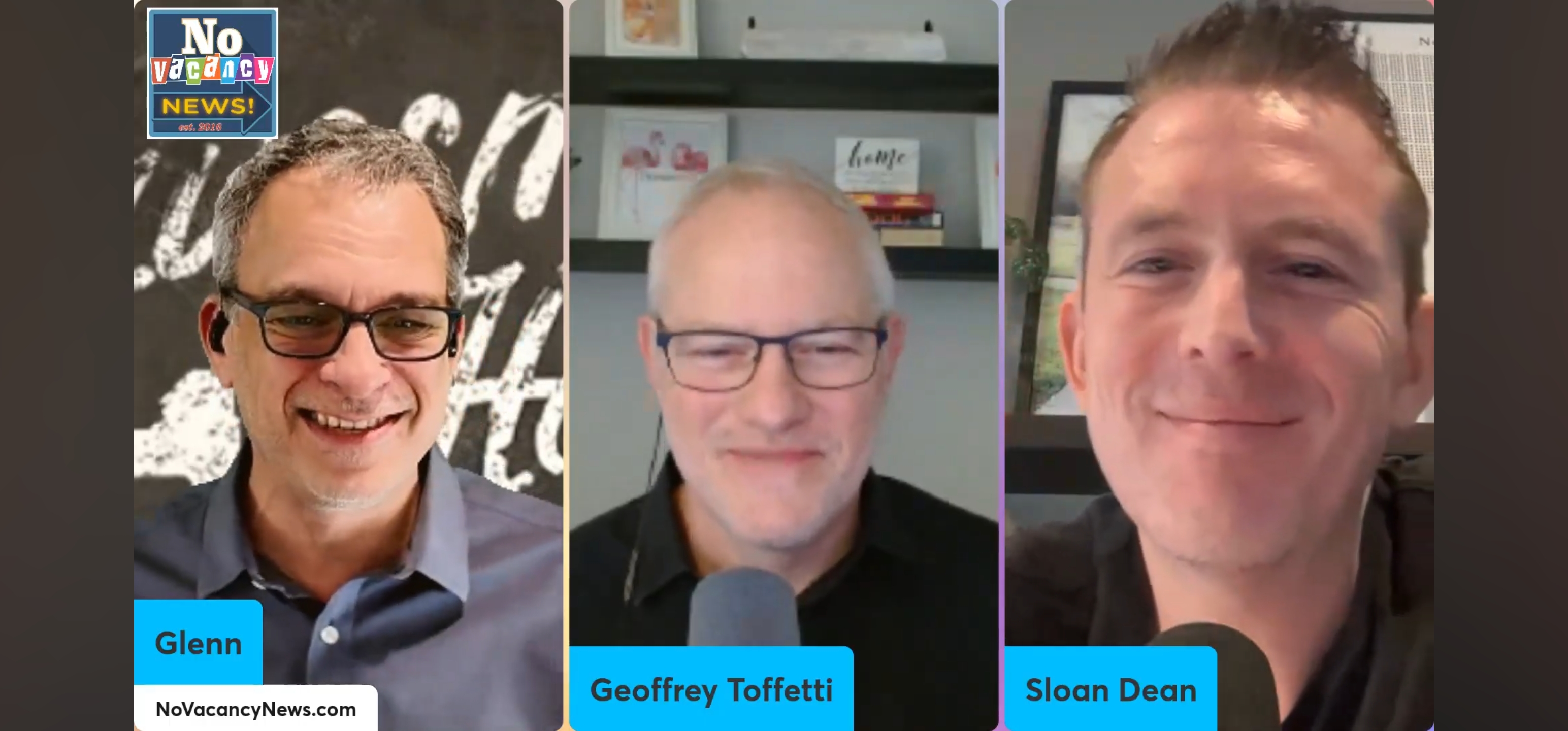
Glenn Haussman talks with Geoffrey Toffetti, CEO of Frontline Performance Group, and Sloan Dean, former CEO of Remington Hospitality, about CheckMax and how hotels use POS data + coaching to raise check averages without slowing service.
Fix drink speed and replenishment so tables order a third round
Use leaderboards so servers see the gap and chase it
Geoffrey says outlets see about 15% revenue per guest improvement year over year
Turn POS data into coaching and short training, including chef-recorded videos
Use AI to spot patterns and create coachable moments
Want the weekly roundup of news, videos, and what you might’ve missed? Text HOTEL to 66866.

Transcript
Glenn: [00:00:01] Hey, everybody, it’s your hospitality friend, Glenn. And I’m excited today because we’re talking food and beverage and learning how to help your team sell more of both those things. We already know you have slim margins, so the more you can sell, particularly in that alcohol category, the more successful you’re going to be. And I want you all to make as much as you can while making guests the happiest they can be in 2026. So in order to make sure that you’re successful, brought in two of our friends. I got Mr. Geoffrey Toffetti. He’s the CEO of Frontline Performance Group and friend of the show, fellow podcast podcaster and former CEO of Remington Hospitality. Jovan, great to see you here today.
Geoffrey: [00:00:42] Great to see you again.
Sloan: [00:00:43] Hey, great to be back.
Glenn: [00:00:45] All right. So Geoffrey, one of the things that I find frustrating is when I’m in restaurants, I’m always a little bit confused. You know, they come in, they got they got their 10,000 specials that they read. I can’t remember anything, so I forget it. They want to sell me cocktails, but they insist on giving me one tiny little cocktail menu for a group of 20 people at the table. I feel like a lot of hoteliers out there are missing out on easy opportunities to make more money. How do you see it?
Geoffrey: [00:01:12] I see it exactly the same way. I find that the last five years has gotten worse. And, you know, there’s just like we talk about on the prior episode, it’s all about engaging the guests where the guest is listening to them and making recommendations. It doesn’t have to take any any more time. It’s just refocusing your effort. But you’re exactly right. Alcohol is the number one opportunity that’s missed. There’s not a rapid enough replenishment rate, meaning they wait too long into service to bring the first round. Our advocacy is as soon as they sit down, get a drink in their hand, even before the water, because it begins the dining experience which creates that vibe that you want. And it leaves room for the third replenishment post dinner. If you wait too long, you’re only going to see serve them two drinks.
Glenn: [00:01:56] And I will say yes, and sometimes only one, because it’s really frustrating. It’s like they’ll get you the one after the first 20 minutes or so, and then you’re sitting there and your meal is there, your meal is there. And by the time they actually get back and say, you want another one, I’m just like, I’ll just wait until after and go to the go to this other bar that we’re planning.
Geoffrey: [00:02:18] Exactly. You’re exactly right. And we’re tracking replenishment rates, and we actually find there is a service trough in the middle of the service. As soon as they bring your dinner or your meal, they leave. And you don’t. You struggle to find them. We’re trying to solve for that too. Oh.
Glenn: [00:02:32] I can’t stand that. Because like, I just. What if I want to get a little something extra? Sloane, I love you’re smiling right now, so I know you got a lot. You got a lot to say.
Sloan: [00:02:41] Well, I told Joffre and the team when I first saw Max. I said, this is going to be bigger than your front desk program, that you have a bigger opportunity to affect change and drive profitability in food and beverage. And I think the solution is unbelievable. You know, if you think about particularly restaurants and outlets and hotels. Yeah. And for those of us that have lived it years and years, there is a tremendous amount of energy and attention that goes into, okay, what is the menu? The food concept design. Then there’s that same level of energy that goes in, okay, am I going to who’s going to be the executive chef and what is their name? Is it a high profile? Michael Beard, etc. type chef. And then there’s a lot of effort that goes into the aesthetics of the actual restaurant itself. Almost no energy or attention goes into the front of the house. How am I going to drive service and sales through servers, bartenders. We all see it as a cost of delivery. And this is a reframe. Do you see it as no. These are your greatest salespeople. You know, you have servers whose average checks are 3,040% higher than everyone else. Wow. You then make that be every server? And it’s a reframing of the mentality of the front of house. And it is so over needed. And, you know, hotels, because the rooms margin is 75 to 80%. I like to say that covers a lot of sins. And so you have a lot of loss leaders in food and beverage and hotels. And I think this technology allows to turn those loss leaders into actual profit centers.
Glenn: [00:04:21] Yeah. And it doesn’t need to be that way. And I should say when we’re talking about beverages there’s been a huge rise in mocktails as well. And those are very profitable. Don’t forget about those as we’re talking about beverages over here. Joffrey, you would think that servers, that being that they’re motivated by that 20% plus tip that they’re going to get, they would already want to do these things that we’re talking about. Why aren’t they and how are you changing it?
Geoffrey: [00:04:51] Yeah, a big part of it is that they don’t know that they’re not as good as they think they are, so they don’t. There’s no way for them to see today that they’re out of 12 servers on the dinner shift. They’re in the middle of the pack or the bottom of the pack. They don’t know that. So the leaderboard and the gamification aspects of the platform are critically important. They know they can’t hide anymore. I’m I’m 10th out of 12. That means that and we break it down for them. That means you’re leaving $5,000 a year, $8,000 a year on the table. That’s a lot. And you’re absolutely it’s a ton. And it doesn’t take any more time. So they’re we’re finding one thing that’s different between front desk and food and beverage is front desk or food and beverage managers and servers are revenue focused intrinsically front desk aren’t necessarily. So it’s a lot harder. You got to do this missionary thing to get them to believe it. What we’re finding is once the server sees that they’re down here and there’s thousands of dollars, they their ears open and they’re wide open for training and coaching, which is we’re seeing, we now have outlets that have been on more than a year, and we’re seeing 15% revenue per guest improvement year over year. Same servers. So it’s having a really material impact. It’s doubling or tripling the profitability of some of these outlets.
Glenn: [00:06:00] So how does it actually work? Because I’m sure it’s got to be more than, hey, you’re in last place. You suck. I’m sure it’s nothing like that at all. So how does it actually physically work to get people to want to participate and strive to be number one?
Sloan: [00:06:14] Well, I mean, I think I said this before, even with the front desk program, is that what gets measured, gets improved. And I think Joffrey hit on a really key point. You know, one of the things that when we installed Frontline performance Group at the front desk at Remington, you’re right, a lot of people that come to work at the front desk see themselves as they don’t see themselves as salespeople. You know, they say, hey, we just wanted to work in hotel operations and a service orientation. And so selling someone isn’t what I signed up for. When you’re a server. You know that the average check size has direct impact on your earnings because you’re making a tip off of that. And like Joffrey said, they just don’t know. And so you’re helping educate them through real time data that’s pulled out of the point of sales and then benchmarking them against their peers. And, you know, they also have gone so far to develop a learning management system where you say, well, then how do I get my check average up? They identify that in a lot of cases it’s drink replenishment, lack thereof, like we talked about. Maybe they’re not selling appetizers in the right fashion. The platform actually allows the executive chef to record a video that the servers can then listen to that and say, oh, that’s how I’m supposed to sell the the caviar, or I’m supposed to sell the octopus to drive appetizer volumes. And so I, you know, what I think is, is it’s just a lack of not having the data or the awareness. And so simply giving it to them in a very gamified way is making a transformational difference.
Glenn: [00:07:50] And one thing I’d like to add out there is stop talking about food terms that the average person doesn’t understand. That’ll probably make it a little bit closer to.
Geoffrey: [00:08:00] Yeah. No gourmet speak.
Glenn: [00:08:01] Yeah. Joffrey, you have been quoted as saying they learned the menu, but not the guests mindset. I think that’s pretty cool. And how are you thinking about teaching to learn a guest mindset so you can meet them where they are for increased sales?
Geoffrey: [00:08:18] Yeah. I mean, a big part of what we’re doing in the food and beverage space and are beginning to retrofit back to, to front desk is using AI. So AI is really good at finding patterns. That’s what it does. So what we’re using it for is to interrogate this really messy data that comes out of a point of sale system and get it down to coachable moments. So we’re actually sending guidance back to the manager saying, you know, Glenn is not great at his appetizer sales. He’s really good at drink replenishment. Sloane is the opposite, So pair them for the next two weeks on your schedule and let them learn from each other, you know? So it’s you, you, you find their individual opportunities and you make it all about helping them improve, not telling them they’re doing something wrong. It’s here’s your opportunity to make more money and you two can work together and help each other.
Sloan: [00:09:08] I think this is really critical because I, you know, if you think about if you run restaurants or you’ve worked in one, what do they do for training? They tend to pair you up with one of the servers that has the most tenure, not necessarily the, the servers that are delivering the highest average check. Right. So this flips it on itself that you have now access to the data to say, these are the top performers and you can re imagine how you actually train people. So many restaurants just have a training program that is premised on, well, you know, Joffrey’s been here five years. He knows the menu back backward and forth. Well, he may not be doing that great of a job in driving average check. And all of a sudden then he’s training all your new people, right? It’s exactly.
Geoffrey: [00:09:54] We it’s funny, Sloan pointed this out to us earlier, and we’ve now made it like a feature that’s coming is to, at the outset, identify who your trainers are and measure them so that the management knows, because you’re right that you you pair, they follow them around for two days and then you let them go. Well, what what behavior has been modeled for them? That’s right. Is it a guest experience focused revenue mindset or is it get the order as quickly as you can and run away from the table.
Glenn: [00:10:21] Yeah. And that is that really is a management thing and such a great opportunity. So Sloan, before we wrap up, what’s the best way to introduce what we’ve talked about here to your teams in order to set it up? Right? So they have maximum success?
Sloan: [00:10:39] Well, I think, you know, most of you, if you’re a management company or hotelier, you probably have multiple outlets, multiple restaurants. I think we’re Fpgs had a lot of success is. Testing and showing the proof is in the pudding with, you know sign up for a couple of restaurants, do an a, B test and the results will speak for themselves. And again, I think this is not only check marks isn’t just applicable for you know, faster fine dining in hotels. Frankly, I think it’s applicable for any FMB restaurant. But obviously their, their core tenant customers are hoteliers. So most folks listening in are probably hoteliers. So try it out in a couple of outlets and see how it goes.
Glenn: [00:11:24] Well, fortunately, we have a few friends out there that are restaurateurs that happen to have hotel rooms.
Sloan: [00:11:29] Oh, there you go. Same thing.
Geoffrey: [00:11:31] Yeah, it goes both ways.
Glenn: [00:11:32] It does. Joffrey, any final words as we wrap things up today?
Geoffrey: [00:11:36] No, I mean, that’s that’s it. You know, we’re not we’re marathon runners. We’re not sprinters. So we want to meet the people that own these outlets. We’ll do a couple outlets. We’ll prove ourselves. We have no, we’re not ego driven. So if you have outlets, we can help you. If you have hotels, we’re here to help you. You can look at look us up online@frontline.com. That’s p g like performance group. Or reach out to me directly on LinkedIn. I’m on there. It’s g tafiti at LinkedIn, I’m an early adopter. So I got my first initial. I don’t have all those numbers behind my name. So it’s easy to find. I’d love to hear from you.
Glenn: [00:12:08] Yeah. I spent my first five years on LinkedIn not knowing the purpose of it, but I was just happy to be there. And who would have known it would define my ability to have a career later on? Sloan, thank you so much for for helping our hoteliers out there find more success. I really appreciate it. Hey, and I appreciate you. Like I said, I couldn’t do any of this without you folks out there. So thank you so much for your support. If you want to continue to support us, please like, share, subscribe, all that kind of good stuff out there. Remember, you’ve got one life. So blaze on and I’ll see you next time.

More Episodes
-
May 8, 2026
Choice Hotels Controls 50% of Extended Stay New Builds: What That Means
-
May 7, 2026
Why Hotel Conversions Need Transactions: Choice CDO Explains the Reset
-
May 5, 2026
Las Vegas Value Strategy: How Virgin Keeps Pricing Clear
-
May 5, 2026
Hotel AI Use Case: Automate Reporting and Win Back Hours Every Day

Subscribe